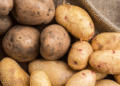
On Guy Cadmore’s seed potato farm on Prince Edward Island, the effects of last year’s drought are still visible. Workers are sorting out defective potatoes, but this spring there is less work than usual because the harvest fell by approximately 30%, according to Cadmore. One variety, Caribou Russet, is also suffering from rot, which Cadmore believes may be linked to the drought. Data from Statistics Canada shows that potato production on Prince Edward Island dropped by 15.9% in 2025 to 21.8 million hundredweight, marking the largest decline in the country. As the planting season approaches, farmers are grappling not only with the aftermath of the drought but also with rising fuel and fertilizer costs tied to the war in Iran.
Despite the reduced harvest across the island, prices have not increased due to strong demand in North America, which has put downward pressure on the market, said Greg Donaldson, CEO of the PEI Potato Board. Climate change remains a serious concern, and farmers have been working for years to improve soil health, water retention, crop rotation, and develop more drought-resistant varieties. Now, interest in responsible supplemental irrigation is growing. Cadmore, despite his anxiety about the situation, plans to plant all 200 acres to avoid letting down his customers. “We’re optimistic about the future and hopeful that we can put our seeds in the ground… we have to hope for the best,” he said.