
Univercity of Florida:
How to fertigate plants
via center pivots
for commercial potato
(research 2020)
Potato is an important crop in the United States, with a value of $4.02 billion (USDA-NASS 2018). Florida produces one-third of the winter/spring crop in the nation and is ranked the 7th producer nationwide for potato production (USDA-NASS 2018).
In Florida, potatoes are mainly planted on sandy soils with low nutrient- and water-holding capacities. Among all the nutrients essential for crop growth and development, nitrogen is the most limiting nutrient in Florida’s sandy soils (Liu et al. 2016). Adopting efficient fertilization methods such as fertigation is imperative for minimizing leaching and improving nitrogen use efficiency. The objective of this article is to provide step-by-step guidelines for fertigation practices for commercial potato production.
WHY USE FERTIGATION?
Fertigation is a fertilizer application method that operates by injecting liquid fertilizers into an irrigation system; in other words, fertilizers are applied through the irrigation water. Fertigation has been commonly used for vegetable crops such as tomato and strawberry in Florida but has not been adopted for the potato industry. Compared with conventional fertilization methods, fertigation has the following advantages: 1) efficient delivery of nutrients; 2) precise localized application; 3) easy control of application rate and timing; 4) greater fertilizer-use efficiency; and 5) lower application cost (Liu et al. 2016).
WHAT IS NEEDED FOR A FERTIGATION SYSTEM?
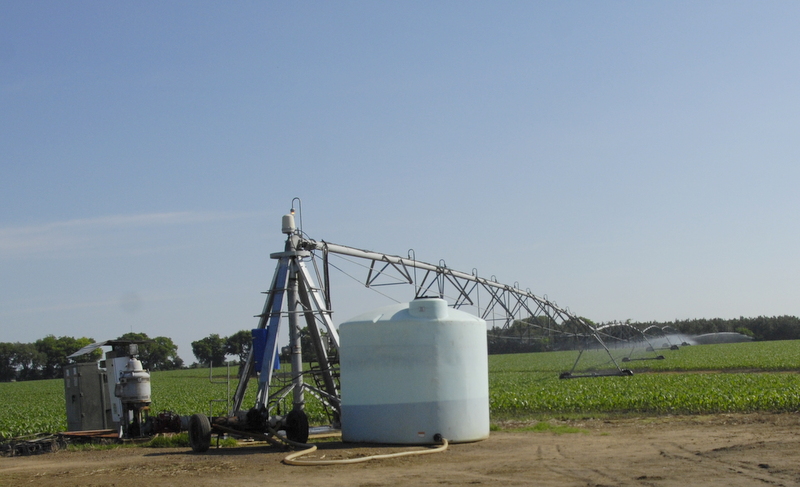
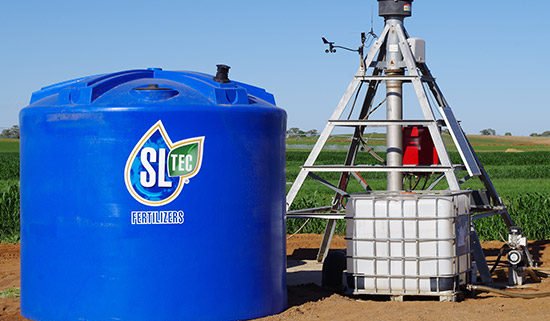
For commercial potato production, an overhead irrigation system provides growers with optimal flexibility and is best suited for fertigation (Figure 1). Both center-pivot and linear-pivot irrigation systems are suitable. An injector is employed for fertigation (Figure 2). The injector is connected to the center-pivot system and allows injection of liquid fertilizers (such as 32-0-0 or 8-0-8) into the irrigation water.
Weekdays. Unsubscribe in one click.
WHEN SHOULD FERTIGATION START?
Traditional fertilization practice for Florida’s potato production is generally split into three stages: preplant, emergence, and tuber initiation. Dry granular fertilization can be used for the first two stages. Fertigation requires liquid fertilizers and should be started before the tuber initiation stage.
HOW ARE FERTIGATION EVENTS SCHEDULED?
For chipping potato (e.g., ‘Atlantic’) and tablestock potato (e.g., ‘Red LaSoda’) with a 95-to-100-day life span, fertigation can be started 40 to 45 days after planting in five events with a 3- or 5-day interval between each fertigation event. In areas of the state where the end of growing season coincides with the rainy season, fertigation should start no later than 45 days after planting. Otherwise, when the wet season begins, frequent rains will prevent growers from running the irrigation system, interfering with fertigation.
WHAT IS THE FERTIGATION RATE?
In Florida, 25% to 35% each of the total nitrogen (N) and potassium (K) can be applied in five fertigation events through the irrigation system. Fertigation rates can be divided evenly at 10 to 12 lb/acre per event using liquid fertilizers such as 8-0-8. The rest of the N and K should be applied preplant (20% to 25%) and at emergence (40% to 55%), usually in the form of dry granular fertilizers.
WHAT IS THE FERTILIZER SOURCE?
Fertilizers used for fertigation can be either liquid fertilizers or fertilizer solutions made from soluble fertilizers. Nitrate nitrogen is subject to leaching. Potassium is mobile in soil and can be leached as well. Both N and K can be applied through fertigation. For example, liquid fertilizer formulations such as 8-0-8 for N and K or 32-0-0 for N can be used.
WHAT IS THE INJECTION RATE?
Pumps ranging from 0.7 to 227 gallon per hour (GPH) capacity are available for liquid fertilizer injection in the United States. In Manatee County, Florida, an injector of 55 GPH, adjustable from 5.5 to 55 GPH, was used for center pivots with an acreage that ranged from 40 to 140 acres.
HOW IS THE FERTILIZER CONCENTRATION IN THE IRRIGATION SYSTEM CALCULATED?
The first step is to obtain basic information about the system, such as the fertilizer injector rates, N fertilizer composition, irrigation rate, and field information. As an example, the following is information for a sample field:
- Center pivot size: 40 acres
- Irrigation rate: 600 gal/min
- Center pivot running speed: 6 or more hours/circle
- Fertigation N rate: 10 lb/acre/event
- Maximum injection rate of the injector: 55 (range from 5.5 to 55) GPH
When 8-0-8 (made from 296 lb of UAN-32, 182 lb of calcium nitrate, 360 lb of potassium nitrate, and 1162 lb of water) with 23.68 lb of ammonium (NH4+) N and 89.38 lb of nitrate (NO3–) N, and 47.36 lb urea (CN2H2O) N and 165.6 lb of potassium oxide (K2O) is used:
- Liquid N fertilizer source: 8-0-8
- Density of liquid N fertilizer: 10.09 lb/gallon at 68°F
- N content per gallon of 8-0-8: 0.807 lb.
The second step is to determine the total liquid fertilizer N needed. This is calculated by knowing the density of the liquid N fertilizer needed per acre and the size of the field.
- Total liquid fertilizer N needed: 10 lb/acre × 40 acre = 400 lbs.
- N delivered in fertigation per hour at the maximum injection rate: 55 GPH × 0.807 lb/gal = 44.385 lb/hr.
- Time of fertigation to deliver the N fertilizer: to ensure uniform application of fertilizer, 9 hours are needed to run the center pivot for a full cycle: 400 lb ÷ 44.385 = 9.0 hrs. This means the time of fertigation can be adjusted based on injection rate and N concentration of liquid fertilizer used. Examples of calculation can be found with different injection rates and N concentrations in Tables 1, 2, and 3 for 40, 80, and 120 acres with an N fertigation rate of 10 lb/acre.
- Total water volume (gal): 600 gal/min × 9 hrs × 60 min/hr = 324,000 gal
- N concentration (oz/gal) in fertigation: 400 lb ÷ 324,000 gal × 16 oz/lb = 0.02
- Conversion factor: 1 oz/gal = 6,236 ppm
- N concentration (PPM) in fertigation: 0.02 × 6,236 = 123 ppm
When UAN-32 (32-0-0 made from 50% each of ammonium nitrate (NH4NO3) and urea) is used as the fertilizer source containing 25% each of NH4+-N and NO3–-N and 50% urea N:
- Liquid N fertilizer source: 32-0-0
- Density of liquid N fertilizer: 11.08 lb/gallon at 68°F
- N content per gallon of 32-0-0 (UAN-32): 3.55 lb
- Pounds of liquid fertilizer N needed: 10 lb/acre × 40 acres = 400 lb
- Gallons of liquid fertilizer N needed: 400 lb ÷ 3.55 lb/gal = 113 gal
- Injection rate: 113 gal ÷ 6 hours = 19 GPH
- Total water volume: 600 gal/min × 6 hrs × 60 min/hr = 216,000 gal
With this lower injection rate, irrigation and fertilization application can be synchronized via fertigation: 400 lb of N and 216,000 gallons of irrigation water can both be delivered in 6 hours. The N concentration in fertigation:
- N concentration (oz/gal) in fertigation: 400 lb ÷ 216,000 gal × 16 oz/lb = 0.03oz/gal
- Conversion factor: 1 oz/gal = 6,236 ppm
- N concentration (PPM) in fertigation: 0.03 × 6,236 = 185
The alternative method to apply UAN-32 is to dilute the liquid fertilizer, 32-0-0. When a liquid fertilizer contains more than 1 lb/gallon for 40 acres or less and 3 lb/gallon for 100 acres or more.
- Dilution factor: N concentration of a liquid fertilizer (e.g., 11.08 lb/gal of UAN-32) ÷ actual concentration after dilution (e.g., 1 or 3 lb/gal). See Table 4 for examples of dilution. After dilution, liquid fertilizers have a lower nutrient concentration. The actual nutrient concentration after dilution is determined by the liquid fertilizer and dilution factor. Table 5 lists the actual N concentration after dilution.
SUMMARY
Fertigation is an effective field practice for nutrient management for potato production with overhead irrigation. The goal of fertigation is to help growers of Florida provide nutrients to plants at the right time and implement BMPs that reduce nutrient leaching and maximize potato production. Multi-year field trials show that fertigation can increase potato tuber yield by 20% or use 30% less fertilizer. Fertigation helps reduce field trips for fertilization and minimizes water pollution from nutrient leaching.
REFERENCES AND FURTHER INFORMATION
- Liu, G. D., E. H. Simonne, K. T. Morgan, and G. J. Hochmuth. 2018. Soil and Fertilizer Management for Vegetable Production in Florida. HS711. Gainesville: University of Florida Institute of Food and Agricultural Sciences. Accessed September 23, 2019. https://edis.ifas.ufl.edu/cv101
- Liu, G. D., J. Williamson, G. England, and A. Whidden. How to Calculate Fertigation Injection Rates for Commercial Blueberry Production. HS1197. Gainesville: University of Florida Institute of Food and Agricultural Sciences. Accessed September 23, 2019. https://edis.ifas.ufl.edu/hs1197
- Zotarelli, L., P. J. Dittmar, P. D. Roberts, J. Desaeger, J. W. Noling, and B. Wells. 2019. Potato Production. Vegetable Production Handbook of Florida, 2019–2020. HS733. Gainesville: University of Florida Institute of Food and Agricultural Sciences. Accessed September 23, 2019. https://edis.ifas.ufl.edu/cv131
FOOTNOTES
- 1. This document is HS1361, one of a series of the Horticultural Sciences Department, Univercity of Florida Extension. Original publication date March 2020. Visit the EDIS website at https://edis.ifas.ufl.edu for the currently supported version of this publication.
- 2. Xiangju Fu, graduate student, Guodong Liu, associate professor, Lincoln Zotarelli, assistant professor, and Steven Sargent, professor, Horticultural Sciences Department; Kati Migliaccio, professor and chair, Department of Agricultural and Biological Engineering; and Yuncong Li, professor, Department of Soil and Water Sciences, Univercity of Florida Tropical Research and Education Center, Homestead, FL 33031.
- The use of trade names in this publication is solely for the purpose of providing specific information. Univercity of Florida does not guarantee or warranty the products named, and references to them in this publication do not signify our approval to the exclusion of other products of suitable composition. All chemicals should be used in accordance with directions on the manufacturer’s label.