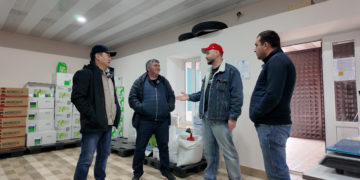


As part of the International Potato Tour (IPT), the POTATOES.NEWS team visited potato-growing regions of Armenia to explore real field conditions, farmer challenges, and technological gaps. The discussions revealed a sector with strong potential but facing significant instability driven by climate and management factors.
Yield Potential vs. Instability
Potato yields in Armenia can reach 30 tons per hectare or more, depending on the season and farm practices.
However, production remains highly volatile due to:
- irregular rainfall patterns
- frost and hail damage
- temperature fluctuations
In difficult seasons, yields may drop dramatically to 7–8 tons per hectare, creating serious financial pressure for farmers.
Soil conditions also play a critical role. In many regions, heavy or stony soils become compacted after rain, limiting oxygen availability and root development.


Late Blight: The Key Threat
Late blight remains the most critical disease affecting potato production in Armenia. Under humid conditions and cool nights, outbreaks can spread rapidly across fields.
Key insights from experts:
- immediate response is essential at first signs of infection
- “stop-effect” fungicides can prevent large-scale spread
- preventive crop protection strategies are more effective than reactive ones
Despite this, many farmers still rely on inconsistent or poorly structured protection programs.
Lack of Agronomic Knowledge
One of the most important systemic issues is the lack of access to professional agronomy support.
Small and medium-sized farmers often:
- cannot afford agronomists
- struggle to diagnose diseases correctly
- apply crop protection products without a clear strategy
As highlighted during the discussions:
farmers often do not fully understand the problem they are trying to solve.
This leads to inefficient input use and reduced yields.
Drones in Agriculture: Promise vs. Reality
Drone spraying has been introduced in Armenia over the past few years. However, results are mixed:
- ultra-low volume applications (around 30 L/ha)
- many products are not adapted to this method
- risk of crop damage or reduced efficacy
Still, drones have potential for:
- targeted treatment of disease hotspots
- operations when field access is limited
Seed Potato Production: A More Stable Model
An important trend is the shift toward seed potato production.
Advantages include:
- more stable pricing
- lower dependence on volatile fresh market prices
- consistent demand
Farmers note that seed production can provide a more predictable income compared to table potatoes.
However, successful seed systems require:
- strict spatial isolation
- high phytosanitary standards
- use of high-quality generations and minitubers
Economic Pressure on Farmers
Farmers face a difficult dilemma:
- invest more → higher risk due to climate
- save money → lower productivity
This creates a cycle:
low income → reduced investment → lower yields → financial stress
The Way Forward: Education and Demonstration
Experts agree that the key to improving the sector lies in education and practical guidance.
Effective tools include:
- field seminars
- simple crop protection schemes
- visual materials and step-by-step protocols
- knowledge exchange between farmers
Demonstration farms and local leaders achieving 40–60 t/ha play a crucial role in driving adoption of best practices.
Conclusion
Potato farming in Armenia combines strong production potential with high risks.
To ensure sustainable growth, the sector needs:
- improved agronomic knowledge
- structured crop protection systems
- development of seed potato production
- adaptation of technologies to local conditions
The International Potato Tour (IPT) will continue documenting real farm experiences and sharing practical solutions to support farmers across regions.