
From the Margins to the Main Field: The Quiet Rise of Differently Abled Farmers in Kenya’s Potato Sector
Key takeaways
- VMG founded by Joyce in 2024, 25 members
- Members with disabilities and caregivers
- Potatoes, cabbages and poultry farmed
- Stigma limits loans, transport and training
- Value addition — crisps — is the stated next step
Why it matters
- For farmers
- Access to certified seed classes and sizing knowledge is the practical barrier here — not physical ability.
- For investors
- Value addition, starting with crisps, is where the group intends to move; that is where support would compound.
60-second summary
A group of differently abled farmers in Nyandarua, Kenya, organised as the Vulnerable and Marginalized Group (VMG), took part in an inclusive Irish potato farming training. Founded by Joyce in 2024, the group’s 25 members include persons with disabilities and caregivers who farm potatoes, cabbages and poultry while facing stigma and limited access to loans, transport and training. Participants George Githiri, David and Joseph described being underestimated because of their disabilities: “People judge our inability without ever giving us an opportunity,” said Githiri. Joseph, who milks cows and grades his own potatoes, welcomed learning the value chain — tissue culture labs, certified seed classes, the science behind sizing — material the group rarely gets access to. The training was supported by Nakuru Tubers, Wakulima Help Desk, the Mastercard Foundation, RUFORUM, AFAAS, KeFAAS Kenya and Egerton University’s COELIB, with Joyce looking ahead to crisps production.
A group of differently abled farmers in Nyandarua, Kenya, organized under the Vulnerable and Marginalized Group (VMG), participated in an inclusive Irish potato farming training. Founded by Joyce in 2024, the group of 25 members includes persons with disabilities and caregivers who farm potatoes, cabbages, and poultry despite facing stigma, limited access to loans, transport, and training.
Participants including George, David, and Joseph shared experiences of being underestimated due to their disabilities while demonstrating their farming capabilities. The training, supported by Nakuru Tubers, Wakulima Help Desk, Mastercard Foundation, RUFORUM, AFAAS, KeFAAS Kenya, and Egerton University’s COELIB, aimed to promote equity and inclusion in Kenya’s agricultural sector, with Joyce envisioning future value-addition projects like potato crisps production.
In the lush valleys of Nyandarua, where the soil is rich and the air is cool, something extraordinary is sprouting — a quiet revolution in the potato fields. But this isn’t just about farming. It’s about dignity, visibility and rewriting the narrative of what it means to be “abled.”
Weekdays. Unsubscribe in one click.
In a world where ability is too often defined by narrow physical standards, a group of determined, differently abled farmers is proving that the true strength of a farmer lies not in limbs, but in the spirit.
Not just planting tuber seeds, but seeds of inclusion
Planting seeds goes beyond the soil — it’s about planting hope, inclusion and opportunity. Recently, during a training and demonstration on Irish potato farming with this remarkable group, what unfolded was nothing short of inspirational.
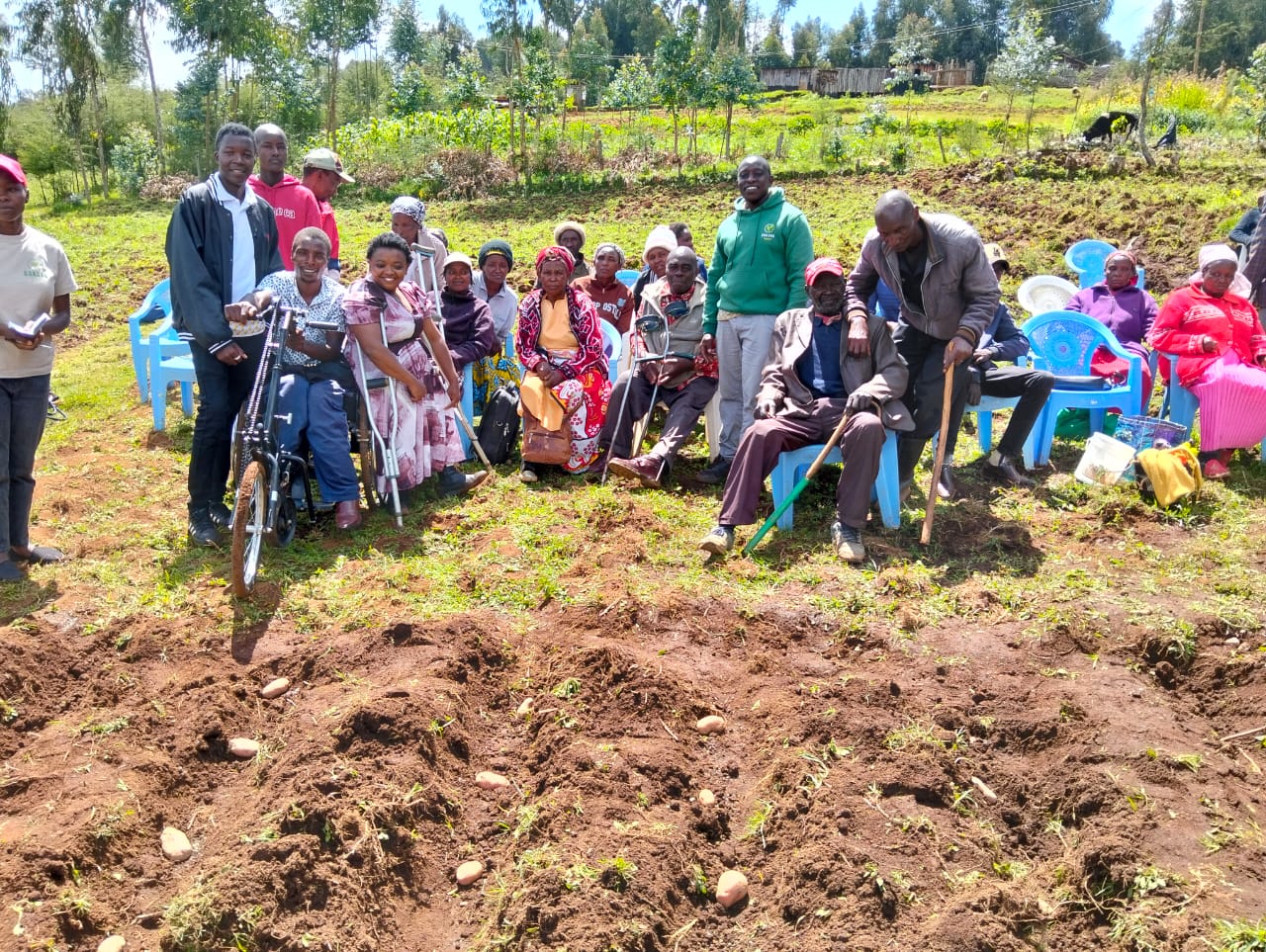
As spades broke the earth and eyes lit up with curiosity, the field transformed into a classroom of inclusion. For many of the participants, this was the first time someone had truly believed in their ability to farm — to not only grow crops, but to grow confidence, purpose and pride.
George Githiri, one of the participants, put it best:
“People judge our inability without ever giving us an opportunity. They see our wheelchairs, our walking sticks, and stop there. But none of them sees how we feed our families, how we push ourselves every day to be part of this world, this economy, this food system.”
His words struck a chord. How many talented farmers have been sidelined, not because they lack potential, but because they were never given the platform to show it?
Mr. David, another participant, spoke with the quiet power of a man who has long defied expectations.
“Yes, I know I am abled differently. But that does not mean I cannot plant. I always prepare my land — not just for potatoes, but for other crops too. This is my life.”
He smiled as he gently packed soil over a row of seed tubers — a simple act, yet layered with meaning. With every handful, he buried the stigma and raised a new standard for what is possible.
Joseph, a hands-on farmer with sharp insight, was thrilled to learn about the potato value chain — from tissue culture labs to certified seed classes and the science behind sizing.
“These are things we never get to learn,” he said.
“People assume we can’t farm. But I do everything at my farm — I milk cows, grade my potatoes, and now I want to learn about value addition. I want to grow beyond the soil.”
Joyce’s vision: From exclusion to empowerment
One of the strongest voices from the field was Joyce, the chairlady and founder of VMG (Vulnerable and Marginalized Group). Formed in 2024, VMG now has 25 members — 12 of whom are persons abled differently and the rest are caregivers or parents of disabled children.
Joyce started the group after experiencing stigma and unemployment herself.
“The group was born out of a need to empower differently abled persons through agriculture,” she shared. “Farming has given me a sense of purpose and confidence. I no longer wait for handouts. I now train others.”
Despite being once told she couldn’t join a potato group because “this work is for able-bodied men,” Joyce pushed forward. Today, she grows potatoes and cabbages, engages in poultry farming, and handles all tasks — from planting and weeding to sorting and marketing.
She’s also clear-eyed about the challenges:
“Most trainings are not accessible. Transport is hard. Banks don’t take us seriously when we ask for farm loans. Even getting quality seeds is a struggle.”
Yet, during this inclusive training session — tailored for farmers abled differently — she felt something shift:
“It was the first time a training was designed with us in mind. The trainers were patient and inclusive. We all learned in our own way.”
Joyce now dreams of leading a value addition project:
“I want to start a potato crisps and flour unit, run by persons with disabilities. It will provide jobs and help us earn more from our produce.”
Her message is as powerful as her work:
“Disability is not inability. We have the skills and the will to farm. We just need access — to tools, training, and land. We don’t want sympathy. We want opportunity.”
Inclusion is the seed of real change
This journey is powered by Nakuru Tubers and Wakulima Help Desk, with crucial support from the Mastercard Foundation via RUFORUM and AFAAS, alongside KeFAAS Kenya and COELIB of Egerton University. It’s not charity. It’s equity — and a commitment to recognize and uplift the full spectrum of farming potential in Kenya.
Too long has the potato sector overlooked talents like George, David, Joseph, and Joyce. When differently abled farmers are supported, they don’t just participate — they lead, innovate, and inspire.
To policymakers and stakeholders: without inclusion, agricultural development remains incomplete. Inclusion is not an afterthought — it’s the foundation.
As Joyce reminds us:
“Food is for everyone, so farming should include everyone.”
And as George says,
“All we need is an opportunity.”
When given, they grow — beautifully.
Global Potato Brief
Top five stories, prices, disease alerts and events. Weekday mornings, no advertising.
Sources
- Participants George Githiri, David, Joseph and founder Joyce — quoted in the article
Linked in this material
- Country
- Kenya
Related stories

Belgium: Latest Trial Digs Put the Potato Yield at 37.3 t/ha, About 11 t/ha Below the Five-Year Average
Plant Into Ripe Soil or Harvest Clods: Russian Growers Debate the 7–10 Day Window


Leave a Reply