“Africa is a source of science and innovation, not only a market”: Prof Nomali Ngobese on potato research, sprout suppression and collaboration
Potatoes.News welcomes Associate Professor Nomali Ngobese (North-West University, South Africa) to the Potato Expert Panel. Her answers on sprout suppression, spatial sciences for smallholders and what the industry can learn from Africa.

Potatoes.News welcomes Associate Professor Nomali Ngobese of North-West University (South Africa) as a new member of the Potato Expert Panel. We talked to her during the World Potato Congress in Kenya about postharvest sprout suppression, spatial sciences for smallholder farmers and what the global industry can learn from Africa. The answers below are published as she wrote them.
Potatoes.News is an independent private media company from Russia and is not affiliated with the World Potato Congress.
About the expert
Nomali Ngobese is an Associate Professor in the School of Agriculture at North-West University, South Africa, and currently serves as the Head of Sustainable Crop and Resource Management Department in the same university. She holds a PhD in Bioresources Systems from the University of KwaZulu-Natal. Her interdisciplinary research spans crop production, plant physiology, post-harvest science, food security and sustainable agriculture. Her potato work covers cultivar performance, nutrient management, climate-smart production, disease management (including late blight), water productivity, post-harvest quality and storage. She has presented potato research at the European Association for Potato Research and the African Potato Association. (Source: biography supplied by Prof Ngobese.)
Weekdays. Unsubscribe in one click.
Interview
1. What brought you to the World Potato Congress in Kenya, and what are you presenting or following most closely here?
I am attending to engage with the global potato research and industry community, share our research findings and identify opportunities for collaboration. Our research is represented through student posters examining the effects of postharvest sprout suppression on subsequent seed-potato performance. Additionally, I am looking for relevant collaborators who share aspirations in smallholder farmer development to promote potato productions and build resilience to climate change-related challenges. To achieve this, I will be participating in workshops on rooted apical cuttings, international potato research collaboration and aeroponics. I am particularly interested in how innovations in seed multiplication, crop physiology, disease management and postharvest technologies can be translated into practical, scalable solutions for African potato producers.
I am also participating as a panellist in the session on Research Collaborative Work in Africa on 27 October, which brings together perspectives on national potato strategies, research and innovation, institutional partnerships, and regional seed systems.
2. How do geo- and spatial sciences help potato production today, especially for smallholder farmers in South Africa and Africa?
Geospatial sciences, remote sensing, GIS and precision agriculture can help improve potato production by identifying spatial variability in soils, crop growth, water availability and environmental conditions. Combined with weather information and field observations, these tools can support more targeted irrigation, nutrient management, crop monitoring and disease-risk management.
For smallholder farmers, the challenge is not simply access to technology, but ensuring that it is affordable, locally relevant and supported by appropriate advisory services. I see considerable potential in collaborations that integrate spatial data, agronomic research and farmer knowledge to develop accessible decision-support tools that improve resource-use efficiency, reduce production risks and strengthen climate resilience.
3. Which potato-related research or projects is your school working on now, and what results do you expect in the next year or two?
My research at North-West University focuses on potato production, plant physiology, nutrient management, climate-resilient agriculture and postharvest quality, with an emphasis on understanding how production and storage interventions influence crop performance.
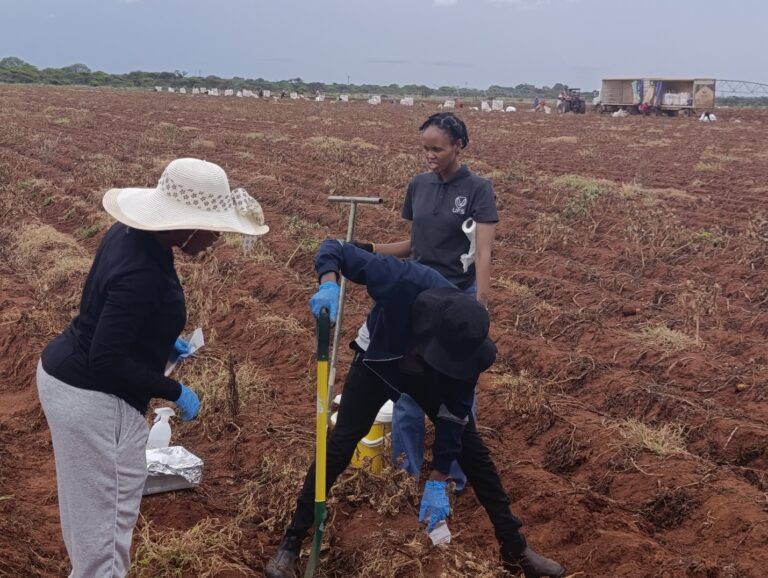
One area of our work investigates the effects of postharvest sprout suppressants on the subsequent performance of seed potatoes. Our research has examined 3-decen-2-one (SmartBlock®) and 1,4-dimethylnaphthalene (1,4-DMN), including their effects on emergence, plant growth, physiological functioning and tuber yield.
Our findings demonstrate that responses vary with cultivar, treatment dosage and nitrogen availability. This highlights an important research question: how can sprout suppression during storage be optimised without compromising seed viability and subsequent field performance? Further validation across cultivars, environments and growing seasons is needed.
Over the next one to two years, I would like to advance collaborative research that connects postharvest management with field performance, seed quality and resource-use efficiency. I am particularly interested in partnerships involving controlled-environment experiments, field trials, postharvest technologies and the development of evidence-based recommendations for potato producers. I am also interested in collaborative work on climate-smart potato production, nutrient and water management, disease mitigation, and innovative seed-potato multiplication systems.
4. What is the main challenge for potato growers in South Africa this season, as you see it?
From a production-science perspective, managing climate variability alongside the costs of production and the need to maintain tuber yield and quality remains a significant challenge. Water availability, temperature fluctuations, input costs, crop health and postharvest losses can interact to affect profitability and production stability.
I would be cautious about identifying a single challenge as the dominant one across all South African production regions without current regional evidence. The constraints experienced by producers differ according to production environment, cultivar, irrigation access and market orientation.
There is therefore a need for regionally adapted research that combines sound agronomic practices, reliable climate information, efficient resource management and appropriate postharvest technologies.
5. What should the global potato industry learn from Africa after this Congress?
The global potato industry should recognise Africa not only as a market for agricultural technologies, but also as a source of scientific knowledge, innovation and practical experience. African potato-producing countries operate under diverse production conditions and face challenges relating to seed availability, climate variability, disease pressure, infrastructure and access to technologies. These challenges also create opportunities to develop locally adapted and resource-efficient solutions. The discussions at this Congress reinforce the importance of collaboration across research institutions, industry, government, farmers and development partners. Seed systems, knowledge transfer, appropriate technology and regional cooperation are particularly important. My view is that the next stage of agricultural innovation must move beyond generating research outputs towards validating solutions under real production conditions, developing scalable implementation models and ensuring that research benefits farmers across different production systems. Stronger South–South collaboration, alongside international partnerships, can help accelerate this process.
6. Had you heard of Potatoes.News or the International Potato Tour before? Which topics would be most useful for researchers like you?
Thank you for introducing me to Potatoes.News and the International Potato Tour. I welcome platforms that connect researchers, producers, technology developers and other stakeholders across the potato value chain.
Topics of particular interest to me include climate-resilient potato production, seed-potato health and multiplication, postharvest sprout management, crop physiology, nutrient and water-use efficiency, integrated disease management, and innovations that improve storage quality and field performance.
Coverage of collaborative research projects, emerging technologies, research-to-industry partnerships and evidence from field trials would be especially valuable to researchers and practitioners.
Regarding the Potato Expert Panel, I would be pleased to participate. I would welcome opportunities to provide evidence-based perspectives on potato agronomy, crop physiology, seed-potato performance, postharvest management and sustainable crop production.
Welcome to the Potato Expert Panel, and an invitation
The Potato Expert Panel by Potatoes.News is a group of specialists from different regions whom we occasionally ask, by email, to comment on industry news in their field. It takes little time, and comments are published with the expert’s name and affiliation. We are glad to welcome Prof Ngobese, who will share evidence-based perspectives on potato agronomy, crop physiology, seed-potato performance, postharvest management and sustainable crop production.
Are you a researcher, agronomist, breeder, storage or seed specialist, or an industry expert? We invite you to join us. Write to v.kovalev@potatoes.news with the subject “Expert”, tell us in one or two sentences how you would like to be introduced, and attach a photo for your expert avatar.