Brown target-like spots on the leaves: Alternaria is moving up the lower canopy
Dry brown lesions with concentric rings on potato leaves point to Alternaria. Field diagnosis, differences from late blight, a control programme and the common mistakes.

The photo from the field shows a picture half the potato growers in the temperate belt are looking at right now: the leaf is still green, but the blade is scattered with dry brown lesions, each ringed by a yellow halo, and the leaflet as a whole is drifting into chlorosis. This is not late blight. This is Alternaria, and it calls for a different response.
What exactly is on the leaf
The symptoms read clearly:
- lesions are dry, firm and sharply bounded — they do not spread as a wet, greasy blotch;
- the larger ones show concentric zonation — the classic target pattern of dead tissue rings;
- each focus is surrounded by a yellow halo, with chlorosis spreading across the leaflet;
- the disease works from the bottom up, through the older leaves of the lower and middle canopy;
- there is no white sporulation along the lesion margin on the underside of the leaf.
That last point is the one that matters most in the field. It is what separates Alternaria from late blight.
Weekdays. Unsubscribe in one click.
The pathogens
Two different fungi sit behind these symptoms, and they differ only in detail when it comes to control:
- Alternaria solani — early blight. Larger lesions with pronounced target rings, usually appearing earlier in the season.
- Alternaria alternata — brown leaf spot. Smaller, shot-hole type lesions without a distinct target, often coalescing.
The two frequently occur together in the same field and even on the same leaf. Precise identification is a laboratory job; for a spray decision it is enough to establish that you are dealing with the Alternaria complex and not with Phytophthora.
Why now
Alternaria is a disease of ageing and stressed foliage. It arrives when:
- the crop has moved into tuber bulking and is diverting resources to the tubers, while the canopy loses its defences;
- the weather is warm with alternating dry days and heavy dews or short rains — the fungus needs leaf wetness periods, but not continuous saturation;
- there is a deficiency of nitrogen, potassium, magnesium or manganese — the disease is always harsher on a hungry crop;
- the stand is too dense and the canopy stays wet for long stretches;
- the variety is early or mid-early — these are generally hit harder than late-maturing types;
- the rotation is too tight: potatoes after potatoes or after tomatoes, with crop residues buried shallow.
Inoculum survives on crop debris and in the soil, so an outbreak recurring in the same field year after year is not bad luck — it is a verdict on the system.
Alternaria or late blight: a field cheat sheet
| Feature | Alternaria | Late blight |
|---|---|---|
| Starts on | lower, older leaves | more often upper/middle canopy, leaflet margins |
| Lesion | dry, bounded, often with rings | greasy, diffuse, expanding fast |
| Margin | yellow, chlorotic | pale green, water-soaked |
| Underside | no growth | white downy sporulation at the lesion edge in humid weather |
| Weather | warm, dews, wet–dry cycling | cool, prolonged wet |
| Speed | slow, over weeks | explosive — a field can go down in days |
If you are unsure, put an affected leaf in a moist chamber (a bag with a damp tissue) overnight at room temperature. Late blight will produce its characteristic sporulation along the lesion margin; Alternaria will not.
What to do
1. Assess the affected leaf area. Count the percentage of assimilating surface lost and the canopy level reached, not the number of spots. If only the lower canopy of a late variety with senescing foliage is affected, the economics of a spray may not add up. If the disease is climbing into the middle canopy while the plant is still active and harvest is weeks away, act.
2. Spray with resistance in mind. Alternaria is controlled by strobilurins (azoxystrobin, pyraclostrobin), SDHIs (boscalid, fluopyram), triazoles (difenoconazole) and protectants such as mancozeb. The working rule is to alternate FRAC groups: never follow one strobilurin with another, and cap the number of applications from any single group per season. Resistance to QoI fungicides in Alternaria is well documented — “the product didn’t work” usually means a selected population, not a counterfeit. Specific products, rates and pre-harvest intervals must follow the current registration list for your country.
3. Fix the nutrition. Alternaria almost always sits on top of a nutritional imbalance. Leaf tissue testing and corrective feeding — potassium, magnesium and manganese first — are part of the disease programme, not a separate job.
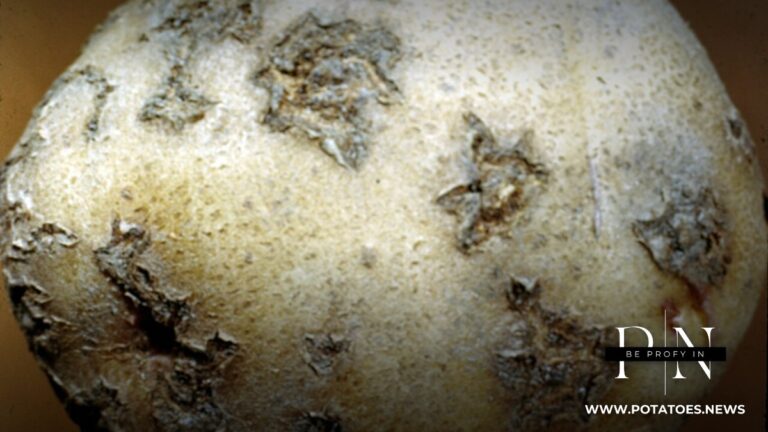
4. Do not forget the tubers. Alternaria also infects tubers through mechanical wounds at harvest, producing sunken dark dry lesions with rot beneath the skin. Hence the standard requirements: allow the skin to set, lift in dry conditions, minimise bruising, and keep bruised or suspect lots out of long-term storage.
5. Draw conclusions for next season. Widen the rotation, ensure residues are properly incorporated and broken down, avoid excessive plant density, choose less susceptible varieties and start from healthy seed.
What not to do
- Do not treat Alternaria with a late blight programme. Metalaxyl and other oomycete-specific products have no effect on Alternaria — these are organisms from different kingdoms. You lose the money and the time, and keep the disease.
- Do not add a third consecutive strobilurin “just in case.” That is the direct route to losing the entire group on that farm within two seasons.
- Do not write the spots off as heat stress and wait. Every week of lost leaf area during bulking is tuber weight you will not get back.
Защита в РФ · справка редакции
Альтернариоз (Alternaria solani, A. alternata): что зарегистрировано на картофеле в России
- Дифеноконазол (FRAC 3): Скор, КЭ — № 041-02-4371-0, до 22.01.2027; Дискор, КЭ — № 002-02-3369-1, до 15.11.2031; Раёк, КЭ — № 021-02-2611-1, до 18.03.2030.
- Боскалид + пираклостробин (FRAC 7 + 11): Сигнум, ВДГ — № 014-02-4529-0, до 24.04.2027; Ралли, СК — № 021-02-9607-0, до 30.09.2028.
- Азоксистробин (FRAC 11): Афродита 250, КС — № 528-02-3701-1, до 05.06.2032.
- Манкоцеб (FRAC M3, контактный): Дитан М-45, СП — № 009-02-2244-1, до 23.05.2029; Индофил М-45, СП — № 159-02-2388-1, до 10.09.2029.
- Резистентность: чередуйте группы FRAC; стробилурины (11) и SDHI (7) — не более 2–3 обработок за сезон и не подряд одной группой. Препараты против фитофтороза (в частности, фениламиды) на альтернариоз не действуют.
Справка редакции potatoes.news по Реестру пестицидов и агрохимикатов, разрешённых к применению на территории РФ (Минсельхоз России, версия от 29.09.2026). Перечень не исчерпывающий, приведён в информационных целях и не является рекомендацией конкретных препаратов или производителей. Нормы расхода, сроки ожидания и кратность обработок — строго по регламенту в Реестре и на этикетке; перед применением убедитесь, что регистрация действует.
Got a field photo you want assessed? Send it to the potatoes.news desk — we publish diagnoses with practical recommendations. v.kovalev@potatoes.news