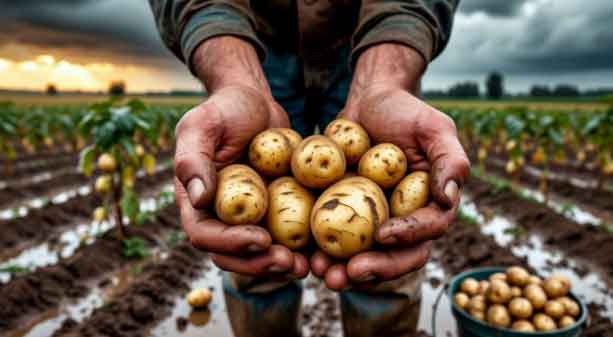
Early test digs conducted by Aviko in partnership with Boerenbusiness reveal a troubling picture for Europe’s processing potato sector this season. The share of large-caliber tubers—the critical fraction for french fry production—has slumped to no more than 70% of the total harvest, a significant drop from the usual 80%+ benchmark expected at this stage of the growing cycle. Agronomists attribute the shortfall to two compounding factors: an unusually high number of tubers per plant, which has spread the plant’s energy too thinly, followed by a scorching, dry summer that stunted bulking. Despite these quality concerns, gross yields have reportedly reached 55 tonnes per hectare, with net yields settling around 47 tonnes per hectare after accounting for approximately 15% waste and rejections. Meanwhile, recent rainfall has driven specific weight down to 385 grams—a decline from 390 grams just a week earlier—signaling that recovering moisture may be arriving too late to save the crop and, worse, introducing fresh threats of secondary growth (doorwas) and cracking, leaving the market in a state of anxious uncertainty.
Why it matters:
These field-level findings lend concrete weight to yesterday’s bearish forecast that the EU’s processing potato output could tumble below 40 million tonnes this year. The crisis, however, is not solely about volume—it is a crisis of geometry. Processing plants depend on a steady supply of uniform, elongated tubers to produce high-quality fries, and the current caliber shortage threatens to clog production lines, raise raw-material costs, and potentially force processors to import or reduce output. With rain now adding sprouting and cracking risks to the mix, every passing day compounds the volatility. For growers, traders, and fry-makers alike, the next few weeks will determine whether this season becomes a story of survival or a full-blown supply-chain shock that echoes through European foodservice markets well into 2027.