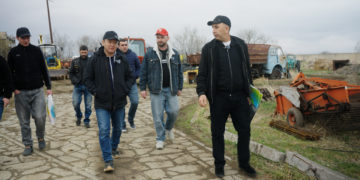


The potato industry in Armenia continues to rely on dedicated farmers who combine tradition with practical innovation. One such grower, with more than two decades of experience, offers a clear взгляд into how modern potato farming operates at the field level — from seed systems to market risks.
His journey began in childhood, learning from his grandfather, a tractor driver in a collective farm. Early exposure to agriculture shaped his future: even before military service, he cultivated his own hectare of potatoes and achieved strong yields. This foundation laid the groundwork for a lifelong commitment to farming.
Today, the farm operates on approximately 33–40 hectares of potatoes, although the farmer plans to slightly reduce planting area in the upcoming season. Planting typically starts in April, but weather conditions remain a key limiting factor. Wet soils often require the use of tracked machinery, highlighting the importance of adapting technology to local field conditions.


Seed Strategy: Building Productivity Through Generations
A major pillar of the farm’s success is its structured seed management system. Each year, elite seed potatoes are purchased and multiplied on-farm. The first reproduction is then used for further planting, while tubers are sorted by size:
- Larger potatoes are sold for consumption
- Smaller tubers are reserved for seed purposes
This approach allows the farmer not only to maintain productivity but also to supply seed material to other growers.
Variety Selection: From Diversity to Focus
Over the years, the farm tested up to eight potato varieties. However, current strategy focuses on 3–4 reliable varieties, including:
- Lucinda
- Colomba (early variety)
- Jelly (valued for taste)
- Bamba (Scottish variety)
The farmer notes strong demand for early varieties like Colomba, especially from producers targeting early markets near Yerevan.
Interestingly, red-skinned varieties are no longer grown. According to the farmer, they are less popular in Armenia and showed weak resistance to late blight, leading to economic losses in previous seasons.
Market Reality: Yield Is Not Enough
The discussion highlights a critical issue in potato economics: high yields do not always guarantee profitability. While the last season was described as successful — with both good yields and acceptable prices — previous years told a different story.
In one particularly challenging year, both production and prices were low, demonstrating the volatility of the potato market. This reflects a broader pattern seen globally, where oversupply can depress prices and reduce profitability even in productive seasons.
Crop Protection and Agronomy
The farm follows an intensive crop protection program. Fungicide treatments are applied:
- 5 times for early varieties
- 6 times for later varieties
This reflects the importance of disease management, especially in regions with влажные условия, where late blight pressure can be significant.
Beyond Potatoes: Diversification and Stability
Although potatoes remain the core business, the farmer also grows other crops, including grains, peas, and buckwheat. In addition, he operates a small hotel business. Despite diversification, agriculture remains his primary passion and focus.
Family Farming and the Next Generation
The farm is a family operation, with both his wife and son involved. His son is currently studying agronomy in Yerevan, preparing to continue and develop the family business. This continuity is essential for the long-term sustainability of the potato sector.
Technology and Partnerships
The farmer also emphasizes the role of agricultural partners, noting that modern crop protection solutions have contributed to improved performance and стабильные результаты.
Conclusion
This Armenian farmer’s story reflects the realities of modern potato production: success depends not only on yields, but on seed quality, variety choice, market timing, and resilience. It is also a reminder that behind every тонна картофеля stands experience, family tradition, and constant adaptation to changing conditions.