What Does It Cost to Spray a Hectare of Potatoes With Your Own Drone? INTA Balcarce Runs the Numbers
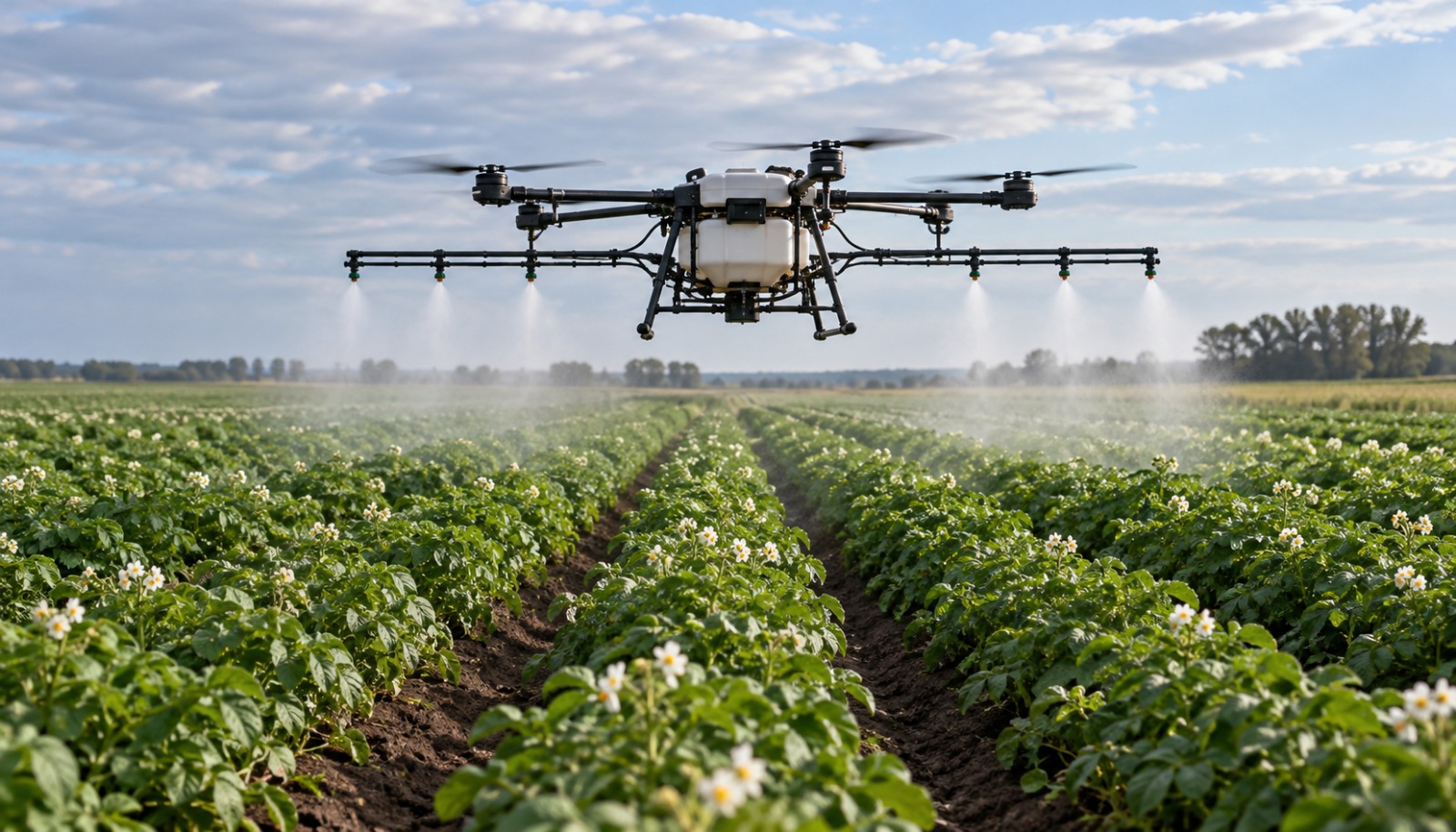
Argentine researchers have costed out drone spraying in potatoes. At 3,000 hectares of annual flight time, the operating cost came to US$ 6.71 per hectare — roughly the same as running a ground sprayer the farm already owns.
The scenario
Specialists at INTA’s experimental station in Balcarce (southeast Buenos Aires province) analysed the cost of crop protection applications in potatoes using a drone owned by the farm rather than hired in. The calculation is built around a mid-scale operation by local standards, and was published in Visión Rural.
The technical assumptions:
Weekdays. Unsubscribe in one click.
| Parameter | Value |
|---|---|
| Operating cost | US$ 6.71/ha |
| Annual utilisation | 3,000 ha |
| Evaluation period | 2 years |
| Effective work capacity | 11.2 ha/hour |
| Swath width | 7 m |
| Application volume | 15 L/ha |
Under these conditions the cost per hectare came out close to that of a farm-owned ground sprayer. The two options differ, however, in how their costs are composed and in what they allow the operator to do — and that is where the real decision lies.
Annual utilisation is the swing factor
The number of hectares covered per season is one of the most important variables in the analysis. The logic is straightforward: the more ground the machine covers, the more widely the initial investment and the remaining fixed costs are spread.
The direct consequence is that US$ 6.71 cannot simply be transferred to a farm of a different size or with a different level of use. For smaller operations, custom application work for neighbours may be the route to better utilisation and a stronger return on the equipment.
Depreciation carries real weight
The authors single out depreciation — of the drone itself and of its batteries — as a significant share of the cost structure. The per-hectare figure is not driven by energy, labour and maintenance alone; how intensively the technology is used across its service life matters just as much.
Before committing to the purchase, a grower should have honest answers to three questions:
- How many hectares can realistically be covered in a year?
- How many applications are planned per season?
- Is there scope to share the machine or to sell application services?
Why drones suit potatoes in particular
Aerial application removes several problems specific to the crop:
- No machinery traffic through the crop. Compaction risk falls, and the yield lost under a ground sprayer’s wheel tracks disappears.
- Access to waterlogged fields. When a field is impassable but weather and disease pressure demand immediate treatment, a drone means the application need not wait.
- Spot treatment of individual hotspots instead of blanket coverage.
- Lower water use — 15 litres per hectare, against the far larger volumes typical of ground equipment.
There is a caveat: performance depends on correct calibration of the machine, on the weather at the time of the flight, and on the characteristics of the product being applied.
How to read the figure
The US$ 6.71/ha is the operating cost of spraying with owned equipment under the specific assumptions of the study. It does not include the crop protection product itself, and it is not the tariff a contractor would charge.
When comparing application systems, the authors advise looking beyond cost per hectare to timeliness of application, field trafficability, work capacity, coverage quality, and losses caused by machinery moving through the crop.
The overall conclusion: drones can reach competitive costs in potato production, but the economic case is tightly bound to annual utilisation and to spreading the investment sensibly.
Technical authors: Leandro Pagliaricci, Franco Donna and Ulises Loizaga (INTA Balcarce). Journalistic write-up: Santiago Santini. Source: Visión Rural — INTA Balcarce; published by Argenpapa, 8 September 2026.