Argentina: McCain Foods and Arcos Dorados Recognise Potato Growers for Regenerative Agriculture
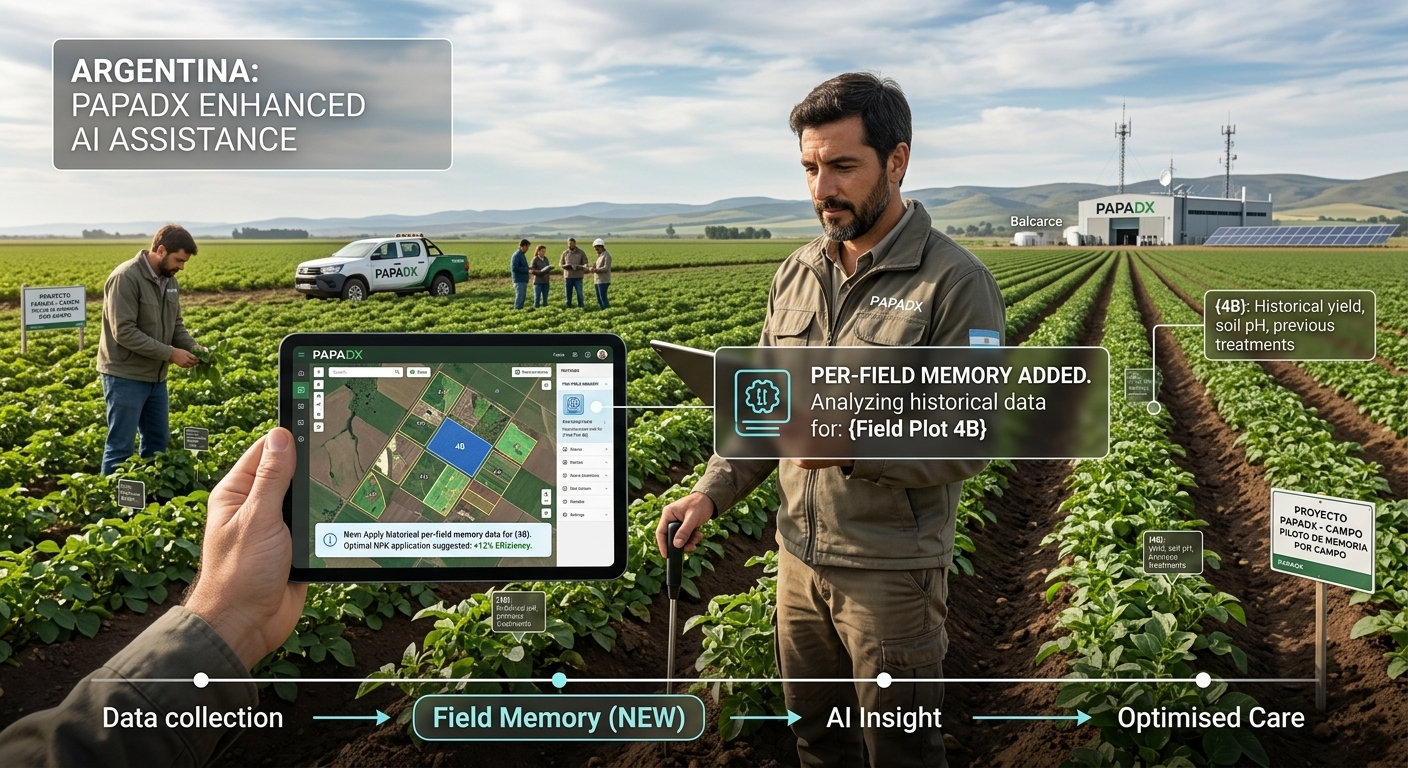
On World Agriculture Day, the two companies announced the winners of the second Regenerative Agriculture Challenge in Argentina. Across two seasons, the share of hectares under regenerative practices within McCain’s Argentine grower network has climbed to 62%.
On 9 September, marking World Agriculture Day, McCain Foods and Arcos Dorados released the results of the second edition of the Regenerative Agriculture Challenge in Argentina. The programme is aimed at potato growers in Balcarce and the surrounding region, and rewards practices that support soil health, efficient input use and the resilience of farming systems.
The winners
First place went to Potato Growers, with Agropecuaria La Gándara taking second and Luciano Garrido and Ricardo Alberto Strada sharing third.
Weekdays. Unsubscribe in one click.
Special recognitions were also awarded to Agropecuaria La Gándara for its La Gringa field, and to Finca Va Da Ju for field 28, Ojo de Agua, for standout performance against individual regenerative principles.
What earned the recognition
The awards rest on measurable field-level change rather than stated intent.
At Agropecuaria La Gándara, the drop in the EIQ (Environmental Impact Quotient) came from two decisions: substituting high-EIQ fungicides with lower-impact products, and adopting disease alert systems (DSS) that cut the number of applications. Fungicides, because of their dosage rates and active-ingredient concentrations, are the single largest driver of that indicator.
At Finca Va Da Ju, the lower greenhouse gas emissions recorded on the field were attributed mainly to lower-emission fertilisers and to dose adjustments based on actual soil nutrient content.
How entries were assessed
The second edition ran from November 2025 to June 2026 and was judged against ten key indicators covering environmental, agronomic and social performance. Those indicators draw on McCain’s Regenerative Agriculture Framework, the roadmap the company uses to guide growers through the transition. Data was independently audited by Carbon Group.
What the participants say
Micaela Uberti, Sustainability Manager for McCain Latin America, said regenerative agriculture now sits at the centre of how the company grows potatoes in the region, and that working on soil health today is how it intends to build a more resilient supply over time. The second edition, she noted, showed the model can scale when growers, customers and technical teams work against the same set of indicators.
Romina Varela, Agriculture Director at McCain Foods Argentina, said the challenge is a way of recognising the daily work of the company’s growers, and that this year’s results demonstrate the transition is built collaboratively and with a long-term view.
Gastón Viani of Potato Growers, winner of both editions, put the practical effect plainly: working to the indicators forces growers to measure what they previously judged by instinct, and seeing soil conditions evolve season by season, backed by data, is what convinces them to sustain the practices.
Carola Baglietto, Senior Manager of Social Commitment and Sustainable Development at Arcos Dorados, said working alongside suppliers and growers turns the sustainability agenda into concrete action across the value chain.
Two seasons of progress
The numbers give a sense of the pace of adoption. In the first campaign, 20% of the 45 growers in McCain’s Argentine network had taken up regenerative practices, 13% of fields had been categorised, and 240 pieces of supporting evidence were collected. By the second campaign, 62% of hectares were under regenerative practices, 78% of fields had been categorised, and accumulated evidence exceeded 1,550 records.
As of the close of the 2026 fiscal year in June, every grower in McCain’s Argentine network had been brought into the Regenerative Agriculture Framework. Globally, the company has committed to helping growers implement regenerative practices across 100% of its potato acreage by 2030.
McCain defines regenerative agriculture as an ecosystem-based approach that improves the resilience, yield and quality of crop production by enhancing soil health and water quality, optimising water use, strengthening biodiversity and reducing the impact of synthetic inputs.
Technical support is provided by the consultancy EDRA, which helps growers understand, implement and measure these practices. That work is complemented by RegenHub, a programme of training, field demonstrations and knowledge exchange among growers, agronomists, suppliers and partners.
About the companies
McCain Foods is a global leader in prepared potato products and appetisers, with products served in restaurants and homes across more than 160 countries. The company has operated in Argentina for over 30 years, running planting, harvesting, development and research activities, and has held B Corp certification since 2025. It directly employs more than 800 people and generates some 3,000 indirect jobs.
Arcos Dorados is the world’s largest independent McDonald’s franchisee and the largest quick-service restaurant chain in Latin America and the Caribbean. It holds exclusive rights to own, operate and franchise McDonald’s restaurants in 21 countries and territories across the region, with more than 2,500 restaurants and over 120,000 employees. The company is listed on the New York Stock Exchange (NYSE: ARCO).
Source: McCain Foods Argentina / Arcos Dorados; published by Argenpapa, 9 September 2026.