The North as a Plant Health Asset: Why Finland Is Gaining Ground in European Seed Potato Production
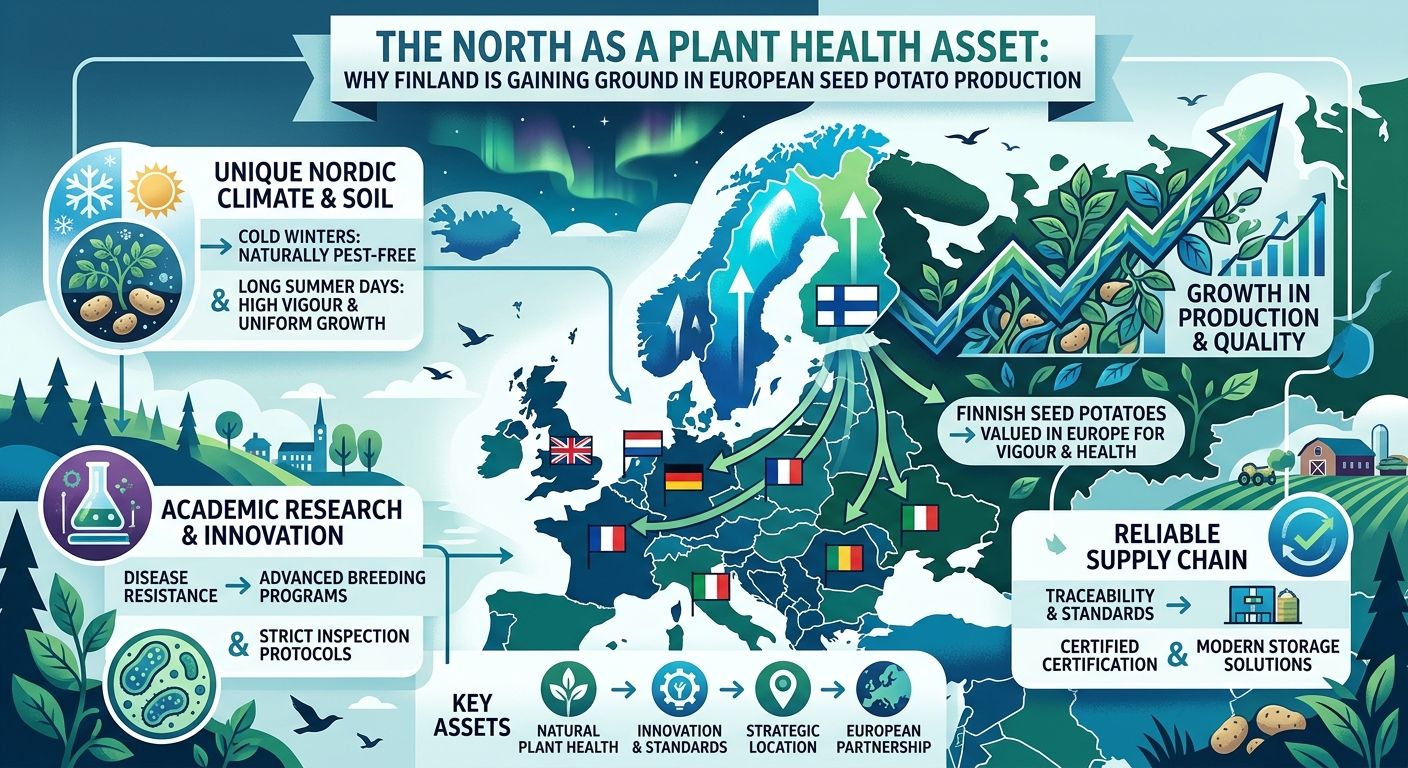
Warming in Central Europe is extending the period of aphid activity, and with it the window for potato virus transmission. Seed systems that once operated with a comfortable margin are finding it harder to hold the highest grades. Against that background, the northern zones of Northern Europe are turning from periphery into asset.
What happened
Finpom Oy, the Finnish subsidiary of the German breeding group EUROPLANT Pflanzenzucht GmbH, based in Tyrnävä in northern Finland, has become a major producer and multiplier of high-grade seed potatoes, according to its parent company. The announcement was timed to PotatoEurope 2026, held on 9–10 September in Gestorf near Hanover, where EUROPLANT presented its variety portfolio at stand E93.
The company’s central argument is not commercial but phytosanitary. Finland’s cool climate, harsh winters and low aphid pressure deliver a significant plant health advantage precisely at the moment when that advantage is eroding in Central Europe.
Weekdays. Unsubscribe in one click.
Vector biology: where the real boundary runs
Aphids transmit several of the most damaging potato viruses, and the mechanics of that damage are temperature-driven. The warmer the spring, the earlier flights begin and the longer the period favourable to virus transmission. For seed production this translates directly into fewer generations that can be carried without losing grade.
Aphid pressure in northern Finland is considerably lower, and two separate points are worth keeping apart here, because summaries routinely merge them.
First. The peach-potato aphid (Myzus persicae), an efficient vector of potato leafroll virus (PLRV), is unable to establish a permanently overwintering population in the high-grade seed production zone. This is not a question of spray intensity but of winter survival: the cycle simply does not close.
Second. Aphids that transmit potato virus Y (PVY) are also significantly less prevalent in the region than in Europe’s main potato-growing areas. The wording here is softer, and the distinction matters. PVY moves non-persistently through a wide range of species, including transient migrants that never colonise the crop, so northern latitude does not deliver zero risk.
The difference between the two points is the difference between a structural barrier and a quantitative edge. Both support seed health, but they will hold up differently as warming continues.
A zone, not just a geography
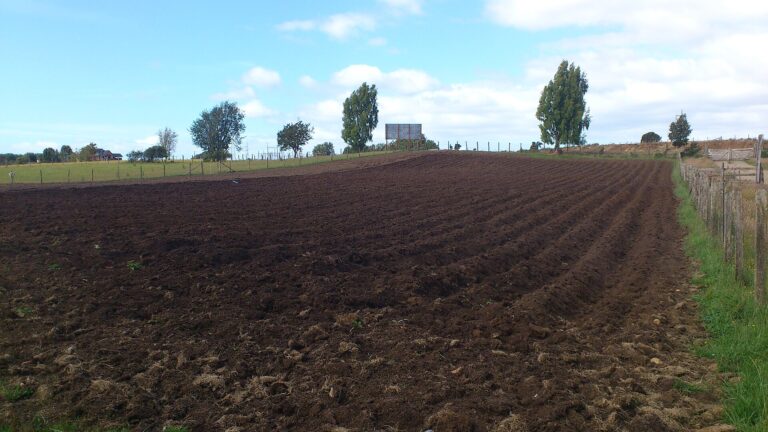
One detail tends to disappear in secondary coverage: production is not simply located “somewhere in the north” but concentrated in the designated high-grade seed potato production zone covering the municipalities of Tyrnävä and Liminka, where special requirements are in place to safeguard the production of high-quality seed.
That changes the nature of the argument. Latitude on its own does not produce healthy seed. The advantage has to be institutionalised: restricting the movement of ware potatoes, regulating rotations and the proximity of plantings, monitoring aphid flights, and giving the zone a defined legal status. The value of the Finnish model lies in the pairing of climate and regime, and it is the second half of that pairing that other regions can actually copy.
The variety portfolio
Alongside seed production, Finpom is working with its parent company to widen the range of varieties available in Finland.
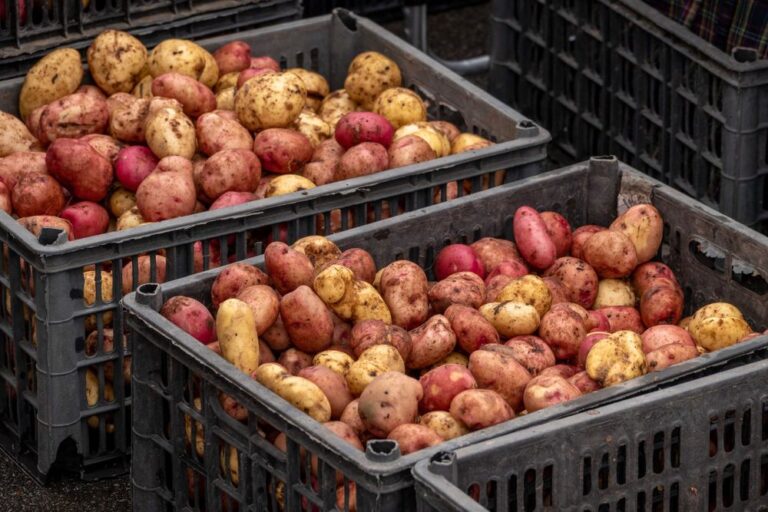
LARISSA and JUVENTA are table varieties that have been successfully introduced to the Finnish table potato market, including under the difficult growing conditions of recent seasons.
Filipa is a recent introduction aimed at the early consumption market, combining first early maturity with strong visual appeal and eating quality.
FAVOLA, a crisping variety, has demonstrated its resilience under current weather conditions in other European countries. The company expects demand to grow on the strength of its excellent long-term storability, a trait that becomes a risk management tool for processors in years of unstable yields.
INA, a table variety, took centre stage at many trial sites this season. Christian Krahn, Export Manager at EUROPLANT, points to the combination of broad nematode resistance with yield, tuber sizing and robustness as essential going forward, noting that European growing conditions have been very difficult, driven above all by high temperatures and a prolonged shortage of rain.
Heikki Markus, Managing Director of Finpom Oy, frames the company’s position around healthy seed as the foundation of the entire potato value chain, arguing that Finland’s northern growing conditions, high-quality agricultural land and grower expertise form a combination that is becoming more important as the climate changes.
What the announcement does and does not establish
An important caveat: the primary source is material distributed by EUROPLANT itself. This is corporate positioning rather than independent research, and it contains no figures on area, no trend data on batch downgrading due to virus, and no comparative statistics against the Netherlands or Scotland. The broader claim that the map of European seed production is shifting north cannot rest on this material alone. It would need several seasons of seed acreage data and post-harvest test results.
What does follow reliably is a shift in the basis of competition, from yield toward phytosanitary predictability. A buyer of high-grade seed is not paying for tonnes but for the probability that the grade will survive into the next generation. That probability increasingly depends on the climate of the multiplication zone, and the Central European climate is moving the wrong way for seed growers.
Transferring the model: latitude is the weaker half
Read as a template for other northern regions, the Finnish case invites one correction. Tyrnävä sits at roughly 64.5°N. In Russian terms that is the latitude of Karelia and the southern Arkhangelsk region rather than Leningrad Oblast, which is agroclimatically closer to southern Finland, where the aphid advantage is markedly weaker. The same applies to any region tempted to claim the benefit on the strength of a map alone.
The transferable element is not the latitude but the institution: a legally defined zone with a dedicated phytosanitary regime, anchored to territory with demonstrably low vector pressure, with flight monitoring and restrictions on ware potato movement inside its boundaries. Without that regulatory frame, a northern location yields an advantage that is spent within one or two generations.
Source: PotatoPro, 7 September 2026, based on material from Europlant Pflanzenzucht GmbH — potatopro.com