El Niño hardens the odds as India approaches its main potato planting window
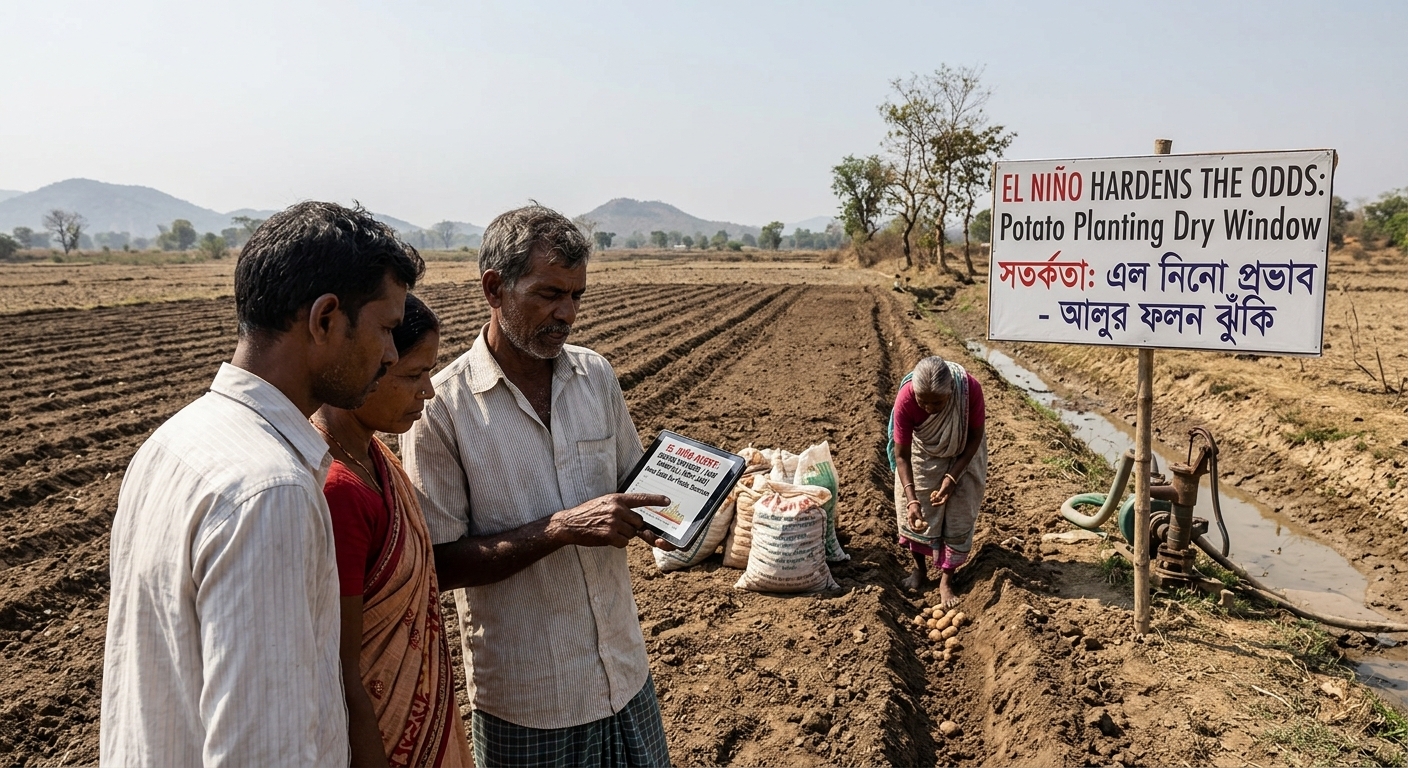
The World Meteorological Organization now puts the chance of El Niño lasting into February 2027 at close to 100%. India heads into planting of its main winter potato crop on the back of what may be its driest monsoon in almost twenty years.
The Pacific signal has sharpened
In a statement issued on 3 September, the WMO said El Niño was now firmly established and on course to become a very strong event, with the peak expected late in 2026. Its forecasting centres put the likelihood of the event lasting at least through February 2027 at close to 100% — language the organisation reserves for outcomes it considers all but settled.
The ocean data explain that confidence. The Niño 3.4 sea-surface temperature anomaly, the standard yardstick for the phenomenon, averaged roughly 1.5°C above normal across May to July and touched 2°C during July. Weekly values then climbed further, running between about 2.2°C and 2.6°C from late July into mid-August. The WMO’s seasonal outlook for September to November carries an ensemble-mean anomaly of approximately 3.6°C — a figure that would exceed the peaks of both the 1997/98 and 2015/16 events.
Weekdays. Unsubscribe in one click.
What sits beneath the surface matters as much as what sits on it. The WMO reported subsurface temperatures in parts of the tropical Pacific running more than 8°C above average during July and early August. That reservoir of stored heat makes a rapid collapse of the event improbable; it will keep feeding surface warming for months yet.
The organisation is careful to separate strength from consequence. A very strong El Niño does not translate into equally severe weather everywhere. A positive Indian Ocean Dipole is expected to develop over September to November, and the tropical Atlantic is forecast to stay warmer than normal — either can amplify, mute or redirect the regional patterns usually associated with El Niño. The models are confident about above-normal temperatures across nearly all land areas. Rainfall is a more local question.
India’s rainfall deficit is spreading
The southwest monsoon closed August 16% below normal, according to India Meteorological Department figures reported by The Indian Express. Cumulative rainfall for the season through August stood at 84% of normal — a deterioration from the roughly 13% shortfall recorded a week or so earlier.
The spread of the deficit is more telling than the headline number. Of the 741 districts the IMD monitors, 312 — 42% — had received deficient rainfall by the end of August. Another 38 districts, or 5%, fell into the large-deficiency category.
By region, August broke down as follows:
- Southern peninsula: more than 27% below normal
- Central India: around 16% below normal
- East and northeast: also around 16% below normal
- Northwest India: roughly 10% below normal
Bihar stands out. One of the country’s leading potato states, it ended August with a 40% rainfall deficit. The picture is not uniform, however: the IMD has indicated that parts of Bihar, eastern Uttar Pradesh, Odisha and several neighbouring areas could still see normal rainfall during September, even as below-normal rain is favoured across most of the country.
IMD Director General Mrutyunjay Mohapatra said September rainfall was likely to come in below 91% of the long-period average. On that trajectory, the full June–September season would finish under 90% of normal. Reuters noted on 4 September that such an outcome would make the 2026 monsoon India’s weakest in close to two decades.
Where the potato risk actually sits
The visible damage so far is in summer crops — rice, maize, soybean, cotton and pulses. Potatoes are absent from that tally for a simple reason: the main crop has not been planted yet, and no credible national estimate of potato losses exists.
The exposure lies in what the monsoon leaves behind rather than in what it has already done.
Most of India’s potato area goes in after the monsoon, during October and November. September rainfall is what builds residual soil moisture, tops up reservoir storage and recharges groundwater — the water buffer the crop draws on through emergence and early growth. A weak finish to the season pushes irrigation demand forward into exactly that window.
Above-normal autumn temperatures would compound the problem by lifting evaporation and crop water requirements. Should excess warmth persist into tuber initiation, it can interfere with tuber set and shorten the period available for bulking. Timing is decisive here: heat during initiation and heat shortly before vine kill produce very different outcomes in the same field.
None of this makes a shortfall inevitable. A large share of India’s commercial potato area is irrigated, and results will turn on groundwater access, reservoir levels, planting dates, temperatures and how any post-monsoon rain is distributed. The accurate description today is elevated production risk — not confirmed loss.
What to watch next
The first meaningful evidence will come off the fields in October and November: how evenly the crop emerges, whether irrigation water is actually available, and what early-season temperatures do. India is the world’s second-largest potato producer after China, so those observations will carry well beyond the domestic market.
Other regions worth monitoring over the same period include the October–December rains in East Africa, the summer rainfall season in southern Africa, spring conditions in Australia and New Zealand, and winter snowpack across the northwestern United States and western Canada.
A word on Europe, where potato losses are already substantial: those losses are documented as consequences of regional heat and drought. Direct attribution to El Niño remains unproven, and should not be assumed simply because the two coincided in time. Nor is there evidence of a global potato shortage caused by this event.
The message for the industry has firmed up without changing shape. El Niño is strengthening faster than looked likely a month ago, and the preparation window is closing. The crop consequences still have to be established region by region.
Sources
- World Meteorological Organization, El Niño set to become very strong, raising risks of extreme weather into 2027, 3 September 2026
- World Meteorological Organization, Global Seasonal Climate Update, September–November 2026
- The Indian Express, IMD on the August rainfall deficit and the September outlook, 1 September 2026
- Reuters, on below-average September rainfall and crop concerns, 4 September 2026
- Potato News Today, El Niño warning intensifies as India’s potato season approaches, 8 September 2026