Japan Bucks the Trend: Calbee Expects 240,000–250,000 Tonnes from Hokkaido
While Europe and North America cut acreage, the Japanese processor is counting on a recovery in raw material supply after a difficult 2025 season.
The ceremony in Tokachi
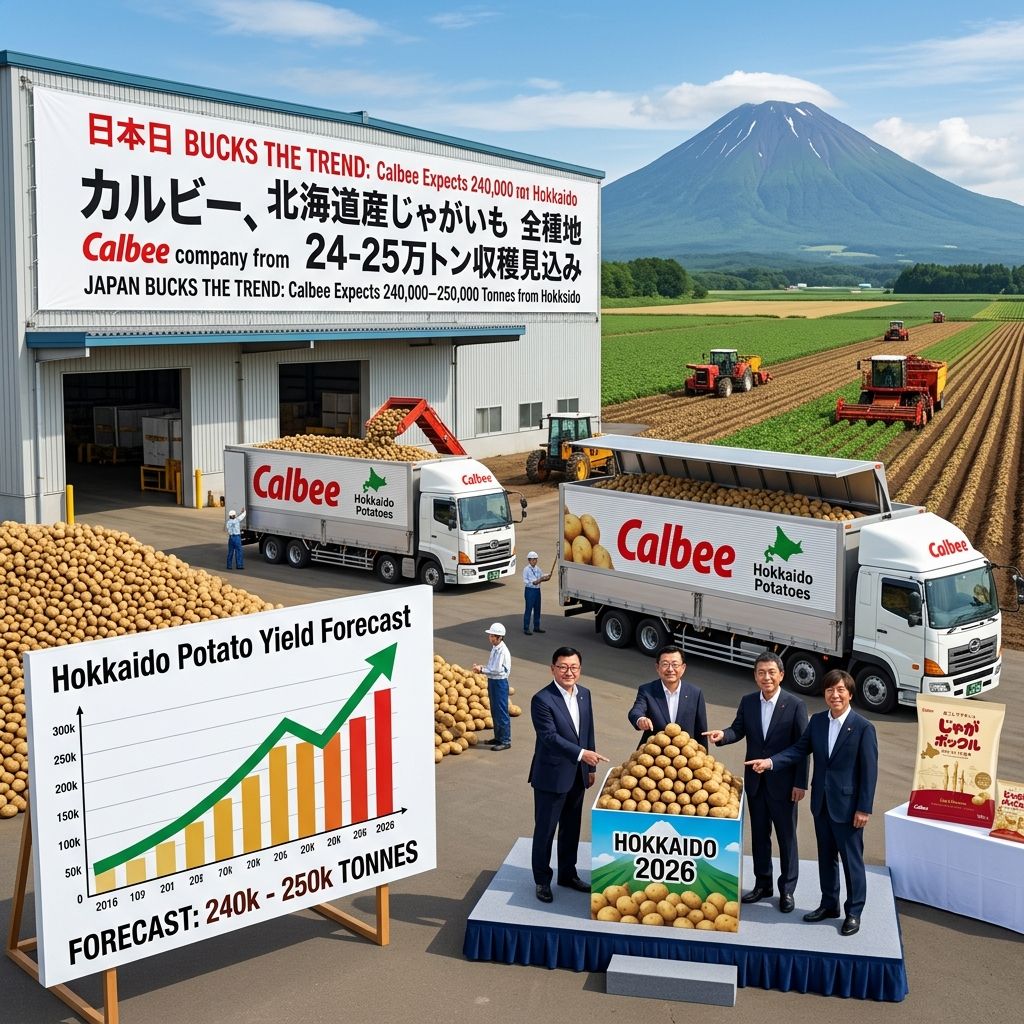
Calbee Potato held its annual Potato Harvest Ceremony 2026 on 1 September. The venue was the Tokachi field in Kami-Obihiro, Obihiro City, Hokkaido — a one-hectare plot managed by Satoshi Sato, president of the Obihiro City Kawanishi Processing Potato Production Cooperative, planted with Toyoshiro, the workhorse processing variety of the Japanese industry.
Kazuya Tasaki, president of Calbee Potato, said the company expects to procure roughly 240,000 to 250,000 tonnes of Hokkaido potatoes in 2026. That is well above last year’s 230,000 tonnes and returns volumes to the range of earlier seasons: 245,000 tonnes in 2024 and 250,000 tonnes in 2023.
Weekdays. Unsubscribe in one click.
Why the 2025 baseline was so low
Without context, the headline figure does not read correctly. The 2025 crop was hit by unusually high temperatures and drought, which cut both yield and tuber quality — and for a processor, the second usually matters more than the first.
The consequences reached well beyond the field. A shortage of usable raw material squeezed output of potato chips and Jagarico, both heavily dependent on Hokkaido supply, and forced the company to scale back promotional activity during peak demand periods, including the year-end season. In a Japanese FMCG market where promotions are the main lever in the fight for shelf space, that is a costly retreat.
So 240,000–250,000 tonnes in 2026 is not a record. It is a return to normal.
What changed in the field
Tasaki points to weather as the main driver of the improvement: average temperatures this season have run lower than last year, and rainfall supported crop development rather than disrupting it.
In parallel, Calbee Potato has been deepening its agronomic work with suppliers. Growers have adopted field-specific fertilisation, with application rates calculated from soil analyses of individual fields on individual farms. The approach is standard precision agriculture, but within the Japanese contract model it signals something more: the processor is moving further into its suppliers’ agronomy rather than simply accepting deliveries against a specification.
Harvest risk
The forecast remains provisional, and Tasaki names the main threat directly: torrential rainfall and linear rainbands (senjo kosuitai), the narrow, stationary belts of intense precipitation that have become a recurring feature of the Japanese late-summer and autumn.
The damage mechanism has less to do with the rain itself than with harvest logistics. Heavy machinery cannot enter saturated fields, so lifting is pushed back. Delay combined with continued high temperatures then raises disease and pest pressure — attacking tuber quality after the crop has effectively already been made.
The final outcome of the season will depend on weather through the remainder of the Hokkaido harvest.
The global picture: Japan is up almost alone
Set against the rest of the northern hemisphere, the Japanese position looks like an outlier.
North-Western Europe. The NEPG recorded a cut of roughly 11% in ware potato area, from about 604,100 hectares in 2025 to around 536,900 hectares in 2026 — nearly 67,000 hectares. The cause was the collapse of the previous season’s market: spot prices sat at €0–2 per 100 kg for weeks on end, below the cost of production. By country, the reductions ran to 16.6% in Belgium, 15.1% in the Netherlands and 9.7% in France, with Poland down roughly 12%.
Weather then compounded the acreage cut. Yield forecasts for 2026 are below last year in the Netherlands (43.3 t/ha, –6%), Germany (45.3 t/ha, –1%), Belgium (42.8 t/ha, –5%) and Poland (30.5 t/ha, –7%). Only France is up, at 42.5 t/ha (+1%).
United States. The June USDA NASS forecast for the 13 surveyed states put plantings at 873,000 acres, down 3% year on year and the third consecutive annual decline. That is the lowest level since 1952. More than half the reduction came from Idaho, where area fell from 315,000 to 300,000 acres. Harvested area is forecast at 867,600 acres, against 896,800 a year earlier.
Canada. Here the decline is marginal: Statistics Canada reported 395,176 seeded acres, just 0.5% below 2025. Alberta has become the country’s largest potato province by planted area at 86,000 acres, ahead of Prince Edward Island (83,700 acres) and Manitoba (70,500 acres). Combined US and Canadian acreage stands at roughly 1.27 million acres.
What it means for the market
Japan is effectively the only major northern-hemisphere market expecting an increase in raw material this season — and even then only as a recovery from a shortfall, not an expansion of the base.
For buyers and processors outside Japan, the read-across is indirect. Calbee covers domestic requirements through its own contracted Hokkaido supply base, so the increase will not feed directly into export flows. What it does do is relieve some of the pressure behind Japanese demand for imported semi-finished product — principally frozen french fries and dehydrated potato products, which helped plug the domestic gap last season.
The broader frame for 2026/27 is unchanged. Reduced acreage in Europe and North America, layered on top of weather risk, leaves global processing with a thinner volume cushion than usual. A single bad September — in Hokkaido or in the Benelux — is enough to rewrite the balance.
Sources
- PotatoPro: Calbee Potato Harvest Ceremony 2026 Highlights Stronger Hokkaido Potato Quality and Yield
- PotatoPro / NEPG: European Ware Potato Area Falls 11% as Growers Cut Plantings
- Potato News Today: Drought pressure spreads across north-west Europe’s potato belt
- FreshPlaza: European heatwave raises concerns for 2026 potato crop
- FreshPlaza: U.S. potato acreage forecast falls 3% in 2026
- Potato News Today: North America’s potato industry in 2026