Russia: Desiccation Down to the Wire — Three Days Between Diquat and Digging
Labels, trials and skin biology all point one way: digging three days after diquat turns the lot into processing stock at best — and a storage write-off at worst.
On the evening of 5 October, Anton Chebotnikov brought to the MAX chat «КАРТОФЕЛЬ И Т.Д.» (Potato etc.) a story heard on many fields this season — but rarely in such a pure form: «Is there a minimum waiting period for diquat before harvest? A story from the field: they treated the field, started digging three days later — the potatoes ran. They lift with a Chinese-made combine into big bags, with plenty of soil and haulm in the lot… Maybe the skin hadn’t set after the first pass?»
Three days between desiccation and digging is not an exception but a symptom. Frosts and rains squeeze the harvest window, and farms increasingly face the choice: wait for the skin to set and risk the field, or dig at once and risk the store. The thread answered Chebotnikov’s question — «the longer after treatment, the less it rots?» — with a near-unanimous yes.
How much time the reglament really gives
Under diquat labels (Reglon Super, Reglon Forte and analogues), potatoes are sprayed at the end of tuber formation and skin roughening, with a ten-day waiting period; strongly foliaged varieties receive two passes spaced 3–5 days apart. Agrochemical guidance is more explicit about the real interval: for most varieties, 14–20 days should pass between application and digging, and only early varieties may be lifted after 8–10 days.
Weekdays. Unsubscribe in one click.
Field trials of diquat-based desiccants at the All-Russian Institute of Plant Protection (VIZR, Leningrad region) showed the same rhythm: marked haulm drying after 4–5 days and complete drying after 10–11 days on weakly foliaged varieties, and 11–16 days after the last of two passes on strongly foliaged ones.
Haulm is not skin
But a desiccant solves the haulm, not the skin. After haulm kill the skin keeps maturing for another two to three weeks, and agronomists stress that the digging date must be set by the degree of skin set — not by how dry the field looks. Formally possible digging and storage-safe digging are often two dates two weeks apart. Alexander Volodin named the extra variable — nitrogen: «There is usually a varietal window for skin set: two to three weeks, then it depends. Especially if there is a lot of nitrogen.» Overfed crops give a lush dense haulm, later maturity and a thinner, slower-setting skin — they can only be dug later in calendar terms.
What breaks when the interval collapses
«Running» potatoes in the thread’s terminology are tubers whose unset skin sloughs off under the harvester’s load in patches, cracks and weeps juice. The consequences stack up along the chain. In the field, wound damage runs many times above normal, and the soil-and-haulm contamination from Chebotnikov’s case makes it worse. In the store, wounds miss the healing period and let Fusarium and bacterial rots in, turning the lot into a write-off on a countdown. At the market, retail rejects such potatoes outright — what remains is deep processing and selling «off the wheels» straight from the field. Sergey Khabuzov added the technological fork: if digging on windrows runs off schedule, be ready to leave the under-50-mm calibre in the field — lift only what can survive sorting.
If the window is already missed
For those already digging too early, practitioners and agronomists converge on one rule: such potatoes must not go into long storage on the hope that they «hold until winter». The working algorithm is accelerated field sales, redirecting the lot to processing, and — if storage is unavoidable — transfer technology with a short healing period and hard culling. And the main lesson for next season: plan desiccation not from the forecast frosts, but from the target digging date minus three weeks. In season-2026, when frost arrived before many farms had set skin, that rule would have been worth more than any fungicide. Cold weather also works against the chemistry itself: cloudy cold slows diquat desiccation across Russia.
Why it matters
The compressed «desiccation → digging» interval is where field risk turns into storage loss: every day cut from skin set raises wound damage at digging and invites Fusarium and bacterial rot into the pile weeks later. For buyers it means more Russian volume pushed toward processing and spot sales rather than the spring table market — at the very moment when farms are finishing the harvest in cold soil, and bruised, cold-dug tubers are least able to heal.
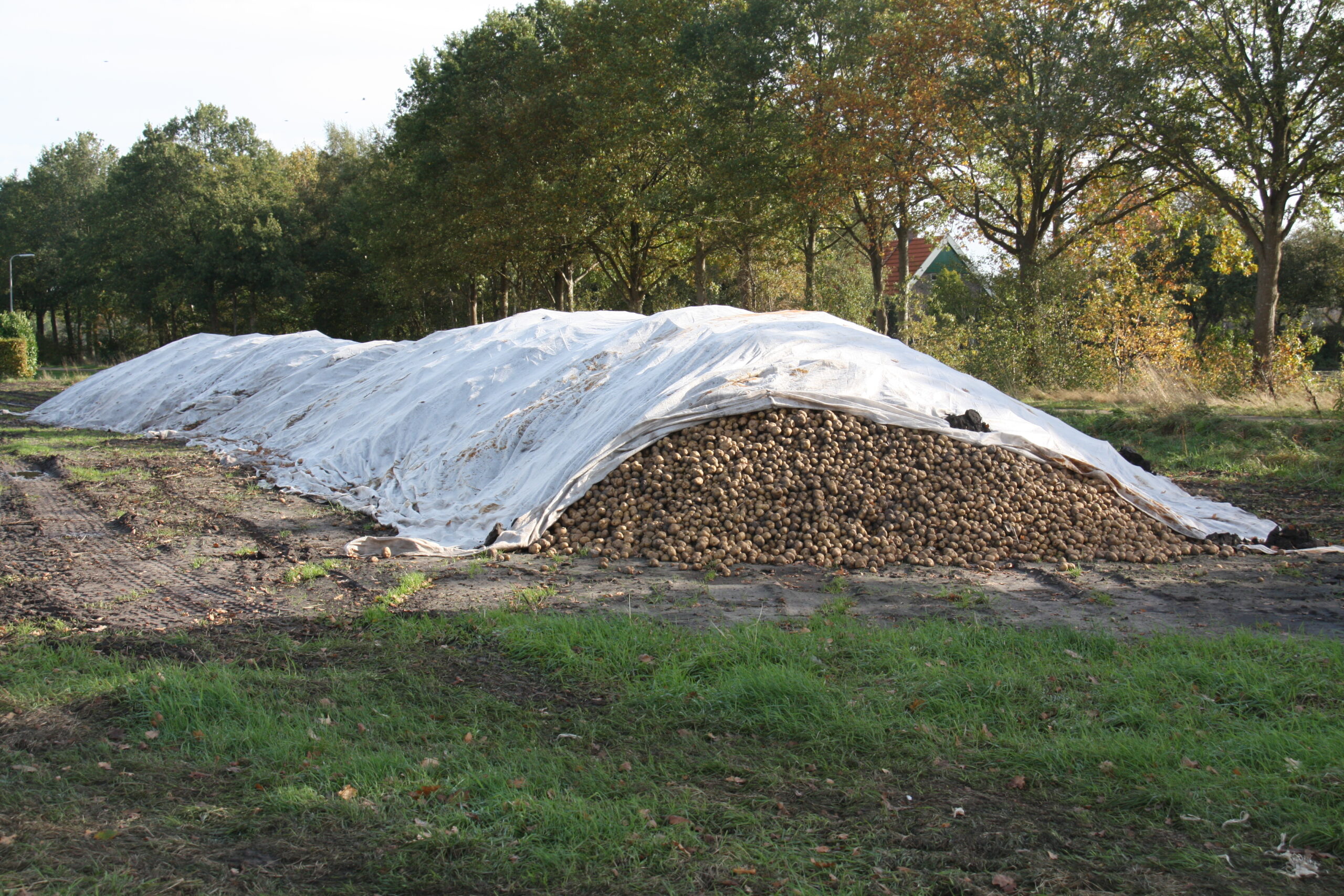
Photo: Potatoes held in a field clamp under a plastic sheet, the Netherlands (illustrative). Silver Spoon / Wikimedia Commons, public domain