Russia: Cold Lift — Potatoes Dug at +4 °C Crack, Rot and Never Reach the Retail Shelf
Cold soil and rain frame the end of Russia's 2026 harvest: tubers dug at +4–8 °C crack, fail to heal in store and get rejected by retail — processing becomes the only outlet.
On the evening of 5 October, a two-line field report from farm owner Sergey Khloptsev in the professional MAX chat «КАРТОФЕЛЬ И Т.Д.» (Potato etc.) drew more reactions than any announcement of the week: «We were digging yesterday — a lot of cracks. Today it’s +8 °C and a completely different story! But then the damn rain started.»
Behind those two lines sits the main production conflict of the closing phase of Russia’s 2026 potato harvest in the Central region and the Volga area: cold soil, a bruised tuber, and rain that arrived right in the middle of lifting. And the second dimension of the problem came from Sergey Khabuzov in the same thread: digging at +4 °C is «brutal trauma» — retail will never take such potatoes, «they’ll only pass for processing.»
What cold does to the tuber
Potato has a critical temperature threshold of sensitivity to damage — about 12 °C. When soil and tuber temperatures drop below that, mechanical damage at digging rises sharply: the skin turns brittle, and every knock against the harvester share or drop into the bunker leaves cracks and bruises. Belarusian and Russian recommendations quantify it this way: at soil below 8 °C tubers are damaged by machinery 9–25% more often than at 12–15 °C. And if the temperature falls below +5 °C, damage stops healing altogether — the wound periderm simply does not form.
Weekdays. Unsubscribe in one click.
That matters because tubers lifted in moderate cold normally repair themselves during the healing period of storage — two to three weeks at 13–18 °C and high humidity. Potatoes dug at +4…+8 °C and tipped straight into the store lose that resource: healing runs slowly or not at all, and the wounds become entry gates for Fusarium, bacterial soft rots, Phoma and anthracnose, which show up in the bulk two to four weeks later.
This is why agronomic guidelines are blunt: start digging when at least 95% of tubers have set a firm skin and soil temperature is above 10 °C — ideally with the tuber itself at 10–15 °C.
«Where do you find that in early October?»
The trouble is that almost nobody gets to live «ideally» this season. Yevgeny Saratov, from the same thread, describes the forced practice of eastern farms: «Either freeze or dig like this. We dug chip potatoes like that last year… A friend digs Koroleva like that every year and doesn’t get much damage. Sure, the ideal temperature is 10-plus — but where do you find that in early October? And digging only in the warm part of the day is unrealistic unless you have two combines for 200 hectares.»
The practitioners’ conclusion: variety decides a lot. Thick-skinned varieties — chip-grade potatoes, Koroleva — tolerate cold lifting relatively well, while thin-skinned pink- and yellow-fleshed lots crack and shatter catastrophically under the same conditions. Alexander Volodin summed up the evening’s main rule: «The single most important thing is to account for tuber temperature at digging.»
The rain that caught Khloptsev on the evening of 5 October adds a third hit: wet tubers sweat in the pile without forced ventilation, and condensation in the store is a direct road to silver scurf, late blight and bacterial rots. For a wet harvest, agronomists advise switching to transfer storage technology: 10–14 days in temporary field clamps with drying, sorting and culling — and only then long-term storage.
Why it matters
Cold-traumatized potatoes are a problem for the whole chain, not just the farm. As Khabuzov reminded the thread, retail screens such produce out: a cracked tuber will fail acceptance at the distribution center and never reach the shelf. The realistic outlet is deep processing — fries and chips — and only if the cracks have not turned to rot already in the field.
For commercial growers the arithmetic is unpleasantly simple: every degree below +10 °C on the last hectares is a percentage of marketable share that no sorting and no price will bring back. Whoever digs these days either catches the warm window of the day and protects the calibre, or prepares the lot for processing right away — without banking it for the spring market. With frosts arriving before many farms had set skin, the choice has become irreversible. Early survey data already shows how tight the season has been: half of surveyed farms in Russia and Kazakhstan report lower potato yields in 2026.
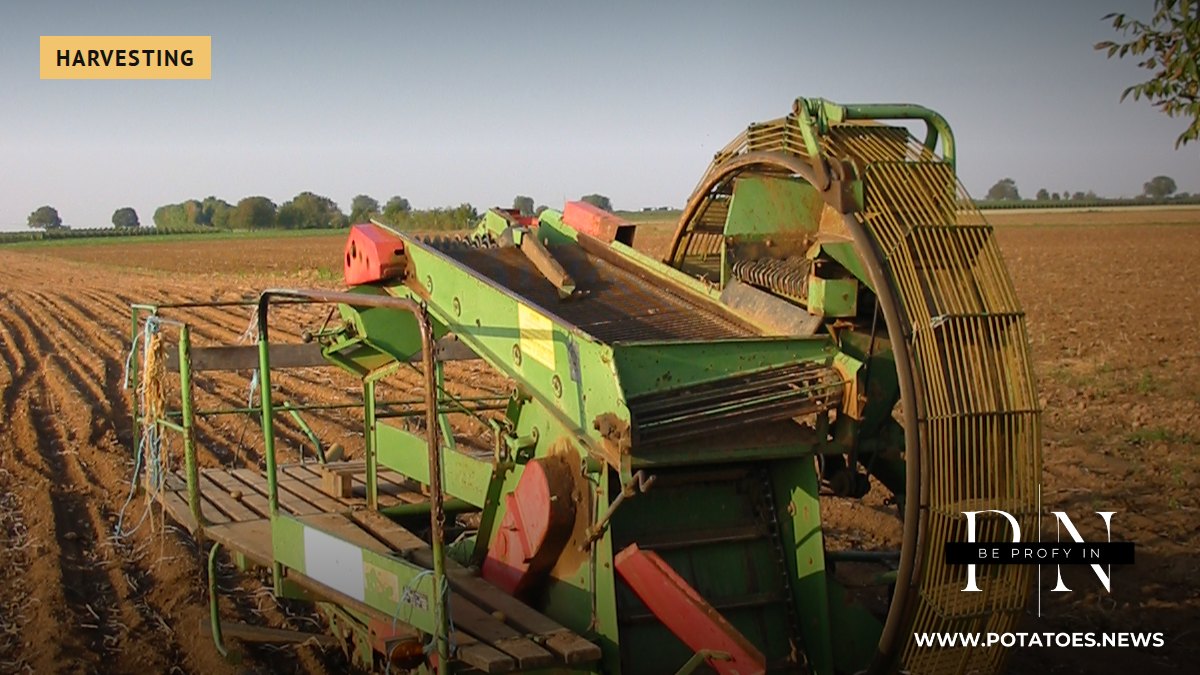
Photo: Potato harvester on a harvested field, Haßloch, Germany (illustrative; the story covers Russia). Georg Slickers / Wikimedia Commons, CC BY-SA 3.0