Potassium Chloride in Autumn: When Pre-Plough Application Protects Potato Yield and Starch
Autumn is a convenient time to put down potash for next year's potatoes. Applying potassium chloride months before planting lets chloride leach below the root zone, so growers keep the cheap fertiliser without losing dry matter.
Autumn ploughing is a convenient moment to put down potash for next season’s potatoes. Potassium chloride (muriate of potash, MOP) is still the cheapest potassium fertiliser. But potatoes react to it in a special way: chloride lowers dry matter and starch in the tubers. The right timing lets growers use cheap potassium without paying for it in quality.
How much potassium a potato crop removes
Potatoes are one of the most potassium-hungry crops. According to the UK Potash Development Association (PDA), tubers contain about 5.8 kg of K₂O per tonne. A crop of 40 t/ha removes about 230 kg K₂O/ha. At peak uptake, however, the crop needs more than 300 kg K₂O/ha, because tubers hold only about 75% of the maximum potassium taken up; the rest stays in the haulm. Rate planning should separate removal with the crop from the needs of the growing crop, and it should start from a soil test.
Why chloride is a problem
Chloride ions slow the transport of carbohydrates from leaves to tubers, raise the water content of tissue and lower dry matter, agronomists at the potash producer K+S explain. The PDA summary shows that MOP reduces dry matter and starch more than sulphate of potash (SOP). For crisp, French fry and starch potatoes this is a direct loss of price. For table potatoes on rich soils the effect can even help, where starch content is expected to be too high.
Weekdays. Unsubscribe in one click.
Autumn versus spring: what the trials showed
Researchers from the University of California and Oregon State University compared three timings of potassium chloride at a site in Hermiston, Oregon: 210 days before planting (autumn), 14 days before planting and 35 days after planting. After the autumn application, chloride in the plants did not increase: by planting time, it had been leached below the root zone. The trial found no difference in yield or specific gravity between the timings. The authors recommend applying potassium chloride in autumn, so that chloride has time to leave the root zone, and to lower the risk of soil salinity.
Practical rules
- With high rates, part of the potash is better applied in autumn. PDA guidance: up to 190 kg K₂O/ha can go into the seedbed in spring; higher rates should be split between autumn/winter and spring; above 300 kg K₂O/ha, split 50:50 to avoid damage from high salt concentration.
- On light soils, autumn application risks leaching of potassium itself. UK advice for these soils is to apply after the turn of the year.
- Where dry matter and starch matter (processing, starch), autumn MOP can be combined with spring SOP, or growers can switch to SOP completely.
- On a new field where potatoes have not been grown before, the rate should come only from a soil test and the target yield. An “average” rate may be too high or too low.
Potassium timing is also covered in our general guide Potato Crop Nutrition: NPK Rates, Timing and Deficiency Symptoms.
Why it matters
Potassium is a large part of fertiliser costs, and processors pay for dry matter. Moving potassium chloride to autumn is a simple way to save on fertiliser without losing tuber quality. The decision has to be made now, before autumn ploughing.
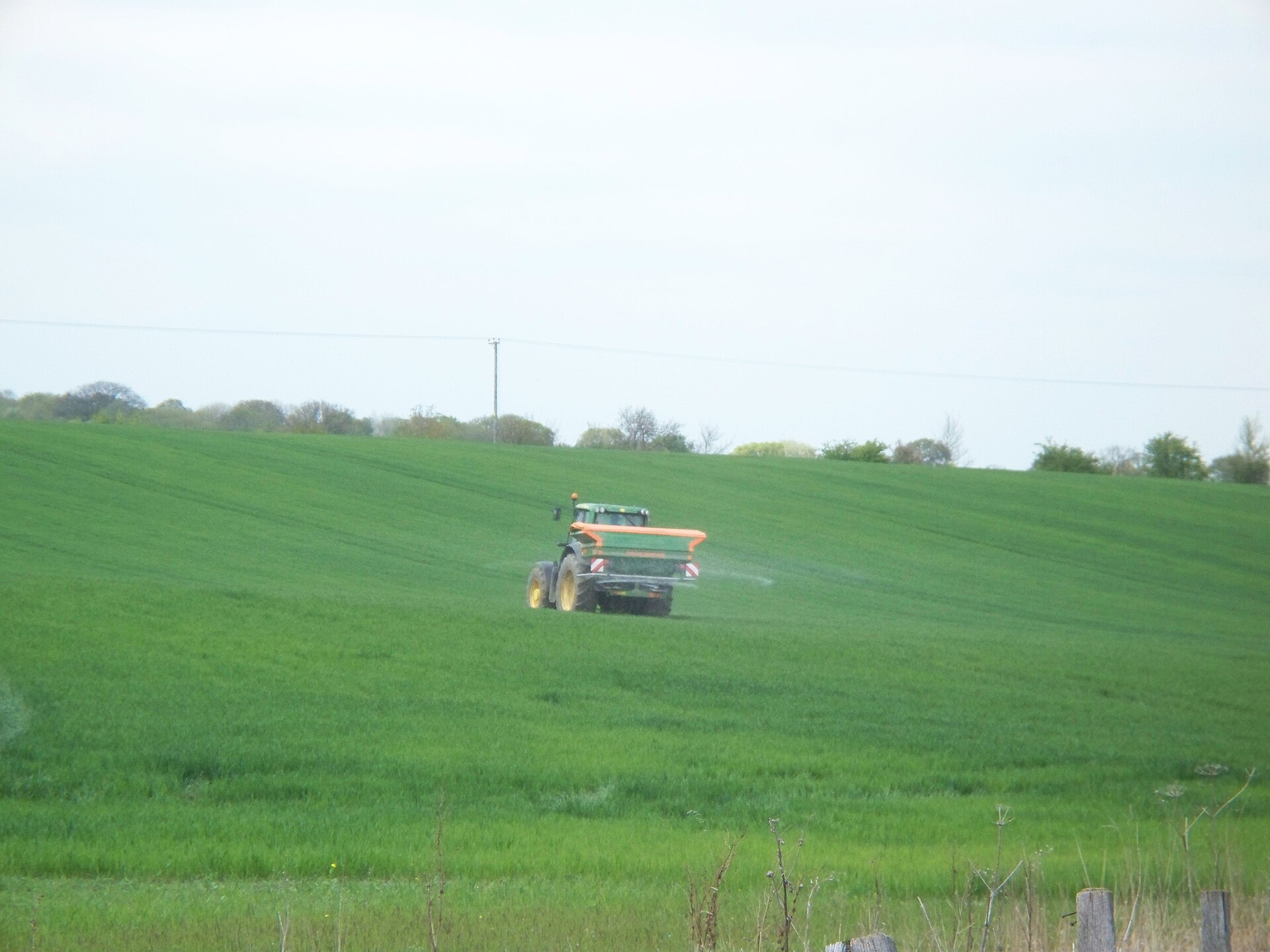
Photo: A tractor spreading fertiliser on a field (illustrative). Michael Dibb / Wikimedia Commons, CC BY-SA 2.0