Why potatoes are harder to feed than cereals
A potato crop is a poor forager. Its root system is shallow, sparse and concentrated in the top 30–40 cm of soil, while a wheat crop of comparable yield explores far more soil volume with a denser root network.
The consequence is practical: potatoes need more fertiliser than their nutrient removal alone would suggest. A crop that removes 200 kg of potassium per hectare may require considerably more applied, because much of what is in the soil never reaches the root.
This is why nutrition decisions in potato are less about hitting a total and more about placing the right nutrient, in the right form, within reach of the roots at the moment the crop can use it.
Weekdays. Unsubscribe in one click.
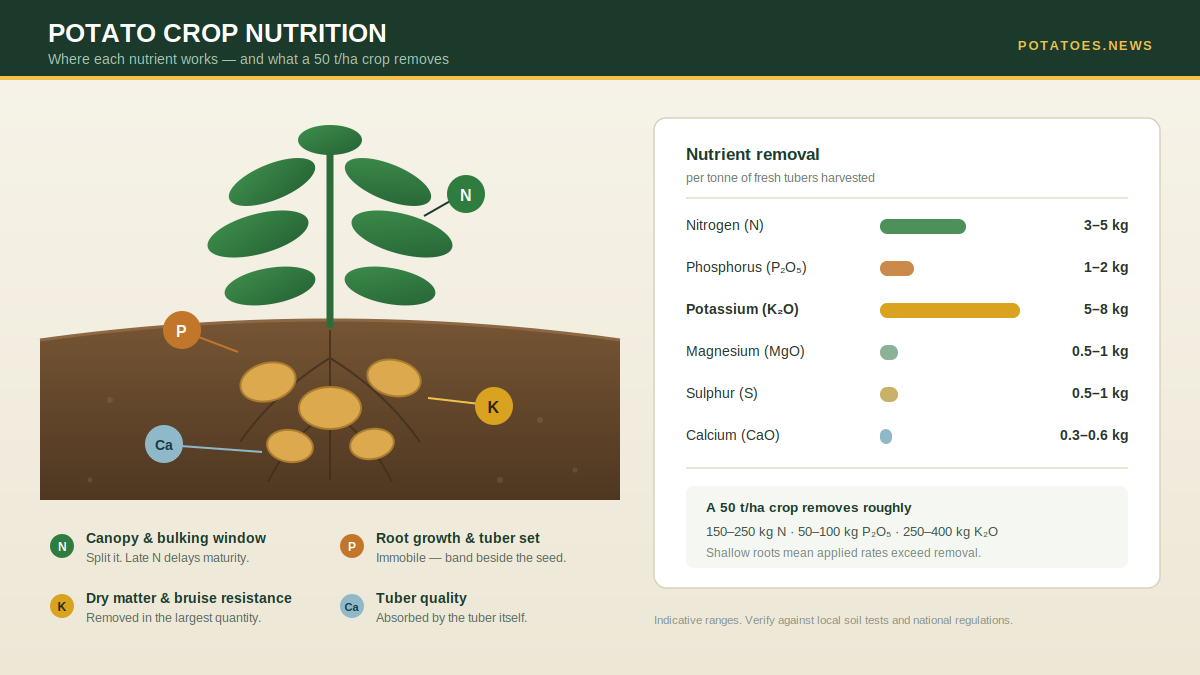
What a potato crop removes
Removal figures vary with variety, dry matter and yield, but useful working ranges per tonne of fresh tubers harvested:
| Nutrient | Removal per tonne of tubers |
|---|---|
| Nitrogen (N) | 3–5 kg |
| Phosphorus (P₂O₅) | 1–2 kg |
| Potassium (K₂O) | 5–8 kg |
| Magnesium (MgO) | 0.5–1 kg |
| Sulphur (S) | 0.5–1 kg |
| Calcium (CaO) | 0.3–0.6 kg |
A 50 t/ha crop therefore removes roughly 150–250 kg N, 50–100 kg P₂O₅ and 250–400 kg K₂O per hectare.
The headline is potassium. Potato is one of the most potassium-hungry crops in commercial agriculture, and K removal exceeds nitrogen removal in almost every system.
Nitrogen: the timing problem
Nitrogen drives canopy growth, and canopy drives yield. But the relationship is not linear, and the damage from excess is more subtle than the damage from deficiency.
Too little and the canopy closes late, senesces early, and the bulking window is short.
Too much, or too late, and the crop keeps investing in leaves when it should be filling tubers. Maturity is delayed, dry matter falls, skin set is poor at harvest, and processing quality suffers. In crisping crops this is the difference between a saleable and an unsaleable load.
Typical rates in intensive irrigated systems run 150–250 kg N/ha, with processing crops at the upper end and early ware crops lower. Rates below 100 kg N/ha are common in rainfed smallholder systems — often because of cost, not agronomy.
Splitting is standard practice. A base application at planting or emergence, followed by one or two top-dressings before tuber initiation. Applications after tuber initiation should be small and evidence-based.
Petiole nitrate testing is the standard in-season check in North American and European irrigated production: the fourth petiole from the growing point, sampled weekly, gives a direct read on crop nitrogen status and prevents both under- and over-application.
Potassium: the quality nutrient
Potassium does not just build yield. It governs tuber dry matter, bruise resistance, storage behaviour and — critically for processors — frying colour.
The chloride question matters more than most growers realise.
| Form | Chloride | Best for |
|---|---|---|
| MOP — muriate of potash, KCl | High | Ware and fresh market; cheapest per unit K |
| SOP — sulphate of potash, K₂SO₄ | None | Crisping, chipping, high dry matter crops |
Chloride depresses tuber dry matter and specific gravity. For a fresh market crop this is neutral or even desirable — the tubers hold more water and weigh more. For a crisping crop it is a defect, because low dry matter means more oil uptake and poorer texture.
Where MOP is used on processing crops, the usual compromise is to apply it well before planting, in autumn or early spring, so chloride leaches before tuber initiation.
Phosphorus: early and placed
Phosphorus is immobile in soil and most needed in the first weeks, when root development and tuber initiation are determined. Uptake is also temperature-sensitive: cold spring soils reduce availability sharply, which is why phosphorus deficiency often appears in crops on soils with adequate P reserves.
Banding at planting — placing starter fertiliser 5 cm to the side and below the seed piece — consistently outperforms broadcasting at the same rate, because it puts P where young roots will find it.
Rates are typically 60–150 kg P₂O₅/ha depending on soil test values, with high-fixing soils needing more.
Calcium, magnesium and sulphur
Calcium is where potato nutrition becomes counter-intuitive. Tubers do not receive calcium through the transpiration stream in the way leaves do — they are supplied through their own roots and the surrounding soil solution. Adequate calcium in the topsoil does not guarantee adequate calcium in the tuber.
Low tuber calcium is associated with internal brown spot, hollow heart and reduced storage resilience. Where these defects recur, calcium applied to the hill during bulking — gypsum or calcium nitrate — usually addresses it better than any base application.
Magnesium deficiency shows first on older, lower leaves: interveinal chlorosis progressing to necrosis. It is common on sandy, acidic soils and on crops receiving heavy potassium, because K and Mg compete for uptake. A high-K programme without magnesium correction is a recognised way to induce Mg deficiency.
Sulphur deficiency has become more common as atmospheric deposition has declined. Symptoms resemble nitrogen deficiency but appear on young leaves rather than old, because sulphur is not remobilised within the plant.
Micronutrients
| Nutrient | Deficiency risk | What you see |
|---|---|---|
| Boron | Sandy, high-pH, leached soils | Growth cracks, brown internal flecking, poor tuber set |
| Zinc | High pH, high phosphorus soils | Interveinal chlorosis, shortened internodes, rosetting |
| Manganese | High pH, organic soils | Interveinal chlorosis with dark speckling on young leaves |
| Iron | Calcareous soils | Uniform yellowing of youngest leaves, veins staying green |
| Copper | Peat and organic soils | Wilting tips, poor tuber skin quality |
Boron requires care. The gap between deficient and toxic is narrower than for any other micronutrient, and over-application damages the crop. Soil or tissue testing before applying is not optional.
Soil pH, and the scab trade-off
The agronomic optimum for potato is pH 5.0–6.5, lower than most rotational crops tolerate.
The reason is common scab. Streptomyces scabies becomes markedly more active above pH 5.5, and growers on scab-prone land deliberately hold soil acidic to suppress it — sometimes applying elemental sulphur or choosing ammonium sulphate as the nitrogen source specifically for its acidifying effect.
The trade-off is real: at low pH, phosphorus availability falls and manganese and aluminium can approach toxic levels. Where potato sits in a rotation with sugar beet or cereals, which prefer neutral soils, pH management becomes a rotation-level decision rather than a crop-level one.
How practice differs around the world
Northwest Europe — the Netherlands, Belgium, northern France, Germany. The highest yields in world production, and the tightest regulation. Nitrate directives cap nitrogen application and mandate record-keeping, so precision is a legal requirement as much as an economic one. Split nitrogen, high potassium, careful late-season restraint.
North America — the Pacific Northwest and Idaho. Fertigation through centre pivot is standard, allowing nitrogen and potassium to be applied in small increments through the season and adjusted on petiole test results. This is the most responsive nutrition system in commercial potato production.
India — the third largest producer. The characteristic problem is imbalance rather than shortage: nitrogen and phosphorus are applied generously while potassium is under-applied relative to removal, a pattern reinforced by subsidy structures. Since potassium governs the dry matter that chip processors pay for, the gap has direct commercial consequences in Punjab, Uttar Pradesh and Gujarat.
China — the largest producer by area. Historic over-application of nitrogen, now the subject of national efficiency programmes aimed at cutting rates without cutting yield.
Sub-Saharan Africa — Kenya, Ethiopia, Tanzania, Nigeria. Fertiliser is the binding constraint. Rates are frequently a fraction of removal, and yields sit far below potential as a direct result. Nutrition here is not an optimisation problem but an access problem.
Central Asia — Uzbekistan, Kazakhstan, Kyrgyzstan. Rapidly modernising, with drip irrigation and fertigation spreading through commercial operations while smallholder practice remains traditional.
Reading deficiencies in the field
| Symptom | Where it appears | Likely cause |
|---|---|---|
| Pale, uniform yellowing | Older leaves first | Nitrogen |
| Pale yellowing | Young leaves first | Sulphur |
| Interveinal chlorosis | Older leaves | Magnesium |
| Interveinal chlorosis | Young leaves | Manganese or iron |
| Marginal leaf scorch, bronzing | Older leaves | Potassium |
| Dark green, stunted, purpling | Whole plant | Phosphorus |
| Growth cracks, internal flecking | Tubers | Boron |
| Hollow heart, brown centre | Tubers | Calcium, or erratic growth rate |
A caution on visual diagnosis. By the time a deficiency is visible, yield has already been lost. Visual symptoms are useful for confirming a diagnosis and for planning next season — they are a poor basis for in-season correction. Soil testing before planting and tissue testing during the season are what actually prevent losses.
Note also that symptoms overlap. Potassium scorch and drought stress look similar. Manganese and iron deficiency are frequently confused. Where a management decision depends on the answer, laboratory confirmation is worth its cost.
Frequently asked questions
How much fertiliser does a potato crop need per hectare? In intensive irrigated systems, broadly 150–250 kg N, 60–150 kg P₂O₅ and 250–400 kg K₂O per hectare for a 50 t/ha crop. Local soil test values, variety and market destination shift all three substantially.
Why is potassium more important for potatoes than for cereals? Potassium regulates water movement and carbohydrate transport into tubers. It determines dry matter, bruise resistance and frying colour — the quality attributes processors pay for. Removal per tonne is also higher than nitrogen.
Can I use MOP on a processing crop? Yes, but apply it well ahead of planting so chloride has time to leach. For high-dry-matter crisping crops, SOP is the safer choice despite the higher cost.
Why do my tubers crack even though soil tests look fine? Growth cracks usually reflect erratic growth rate — irregular water supply — or boron deficiency. Check irrigation uniformity first, then tissue test for boron.
When should I stop applying nitrogen? Once tuber bulking is underway, further nitrogen mostly delays maturity. Applications after tuber initiation should be small and justified by petiole testing.
Does foliar feeding replace soil application? No. Foliar application corrects micronutrient deficiencies quickly and can supplement late-season demand, but the quantities involved are too small to meet a crop’s macronutrient requirement.
The practical summary
Get potassium right and get nitrogen timing right, and most of the crop’s nutritional performance follows. Phosphorus placement matters more than phosphorus rate. Calcium and boron are quality nutrients — they show up in the tuber, not the canopy. Everything else is correction.
And test. Soil testing before planting and tissue testing during the season cost a fraction of one wasted fertiliser application, and they are the difference between feeding a crop and guessing at it.
Rates and product choices in this article are general guidance. Fertiliser recommendations, permitted rates and product registrations vary by country — verify against local advisory services and regulations before planning a programme.
What does your nutrition programme look like this season? We publish field reports from growers worldwide — get in touch.