Physiological Age of Seed Tubers: Potato Research Review Confirms the Absence of a Rapid Pre-Planting Test
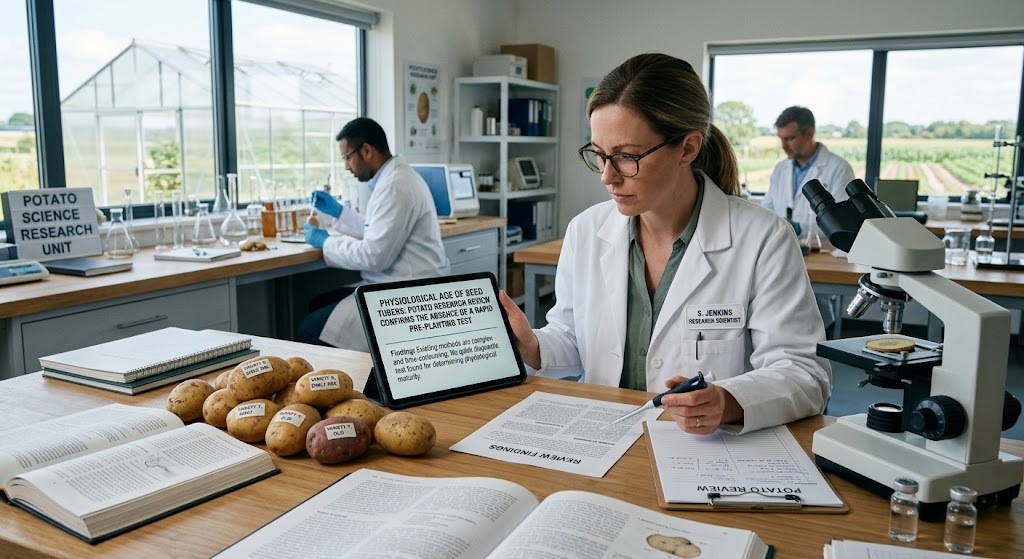
Two tubers of the same variety, lifted on the same day and certified to the same health standard, can produce different crops. Part of the reason is physiological age (p-age) — the internal developmental condition of the seed tuber. A review published in Potato Research on 17 July 2026 (Wagle, Swarts, Wilson, Tivendale; volume 69, article 152, open access) concludes that physiological age directly affects plant vigour, canopy development and final yield, yet most existing assessment methods are labour-intensive, slow and insufficiently robust for rapid decision-making under commercial conditions. A seed lot can be tested for pathogens, graded by size and verified for varietal identity. The industry still has no rapid, universally dependable test of planting readiness.
The mechanism of ageing
A tuber remains metabolically active after harvest: respiration and water loss cause a gradual decline in quality and weight as ageing advances. Dormancy typically lasts 5–19 weeks depending on cultivar and storage environment. Temperature is the principal regulator: above the usual base range of 2–4 °C, respiration rates rise, dormancy shortens and physiological ageing accelerates.
Ageing stages have characteristic sprout phenotypes: physiologically young tubers produce a few short, sturdy sprouts; intermediate tubers produce multiple, often branched sprouts; very old tubers produce elongated, fragile (“hairy”) sprouts indicating senility.
Weekdays. Unsubscribe in one click.
The agronomic consequence is direct. Young seed, under apical dominance, forms fewer stems and emerges more slowly, but builds a vigorous canopy with a longer bulking period, delayed senescence and fewer, larger daughter tubers. Older seed emerges earlier, forms more stems as apical dominance weakens, sets tubers sooner and yields a greater number of tubers of smaller average size because of increased intra-plant competition — favouring earliness, but potentially limiting final yield in long-season systems.
There is no universal optimum: younger seed suits processing markets seeking large tubers, older seed suits early markets and seed multiplication, and intermediate p-age represents a balance between the extremes.
What the field data show
The Netherlands. Zou et al. (Potato Research 68(1):187–217) evaluated four contrasting cultivars — Agria, Festien, Innovator and Lady Claire — across three sites in the Netherlands over three years, with differences in physiological age induced by storage at 4, 7, 10 and/or 17 °C. Cultivar-specific effects of storage temperature were evident during early growth stages and at 17 °C in the third cycle, while within the 4–10 °C range the influence was small or inconsistent. Overall effects on canopy cover, stem and tuber number, yield and quality were limited. The authors conclude that very high storage temperatures should be avoided in regions with long crop cycles, but that stringent cold-storage regimes are not necessary to achieve optimal growth vigour in the cultivars studied under temperate conditions.
Washington State, USA. Ogundiya, Nichol, Thurgood and Blauer, HortTechnology 35(5):699–709, 2025, Washington State University. According to the thesis work based on the same material, seed tubers of Caribou Russet, Dakota Russet and Laona were aged under controlled conditions to 80, 450 and 900 degree-days. Moderate ageing at 15.6 °C to 450 DD improved emergence, stem number and yield, while excessive ageing to 900 DD reduced performance; responses were cultivar-specific.
Kenya. Kwambai et al. (Potato Research 66(4):1091–1115, 2023) assessed 47 genotypes grown at three altitudes with three replications per location across two contrasting seasons, recording dormancy release, sprout number, sprout weight, sprout length and tuber weight loss. Dormancy duration ranged from 54 to 136 days, with strong genotype-by-environment interactions. Tubers grown at low altitude showed longer dormancy than those from higher sites, while genotypic differences in dormancy were highly consistent across environments. The local check Shangi averaged about 53.8 days to sprouting — the shortest in the set.
Why a rapid test still does not exist
Sprouting assays — the most widely used approach — involve incubating tubers in darkness and monitoring sprouting visually, typically over 2–3 weeks, with results strongly dependent on genotype, production location and storage history; ecodormancy can also mask internal ageing. The heat-accumulation method is calculated as p = t·(T−4), where t is the number of days since dormancy break and T the mean daily storage temperature. It is operationally simple, but lots with the same accumulated heat can show different dormancy durations and sprouting patterns; the method ignores ageing at and below 4 °C and does not account for cultivar-specific responses. The physiological age index (PAI) is the ratio of the period from haulm killing to the potential planting date to the period from haulm killing to the end of the incubation period (incubation in darkness at 17 °C and 90–95 % humidity), on a scale from 0 (young) to 1 (very old). It requires monitoring over more than a month and is labour-intensive.
The omics route is presented as promising but immature: the only clearly dedicated proteomic study linking post-harvest physiological ageing to the tuber proteome remains Delaplace et al. (2009), in which tubers stored for 270 days at 4 °C yielded 31 identified proteins from 43 selected differentially expressed spots.
The review’s authors state plainly that a single universal biomarker is unlikely, given genotype-by-environment interactions and variation in storage conditions; panels of indicators will probably be required. These methods are not intended for routine on-farm use, but for seed-testing and certification laboratories.
Practical conclusions for growers
Assessing a seed lot. Guidance from the New Brunswick Department of Agriculture (Canada) recommends taking representative samples from cold storage, moving them immediately into darkness at 15–18 °C, and recording the time required to reach the white-point stage, when sprouts just begin to emerge. This provides an estimate of the warming period required in store for that particular variety and lot. The test is not a laboratory diagnosis — it is a comparison between lots.
Interpretation by market objective. A single apical sprout means few main stems and a low tuber set; this stage suits growers wanting the crop to size early, but a reduced set should be expected. Multiple sprouting produces multi-stemmed plants with high tuber numbers and early maturity — the preferred outcome for a seed crop. Weak, branched sprouts signal excessive ageing: the plant will be weak and mature before maximum yield is reached, giving many small tubers at low harvest weight. In extreme cases ageing progresses so far that no plant emerges at all and small tubers form directly on the seed piece.
Warming regime and the risk of planting delay. Seed should not be planted directly from cold storage (4–5 °C); warming to 10–15 °C advances physiological age and promotes sprout formation, and with careful control of the warming period seed can reach planting at the white-point stage. Warmed tubers must be planted immediately, re-cooled or exposed to light as soon as sprouting begins, otherwise sprouts elongate. Long sprouts are tender and vulnerable to mechanical damage; if they break during planting, plant vigour is lost. Through-the-pile ventilation with a large volume of high-humidity air also helps slow sprout growth.
The link to profitability. Tuber number and size are largely determined by stem density: the higher the stem population, the more numerous and the smaller the tubers. Producing small whole seed requires more than 30 stems per square metre, while tablestock and processing crops require substantially lower stem densities. A shift in the physiological age of a lot shifts the size profile of the crop and, with it, compliance with a processor’s contract.
Limitations
The Dutch result does not transfer automatically to other conditions: it was obtained with four cultivars, under controlled seed production and in a temperate climate. In tropical and subtropical regions, where storage at ambient temperature is often unavoidable, tubers may age rapidly and sprout prematurely, requiring different strategies such as sprout suppression or shortened storage. The optimal physiological age is context-dependent and should be matched to market goals, season length and local growing conditions, with storage and handling tailored accordingly.
For growers buying in seed, the practical conclusion is that variety and grade do not describe the condition of the lot. The tuber carries with it the history of the field, the season, the store and the transport chain — and its physiological readiness to plant is currently neither certified nor quickly measurable.
Sources
- Wagle P., Swarts N., Wilson C., Tivendale N.D. Physiological Ageing of Potato Seed Tubers: Mechanisms, Assessment Challenges, and Emerging Omics-Based Solutions. Potato Research, 69, art. 152, 17 July 2026. https://link.springer.com/article/10.1007/s11540-026-10099-8
- Zou C., van der Putten P.E.L., Datema M., Mossink L., Lommen W.J.M., Struik P.C., van Ittersum M.K. Physiological Age of Potato Seed Tubers of Contrasting Cultivars Hardly Affects Crop Performance in a Temperate Climate. Potato Research, 68(1):187–217. https://link.springer.com/article/10.1007/s11540-024-09731-2
- Ogundiya O.O., Nichol N., Thurgood L., Blauer J.M. Physiological Aging under Commercial Conditions Enhances Performance of Three Potato Cultivars. HortTechnology, 35(5):699–709, 2025. https://journals.ashs.org/view/journals/horttech/35/5/article-p699.xml
- Ogundiya O.O. The Role of Temperature Stress on Potato Production Potential. MS thesis, Washington State University, December 2025. https://rex.libraries.wsu.edu/esploro/outputs/graduate/THE-ROLE-OF-TEMPERATURE-STRESS-ON/99901356976801842
- Kwambai T.K., Griffin D., Nyongesa M., Byrne S., Gorman M., Struik P.C. Dormancy and Physiological Age of Seed Tubers from a Diverse Set of Potato Cultivars Grown at Different Altitudes and in Different Seasons in Kenya. Potato Research, 66(4):1091–1115, 2023. https://link.springer.com/article/10.1007/s11540-023-09617-9
- Government of New Brunswick. Physiological Age and Seed Preparation. https://www2.gnb.ca/content/gnb/en/departments/10/agriculture/content/crops/potatoes/physiological_age.html