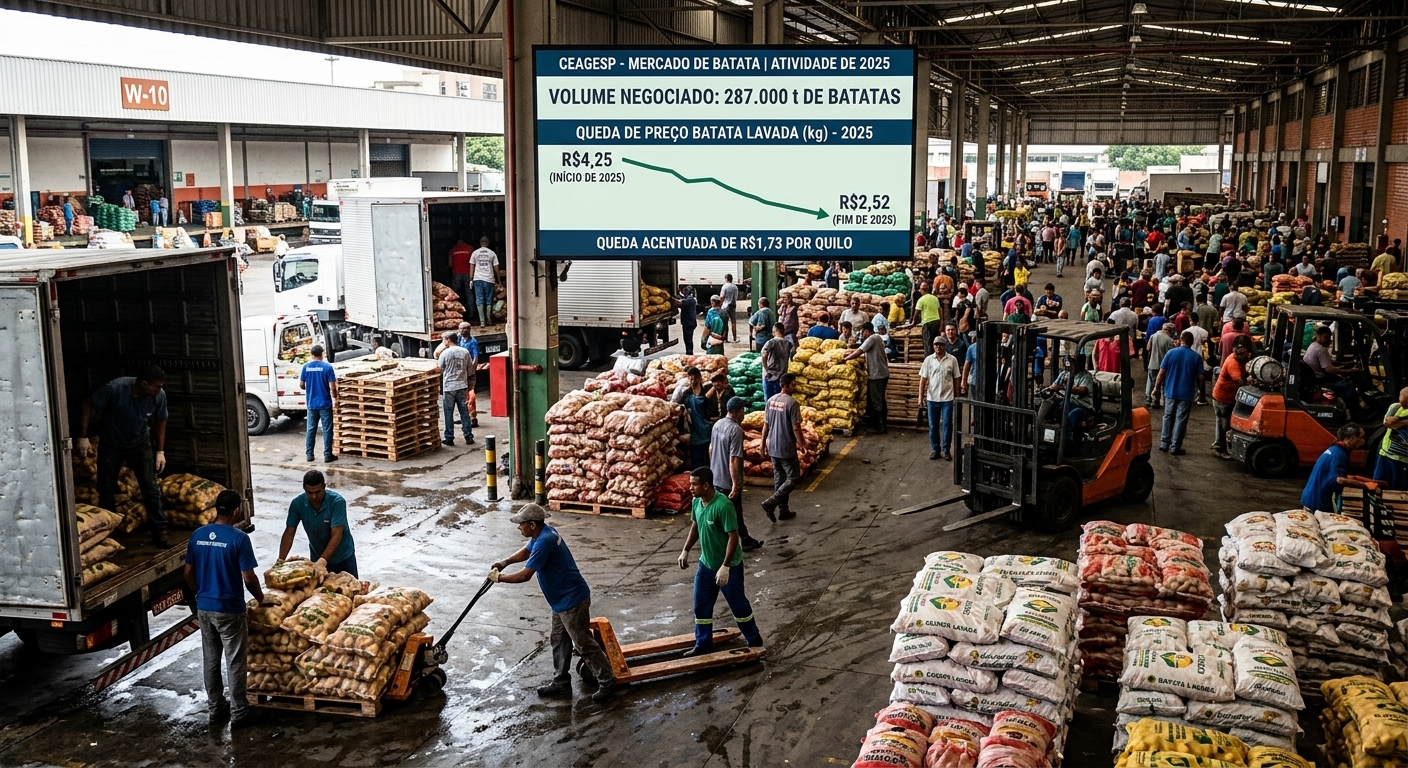
CEAGESP wholesale market: 287,000 t of potatoes traded in 2025 as washed-potato prices fall from R$4.25 to R$2.52/kg
After a supply-short 2024 that pushed the value of potato trade at Brazil’s largest wholesale market to a record, the 2025 supply recovery cut prices by more than 40% even as physical volume grew. The same CEAGESP study points to a structural weakness in the sales chain: washed potatoes dominate the market, and varietal identity is lost on the way to the consumer.
The scale of the market
In 2025 potatoes were the highest-volume single product traded at the CEAGESP terminal in São Paulo — roughly 287,000 t, or 9.5% of the terminal’s total turnover. Across the PROHORT/CONAB system, wholesale centres traded some 1.36 million tonnes of potatoes, of which CEAGESP accounted for about 21%.
By our calculation, 287,000 t at a 9.5% share implies a total terminal turnover of about 3.02 million tonnes, consistent with independent estimates putting CEAGESP’s annual throughput near 3 million tonnes of food with a financial turnover of around R$16 billion.
Weekdays. Unsubscribe in one click.
The authors are explicit that PROHORT figures cover only markets registered in the system and do not capture the whole of Brazilian trade. Direct purchasing by large retail chains from packing and conditioning facilities, in particular, falls outside the perimeter. The figure is therefore unsuitable as a proxy for national consumption.
From the 2024 price peak to the 2025 slump
In 2024 drought and flooding cut production and reduced potato availability. Scarcity drove the value of potatoes traded at CEAGESP to roughly R$1,135 million — a record built on price, not on volume.
The 2025 supply recovery reversed the picture. The annual average price of washed potatoes fell from R$4.25 to R$2.52 per kilogram, and the annual traded value dropped by approximately 36%.
By our calculation, working backwards gives a 2024 volume of about 267,000 t, meaning physical volume rose roughly 7.5% in 2025 while the average price fell 40.7%. CONAB data confirm the direction: in the 2025 annual results the roots, bulbs, tubers and rhizomes subgroup grew against an overall decline in vegetable turnover across the Ceasas network, driven by increased supply of potatoes and carrots.
The trend carried into 2026. In July the weighted average potato price across Brazilian Ceasas stood at R$2.97/kg, down 37.33% month on month, which CONAB attributes to the build-up of the winter crop.
Seasonality
Over the period analysed, monthly average prices peaked in May and June and bottomed out in September and October. Successive harvests across different producing regions sustain supply year-round but do not eliminate the swings.
The mechanism is consistent: May and June fall in the gap between the rain-fed and winter crops, aggravated by rainfall in Paraná and Minas Gerais that hampers lifting, while September and October coincide with peak winter-crop arrivals. In the last week of May 2024 this dynamic produced weekly price increases of 86% at CEAGESP São Paulo and 104% at CEAGESP Piracicaba.
Washed potatoes dominate, varieties disappear
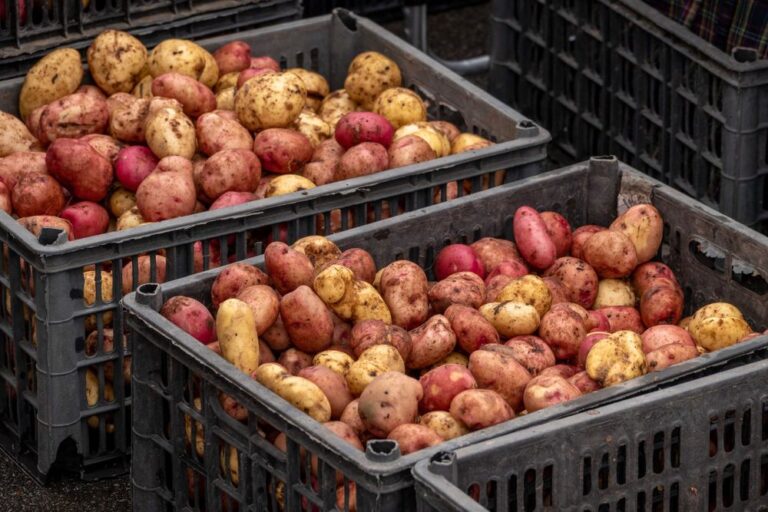
Roughly 80% of the traded volume is washed potato, predominantly Ágata and similar varieties. Brushed produce (Caesar, Markies) and the Asterix variety also feature.
The commercial nomenclature mixes conditioning method with varietal names. As a result, part of the varietal range is grouped under general categories that do not allow culinary differences to be recognised. Supermarkets and other self-service outlets prioritise washed potatoes and uniformity of presentation, leaving shoppers with little information on which to base a choice for a specific preparation. Street markets and specialist retailers can offer greater diversity and steer the purchase according to intended use.
For comparison: an earlier MAPA/ABBA study commissioned by CEAGESP wholesalers put the brushed segment at around 10% of terminal volume, noting that Brazil is one of the few potato-producing countries where virtually all fresh potatoes reach the market washed. That estimate relates to an earlier period.
An agronomic note from our side: washing removes the periderm’s natural protection and raises surface moisture, shortening shelf life and increasing the risk of soft rot and greening under retail lighting. The washed-plus-fast-turnover model works only where the field-to-shelf cycle is short, and it demands tighter discipline in harvesting, wound healing and temperature management than the brushed alternative.
The wholesale–retail gap
Comparing CEAGESP wholesale quotations with retail prices tracked by DIEESE in São Paulo gives an average mark-up of 137% across 2024 and 2025: for every real of wholesale price, the consumer paid an average of about R$2.37.
The authors state plainly that this differential covers transport, storage, losses, taxes, labour and other costs in addition to commercial profit, and cannot be read as net retail profitability. By our calculation, an average wholesale price of R$2.52/kg in 2025 implies an average retail price of roughly R$5.97/kg; the estimate is approximate, since the coefficient averages two years of very different market conditions.
HortiEscolha as a differentiation tool
CEAGESP, together with ESALQ/USP, runs the HortiEscolha programme, which guides institutional buyers, restaurants and catering operations in selecting produce on the basis of price, usable yield and preparation losses. The approach broadens the purchasing criterion beyond price per kilogram to include how much usable product is actually obtained and which characteristics each preparation requires. CEAGESP’s official portal hosts a potato variety guide and seasonality tables for volume and price at the terminal.
What this means in practice
Revenue is driven by scarcity, not volume. The 2024–2025 cycle showed a physical volume gain of roughly 7.5% accompanied by a 36% fall in traded value. Betting on gross yield in favourable weather years does not protect margin. The controllable levers are cost of production and timing of market entry: the May–June window carries the highest price premium, September–October the lowest.
Varietal labelling is the cheapest available source of added value. A classification that conflates conditioning method with variety suppresses any premium for culinary properties: a high-dry-matter variety suited to frying sells at the price of anonymous “washed”. Separate labelling with an indication of culinary use requires no agronomic investment. The limitation is channel-specific — the premium is realisable in HoReCa, institutional procurement and specialist retail, while chain retail built around uniform presentation resists segmentation.
The 137% mark-up is not intermediary profit. It reflects the cost of logistics, storage, losses and taxes. Shortening the chain through direct supply to HoReCa pays off only where the supplier holds its own storage and packing capacity.
For exporters, CEAGESP is a price reference, not a measure of market size. Direct purchasing by retail chains from packers does not enter PROHORT statistics, so the real Brazilian market is larger than the system reflects.