Argentina: Santa Fe market official links potato price volatility to the absence of standardised market information
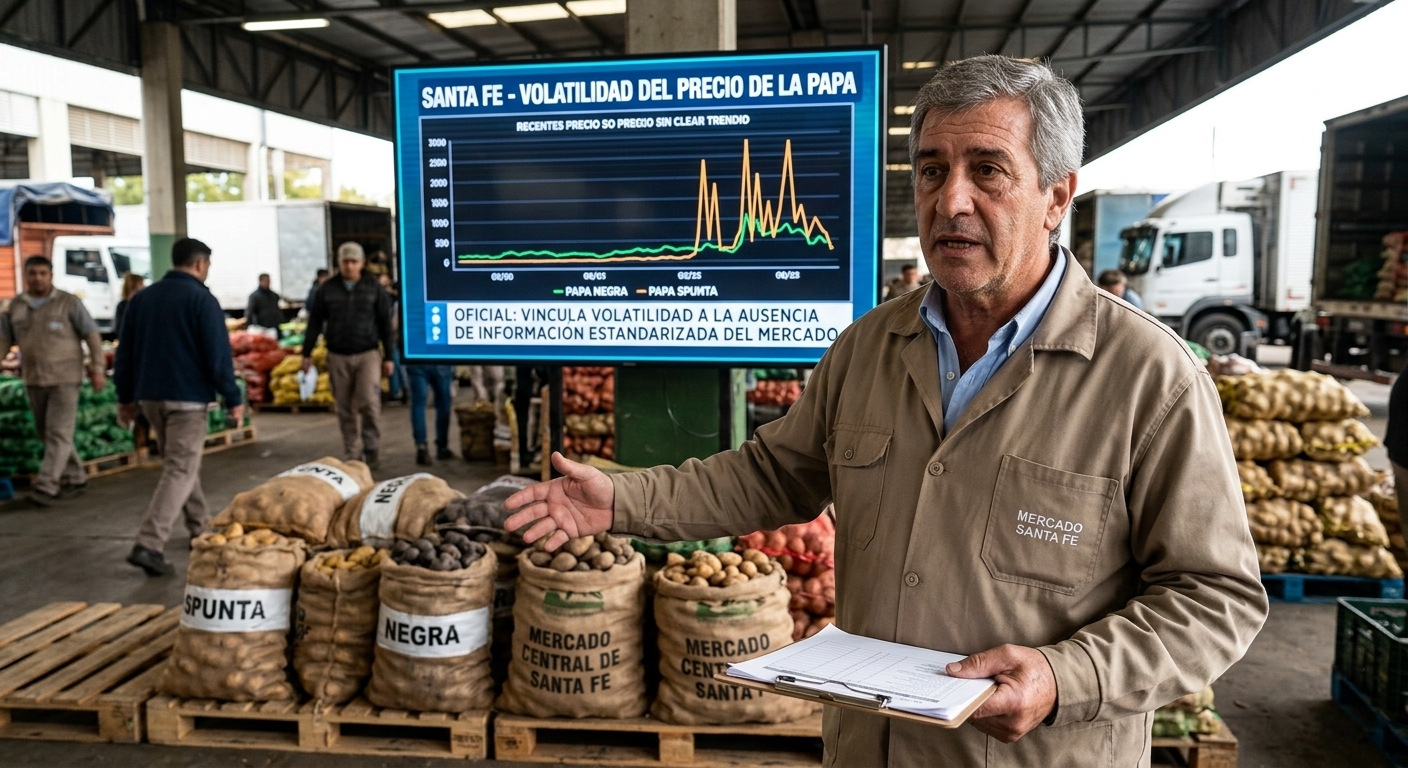
Argenpapa has launched a series of interviews with participants in Argentina’s potato chain. The first was Sebastián Novello, secretary of the board of the Santa Fe Market of Fruit, Vegetable and Horticultural Producers and Suppliers (MPASFE). His central argument: a significant share of wholesale trading decisions rests on partial data and informal reference points, which widens the price spread between transactions and amplifies volatility.
Price formation and information asymmetry
Novello describes price setting as a daily supply-and-demand balance overlaid with the volume of the incoming consignment, the production zone, the season, quality, size grade, variety, packaging type, transport costs, weather conditions and the urgency with which the grower or trader needs to sell. To this list he adds information asymmetry: decisions are frequently taken on informal references and scattered information about volumes, origin, quality and the values at which deals are actually struck.
The practical consequences he identifies:
Weekdays. Unsubscribe in one click.
Quality variation within a single package. Despite a decade of improvement in grading, washing and brushing, consignments still reach the market with substantial quality differences inside the same bag. The result is claims, losses and difficulty in setting a price.
Absence of labelling. Novello proposes identifying the grower or packer, zone of origin, variety, weight and quality category as the basis for product differentiation and traceability.
Absence of uniform commercial classification criteria. A general “potato price” with no reference to variety, size, quality category, origin and presentation is not a workable benchmark for either seller or buyer.
The proposed remedy is a shared information system linking the main markets and production zones, publishing daily arrival volumes, origin, varieties, quality categories and the ranges at which trades were actually executed. Digitalisation of transaction records and artificial-intelligence tools — forecasting shortages and oversupply, image-based tuber grading, logistics planning — are positioned as a layer built on top of that base rather than a substitute for it. Novello himself notes that such tools function only where the input data is reliable.
Quantitative context: August 2026 at the Buenos Aires Central Market
The scale of the volatility in question is illustrated by data from the Buenos Aires Central Market (MCBA) for August 2026.
| Date | Trucks | ARS per 18 kg bag | ARS/kg |
|---|---|---|---|
| 3 August | 77 | 27,000 | 1,500.00 |
| 10 August | 88 | 27,000 | 1,500.00 |
| 17 August | 112 | 23,000 | 1,277.78 |
| 24 August | 103 | 16,000 | 888.89 |
| 31 August | 96 | 18,000 | 1,000.00 |
Brushed Spunta, south-east Buenos Aires province, average price at the trading stalls (puestos). Source: Argenpapa’s daily register of prices and arrivals at MCBA.
The price fell 40.7% over three weeks, then recovered 12.5%, closing the month 33.3% below its starting level. In the potato hall (Nave de Papa), unbrushed produce from the same origin dropped from 24,000 to 14,500 pesos per bag (−39.6%), while brushed produce fell from 26,000 to 17,000 pesos (−34.6%).
The price trough fell on 24 August, whereas peak arrivals were recorded a week earlier, on 17 August (editorial calculation based on the figures above).
What already exists, and what does not
The gap Novello describes is not a complete absence of price data. MCBA’s Department of Information, Statistics and Transparency runs a regular wholesale price survey and publishes weekly reports analysing the drivers behind price movements. Argentina’s Ministry of Agriculture has issued a Monitor de Precios since 2019, comparing wholesale and retail values. The MCBA wholesale price series is available on the national open data portal.
What is missing is different: an inter-market network extending beyond MCBA to regional markets, broken down by variety, size grade and quality category, and publishing actual rather than nominal transaction ranges. That is the gap the interview describes.
Constraints on the proposed model
Three constraints go unaddressed in the interview.
The first is the conflict with informality, which Novello himself identifies as a feature of the segment. Publishing actual transaction prices requires registering them first — that is, formalising turnover — which runs against the interests of some market participants.
The second is implementation cost. Electronic recording of arrivals, sales, origin and destination requires capital investment and ongoing administration; no funding source is identified.
The third is the dependence of analytical models on input data quality. AI-based forecasting of shortages and oversupply yields nothing on an incomplete or distorted base. The sequence here is the reverse of the order in which such technology is usually presented: registration and classification first, analytics second.
Practical implications
For growers. Consignment labelling — producer, zone, variety, size grade, quality category — is not currently a regulatory requirement, but it remains a route out of average-price trading. When the price traverses a range of 16,000 to 27,000 pesos per bag within a single month, differentiating the consignment is one of the few profitability levers a grower controls.
For traders. Quality uniformity within the package translates directly into fewer claims and lower product losses. The cost of variation inside the bag is currently borne by both sides of the transaction.
For market analysts. Argentina’s wholesale potato market shows high price elasticity with respect to arrival volumes against a weak information infrastructure outside MCBA. Public data from regional markets is fragmentary, which limits the construction of national price indices by variety and quality category.
Sources: Argenpapa (interview, 2 September 2026; MCBA price review, 31 August 2026, based on its own daily register); Corporación del Mercado Central de Buenos Aires; Ministerio de Agricultura, Ganadería y Pesca de Argentina; datos.gob.ar open data portal.