Belarus: first liftings at Agro-Motol in Brest region yield 25 t/ha against a 30 t/ha benchmark
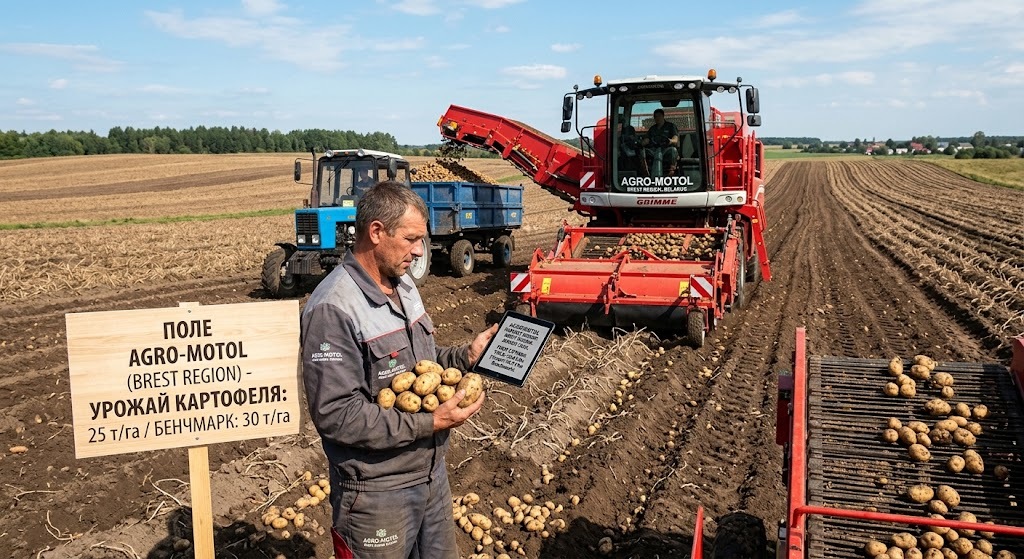
The farm expanded its potato area by 7% for 2026, but a June–July drought cut tuber bulking on light Polesie soils
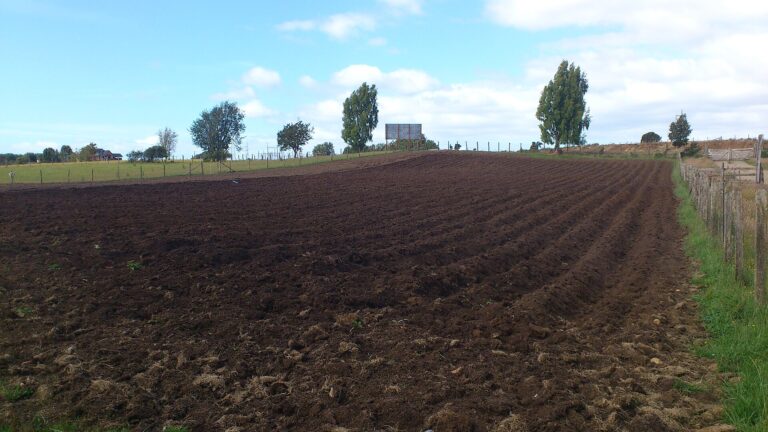
Agro-Motol, a seed-potato producer in Ivanovo district of Belarus’s Brest region, has increased its potato area from 535 ha in 2025 to 574 ha in 2026. As of 6 September roughly 20 ha had been lifted, yielding about 25 t/ha (250 c/ha) — below last season. That is around 3.5% of the planted area (editorial calculation), so the figure reflects early liftings rather than farm-level performance.
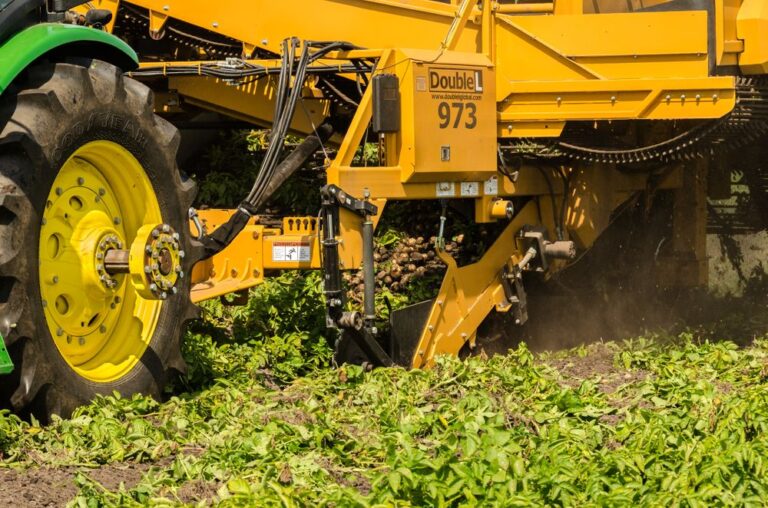
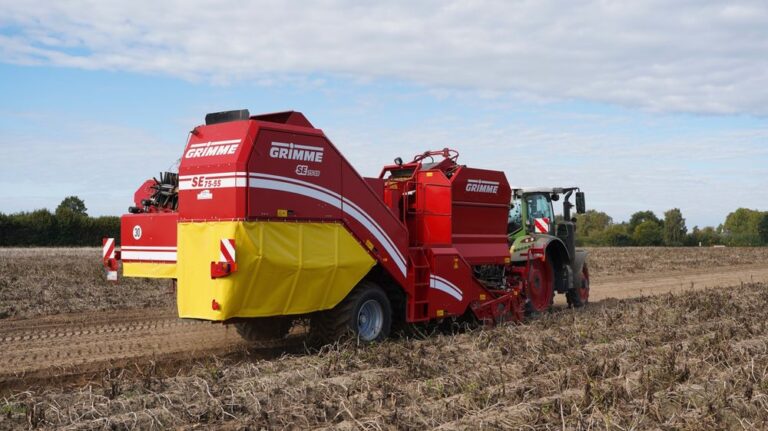
Chief agronomist Vasily Satsuta attributes the shortfall to severe drought in June and July, extending partly into August: with moisture lost at the critical stage, tubers failed to bulk. The farm still expects to reach its 2025 level of about 30 t/ha. Main harvest began on 3–4 September, with completion targeted before 1 October; a trial lifting was carried out on 23 July.
Weekdays. Unsubscribe in one click.
Agronomic context (editorial commentary). A moisture deficit in June and July coincides with tuber initiation and bulking, the period of peak water demand. Losses at this stage are not recovered by later rainfall: tuber number is already set, and mass accumulation is capped by the remaining growing period. Soil type compounds the effect — seed agronomist Maria Mikhovich notes the farm works lighter soils than neighbouring operations, which under an equal rainfall deficit means less plant-available water in the rooting zone.
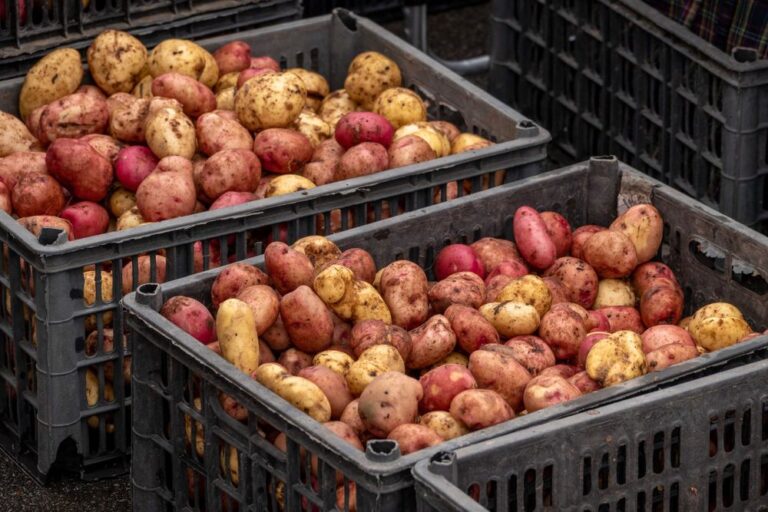
Cropping structure. Fourteen varieties were planted: earlies Colomba and Riviera; Belarusian-bred Skarb, Mastak, Vektar, Lileya, Boyarsky and Zdabytak; table varieties Gala and Soraya; and crisping varieties Madison and Lady Claire. Around 200 ha — about 35% of the potato area (editorial calculation) — is under crisping varieties, grown on processor contracts and selected on dry matter content. Roughly 40% of the potato area is under seed production, supported by an in-house microclonal propagation laboratory. Climate-controlled storage capacity is 12,000 t. Potatoes account for 5–7% of the enterprise’s total cropped area; cereals take 70%.
National picture. Per the Ministry of Agriculture and Food bulletin of 2 September, potatoes had been lifted from 6% of the area — over 1,000 ha of a 22,000 ha plan for agricultural organisations — for 53,000 t at an average 37 t/ha, up 1.1 t/ha year on year. Brest region accounted for 14,000 t, with Mogilev region leading at 24,000 t. The 37 t/ha and 25 t/ha figures are only loosely comparable: the national number averages all agricultural organisations across 6% of area, while the Agro-Motol figure covers 3.5% of one farm’s area on light south-western soils.
For reference, Belarusian agricultural organisations lifted 675,000 t in 2025 against 550,000 t in 2024, with Brest region at 132,000 t. Across all categories of holdings, the 2025 crop reached 3 million t at an average 21.9 t/ha.
Variety strategy. Yuliya Gunko, head of the potato breeding department at the NAS of Belarus Research and Practical Centre for Potato, Fruit and Vegetable Growing, expects the national crop to match last year, noting that central Belarus saw no severe drought. Her main recommendation is against relying on a single variety: maturity groups differ in when they accumulate yield, so a mixed portfolio raises the probability that at least one critical window catches rainfall. Her second point concerns the curing period — hold tubers 2–3 weeks after lifting to allow latent disease to express, then grade and move into long-term storage.
Practical implications
- Diversifying across maturity groups functions as insurance against drought in a specific month, not as a route to higher average yield. In 2026 in the south-west, growers whose bulking window missed June–July came out ahead; at Agro-Motol the best results are expected from table varieties.
- Curing is critical in a dry season. Dehydrated tubers with mechanical damage are an entry point for Fusarium dry rot and bacterial soft rots once loaded into a 12,000 t store.
- Crisping contracts are specified on dry matter. Drought typically raises DM but reduces marketable size grade — across 200 ha, the risk shifts from quality to contracted volume.
- Optical sorting remains out of reach for most farms. Agro-Motol does not use photo-separators, citing equipment cost, and retains manual grading on belts. The payback threshold is set by seasonal labour cost, not by line throughput.