
From Smoke to Soil: China Begins Turning Coal Plant Emissions into Fertilizer
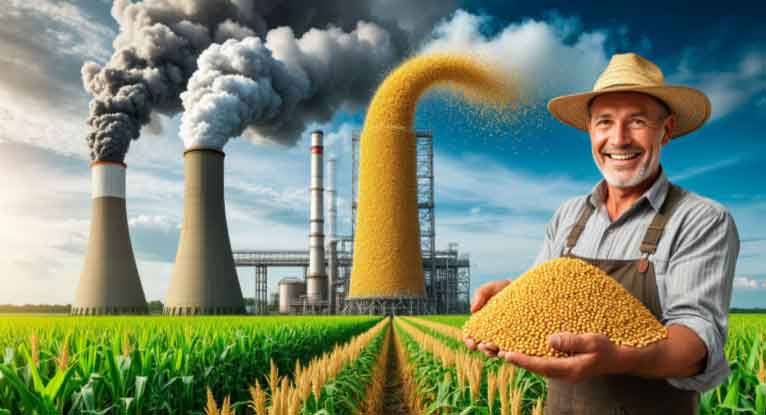
Since August 2025, a groundbreaking facility at the Jiufeng coal-fired power plant in Ningbo, Zhejiang province, has been capturing flue gas and converting it into mineral fertilizer. Developed by Jiangsu Jiangnan Ecological Carbon Technology Group, the installation uses an integrated ammonia-based cleaning process to capture both sulfur dioxide (SO₂) and carbon dioxide (CO₂) from coal combustion emissions. The principle is elegantly simple: first, ammonia binds with SO₂ to produce ammonium sulfate; then, it binds with CO₂ to produce ammonium bicarbonate. Additives are mixed in, and the resulting compound is granulated into fertilizer. The process achieves over 90% removal efficiency for both gases with no polluting byproducts. “We turn harmful air pollutants into soil nutrients,” explains project leader Sun Guangbin.
Field trials have demonstrated impressive agricultural and economic benefits. The Jiufeng facility is designed to capture 10,000 tons of CO₂ annually while producing approximately 30,000 tons of compound fertilizer containing 15% nitrogen, 5% phosphorus, 5% potassium, plus 5% sulfur and 10% carbon. Rice paddy tests conducted by the Ningbo Academy of Agricultural Sciences showed a 6.2% increase in yield compared to conventional fertilizers, while the cost-to-income ratio improved from 6.20 to 8.08. “Farmers spend less money, buy more fertilizer, and harvest more grain,” Sun concluded. Successful trials have also been conducted in Xinjiang, Jiangsu, and Inner Mongolia — one cotton farmer in Manas County was so satisfied with the results that he expanded his treated area to 6.7 hectares this year. Unlike costly carbon capture and storage methods that require specific geological conditions for burial, this Chinese innovation turns pollution into profit while enhancing soil fertility.