Global: Legume Cover Crops Lift Following Potato Yields by Up to 38% and Cut Nitrogen Need by 30 kg/ha
Studies collected in a 2025 review show potatoes after vetch, faba bean and other legumes yielded 12.7–38% more than after winter wheat, while oats alone lowered yields in one study.
Cover crops sown before potatoes can add nitrogen, protect soil in winter and reduce some soil-borne diseases. But research shows the effect depends strongly on which cover crop is used. Legumes often raise the next potato yield, while oats alone have been linked to lower yields.
A systematic review in Horticulturae (2025) by S. Xaba, Z. Bello, M. Rapiya and N. Z. Ngobese collected results from many field studies. According to studies cited in the review, potatoes grown after common vetch and faba bean gave 12.7% and 15.0% higher tuber yields than after a winter wheat cover crop. Another study found 36% to 38% higher yields after legume cover crops than after winter wheat. A third reported comparable or higher yields (10–25%) after winter pea or forage radish. After legumes, the economically optimal nitrogen rate for potatoes fell by 30 kg per hectare. In contrast, one study found that oats as the preceding cover crop led to lower potato yields.
Disease effects are also reported. In Maine, USA, work by Larkin cited in the review found that rotations with rapeseed, ryegrass, canola and barley reduced Rhizoctonia by 15–50%. Adding winter rye in the autumn reduced Rhizoctonia and common scab by a further 5–20%.
Weekdays. Unsubscribe in one click.
Older extension guidance points the same way. A McGill University Ecological Agriculture Projects guide by Jean Duval says the effect of a preceding cover crop can equal an application of 10 to 90 t/ha of manure, depending on whether the green manure was fertilised. It cites a University of Maine study where an oats-pea-vetch mix supplied up to 250 lb of nitrogen per acre for potatoes. The guide gives a seeding rate of 100–120 kg/ha for rye and 10–15 kg/ha for crucifers such as mustard.
Quality can improve too. In a chapter in Sustainable Potato Production: Global Case Studies (2012), Samuel Essah reported commercial farm trials from 2005–2008 in which green manure crops increased yield through larger tubers and reduced knobs, growth cracks and misshapen tubers.
Why it matters
Nitrogen fertiliser is one of the largest costs in potato production. A legume cover crop that cuts the nitrogen need by 30 kg per hectare and lifts yield can pay for its seed. A poorly chosen cover crop can do the opposite.
The review also lists limits: cover crops compete for water, can delay potato growth, may host pests and add labour. The choice of species, the date of incorporation and local disease risks should be tested on each farm.
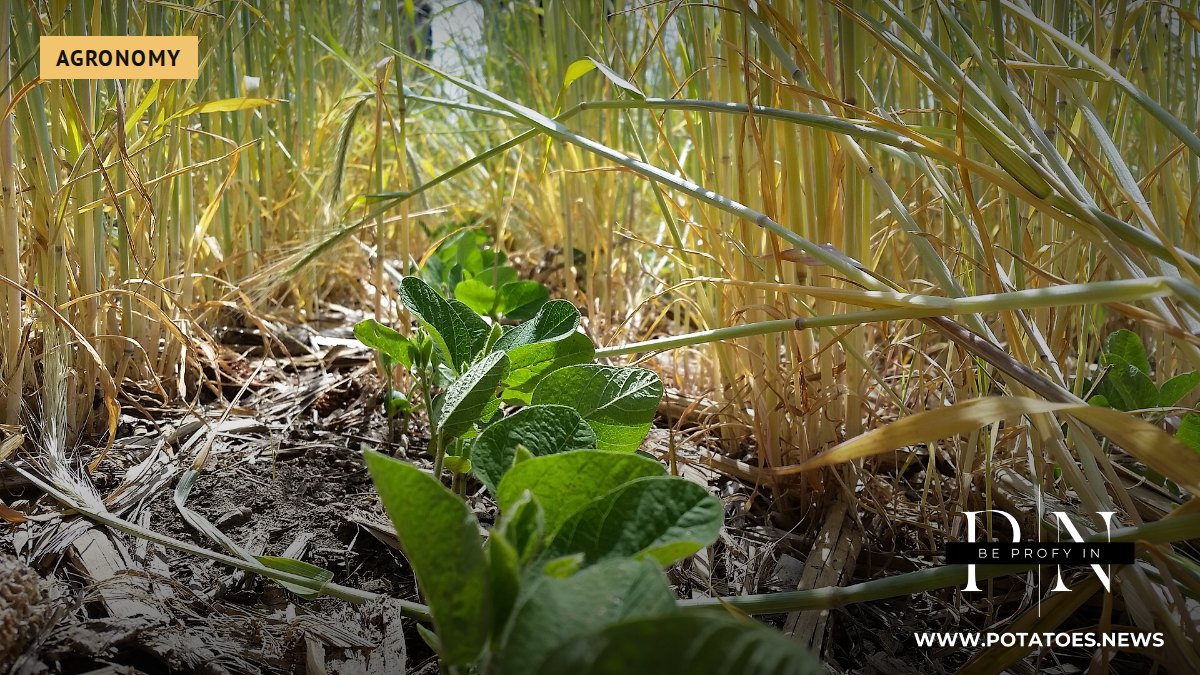
Photo: Crop emerging in a rye cover crop (illustrative). USDA NRCS South Dakota / Wikimedia Commons, Public domain