End-of-Season Price Rally: Why Potatoes in Russia Are Getting Cheaper, Yet Remain Above Last Year’s Levels
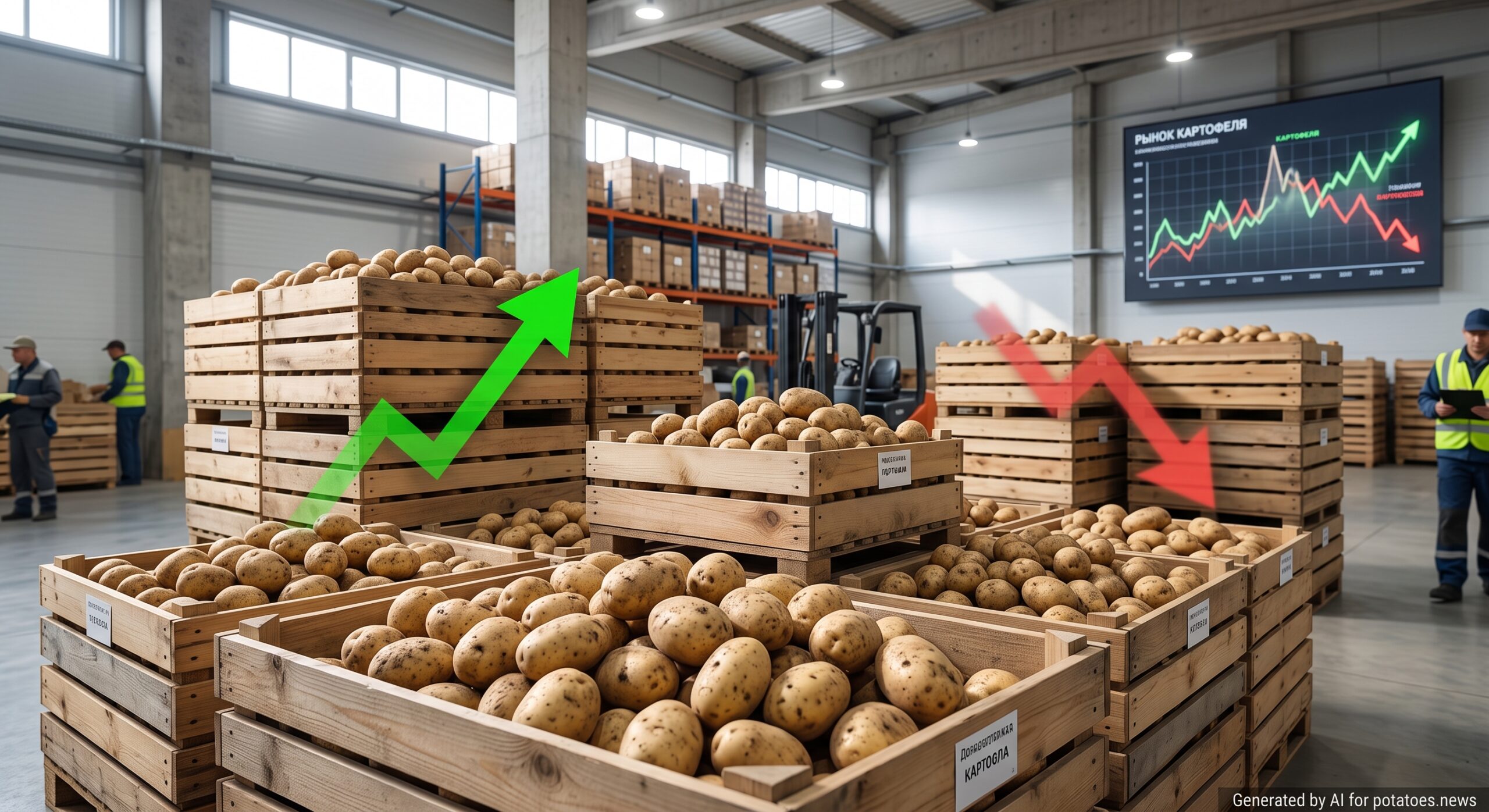
The massive deployment of machinery into the fields has expectedly cooled the Russian vegetable market. According to data from early September 2026, the selling prices of potato producers have rolled back by 12.3%, stopping at 26.3 rubles per kilogram. However, a fundamental rise in production costs hides behind this seasonal deflation: in annual terms, the “borscht set” is still trading at a 30-percent premium compared to last year.
Seasonal Dip or Market Correction?
September traditionally becomes the month of minimum prices in the open-field vegetable market. Farms and agricultural holdings lacking sufficient facilities for long-term climate-controlled storage strive to sell their harvest straight from the field as quickly as possible.
This trend is clearly reflected in the latest reports from the Ministry of Agriculture: the selling price for potatoes has dropped to 26.3 rubles/kg. The consumer sector reacted even more synchronously—retail prices for potatoes dropped by 16.5%, cabbage by 16.4%, while carrots and table beets lost 12.6% and 11.8% in retail, respectively.
Weekdays. Unsubscribe in one click.
As of September 7, farmers have already harvested about 1.6 million tons of open-field vegetables. The harvesting pace matches last year’s schedule, which is particularly notable given the challenging agro-climatic conditions (alternating droughts and excessive rainfall in key growing regions).
Investments in Food Security
Despite the current price dive, the macroeconomic indicators of the industry remain stable. By the end of 2025, the gross harvest of potatoes in the commercial sector amounted to a solid 8.5 million tons, and vegetables—7.6 million tons.
The main indicator for investors and the government is the self-sufficiency rate. The Food Security Doctrine of the Russian Federation sets the threshold for potatoes at 95%. The actual figure reached 97.9%. For vegetables, the level was 89.6% (against a norm of 90%). Thus, the market is almost completely isolated from the need to import table potatoes during the active season.
Long-Term Trend: Rising Costs Push the Bottom Up
The Ministry of Agriculture predicts a further price decline as the harvesting campaign accelerates. However, processors and retail should not expect a return to historical lows.
Looking at the dynamics since the beginning of the year, potatoes, cabbage, onions, and beets remain about 30% more expensive than in the same period last year (carrots are up by 40%). This gap is a direct consequence of growing operating costs in agribusiness. The increased cost of logistics, spare parts for imported machinery, crop protection products, as well as a shortage of line personnel for sorting, form a new economic reality in which the basic cost price of a kilogram of potatoes is steadily rising.