Seven Markets Assess U.S. Seed Potato Supply as Delivery Timing Becomes a Competitive Lever
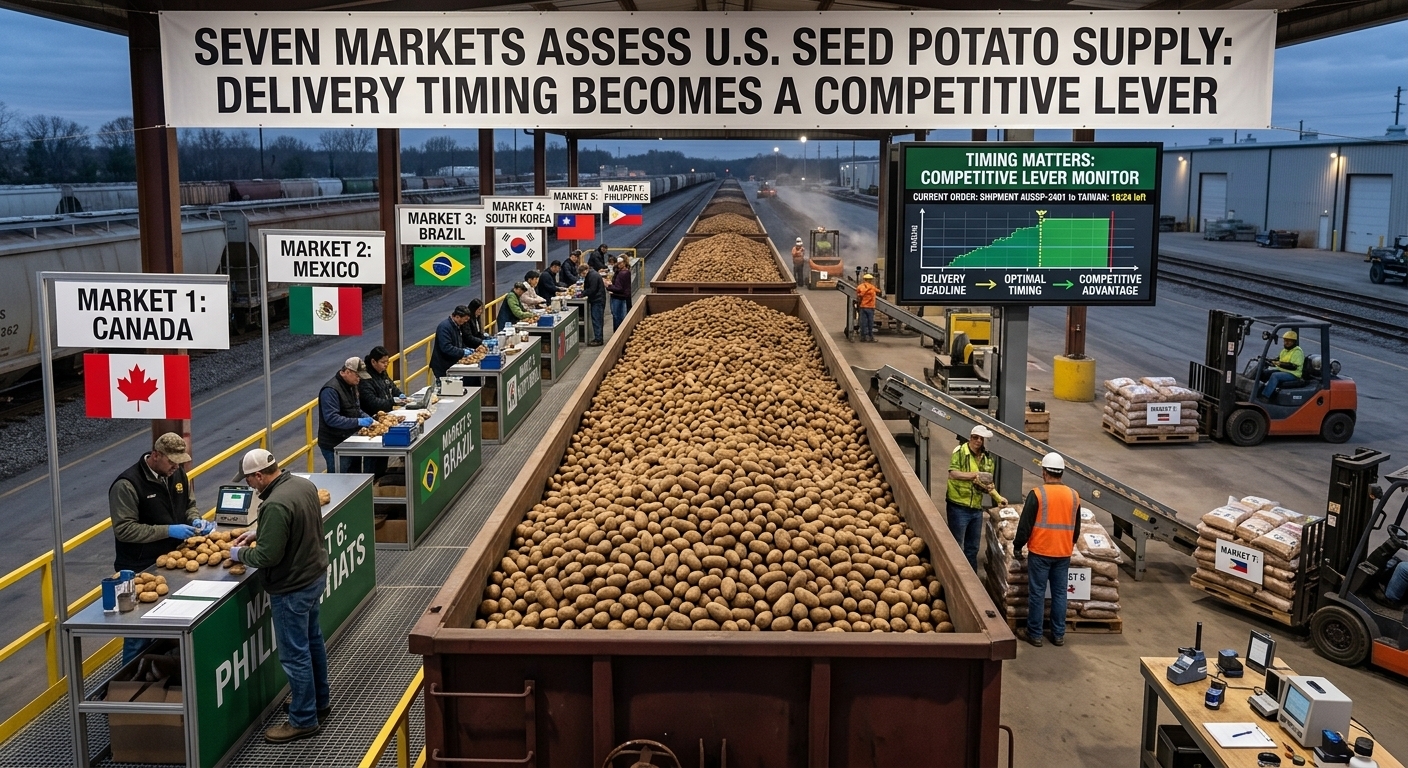
Potatoes USA has completed its biennial International Seed Symposium and Tour, hosting seed buyers, growers and government plant-health officials from seven countries across three continents. The African delegation comprised Namibia, Zambia and Senegal; the Dominican Republic represented the Caribbean; Honduras and Nicaragua came from Central America; and Uruguay from South America — the only South American participant. According to the organisation’s Seed Export Program newsletter, the 2026 symposium and tour were scheduled for 3–7 August 2026. FreshPlaza
Programme structure
The programme opened in Denver with a one-day seed symposium at which universities and seed companies holding variety intellectual property presented material suited to the participating markets, while delegates set out the characteristics of potato production in their own countries. The organiser’s own description of the format lists the technical agenda: seed production systems, certification standards, available varieties and the technical requirements of importing countries. FreshPlaza
The delegation then split into two groups, one travelling to Idaho and the other to North Carolina, visiting seed production operations, state certification programmes, university research and experiment stations, and commercial seed farms. FreshPlaza
Weekdays. Unsubscribe in one click.
The presence of national plant-protection officials alongside commercial buyers is structurally significant rather than ceremonial. In many importing countries, varieties must be officially registered before commercial sales can begin — which makes the regulator, not the buyer, the gatekeeper on market entry.
The U.S. argument: variety fit plus delivery window
Potatoes USA identifies variety availability, certification standards and production timing as the factors shaping the position of U.S. seed potatoes in export markets. Tim Rendall, who leads production research at the organisation, framed the proposition as a dual match — the right variety, delivered at the point in the calendar a given market needs it. FreshPlaza
The logistical case is specific. Geographic proximity allows U.S. suppliers to move seed to Central American markets faster than European suppliers, who currently hold a share of that trade. The organisation’s programme document generalises the point: in many export markets, the ability to deliver seed earlier than competing origins creates a significant competitive advantage and helps establish buyer relationships. FreshPlaza
What that means in practice emerged at a field day Potatoes USA held in May 2026. At Miraflor, Estelí, Nicaragua, growers raised the need for earlier access to high-quality seed during the August–October planting window, ahead of typical European supply availability. The same event, hosted at the farm of Freddys Osorio, featured commercial plantings of the U.S. varieties Soraya and Golden Globe alongside a Dutch control, with participation from growers in Estelí, Matagalpa and Jinotega, Nicaragua’s plant protection agency IPSA, the USDA Foreign Agricultural Service and the U.S. Embassy. Organisers reported that Soraya drew particular interest for its combination of yield, tuber quality and resilience under local disease pressure. That assessment comes from the party promoting the material; no independent trial data has been published.
Africa is positioned as the next expansion front. Projected population growth is cited as a factor in potential demand. An S&P Global assessment commissioned by Potatoes USA identified West Africa as a promising region, with U.S. shipments possible roughly four weeks earlier than European ones, and the organisation has received grant funding to develop markets including Senegal, Mali, Mauritania, Ivory Coast and Ghana. The study was industry-commissioned and should be read as such. FreshPlazaSpudman
Uruguay: three origins in two seasons
Uruguay’s participation is not exploratory. Potatoes USA reports that U.S. seed sales to Uruguay reached 400 metric tonnes in Market Year 2024. Potatoes USA
The background, as given by the supplier side: Uruguay had imported the Red Magic variety from France for several years before production problems there prompted a switch to U.S.-grown Red Magic, with continuing demand for new red-skinned varieties and for the standard variety Chieftain. Potatoes USA
A third origin opened in parallel. In June 2024, the Chilean firm Semillas SZ of Frutillar, in the Los Lagos region, shipped Uruguay its first 100 tonnes of seed potatoes — the varieties Memphis and Red Scarlett — following years of work to harmonise technical and phytosanitary protocols between the two countries; the same season the company planned 350 tonnes of Asterix for Brazil. General manager Rodrigo Cea attributed the improving outlook for Chilean exports to difficulties affecting European seed potato producers, who supply a large share of world demand. potatopropotatopro
Within two seasons, in other words, a market supplied largely from Europe has become a three-origin market.
What this means in the field
Competition has shifted from genetics toward the delivery calendar. The contest between origins is decided less by variety merit than by arrival relative to the planting window. Buyers assessing suppliers should now weight ship date alongside agronomic characteristics — the Nicaraguan August–October window is a concrete illustration, where a shipment that lands in November has no commercial value regardless of variety.
Registration, not price, is the entry barrier. Timelines are long: Cuba requires at least four years for variety registration. Exporters should budget three to five years between first in-country trials and regular commercial volumes, and treat engagement with national plant-protection agencies as a precondition rather than a formality. Potatoes USA
Origin diversification is becoming structural, not cyclical. The Uruguayan case shows the mechanism: a disruption at a single supplier triggers a search for alternatives, and once phytosanitary protocols with a new origin are agreed, they remain in place after the original channel recovers. For European seed producers, market share lost in a poor season does not return automatically.
Constraints. A timing advantage does not neutralise differences in phytosanitary requirements, material cost or logistical risk. Varietal suitability to local soil and climate conditions is established only by multi-season in-country trials; the variety assessments cited above were generated at demonstrations run by an organisation with a commercial interest in the outcome.