Chilean researchers to validate single-test diagnosis for powdery and common scab
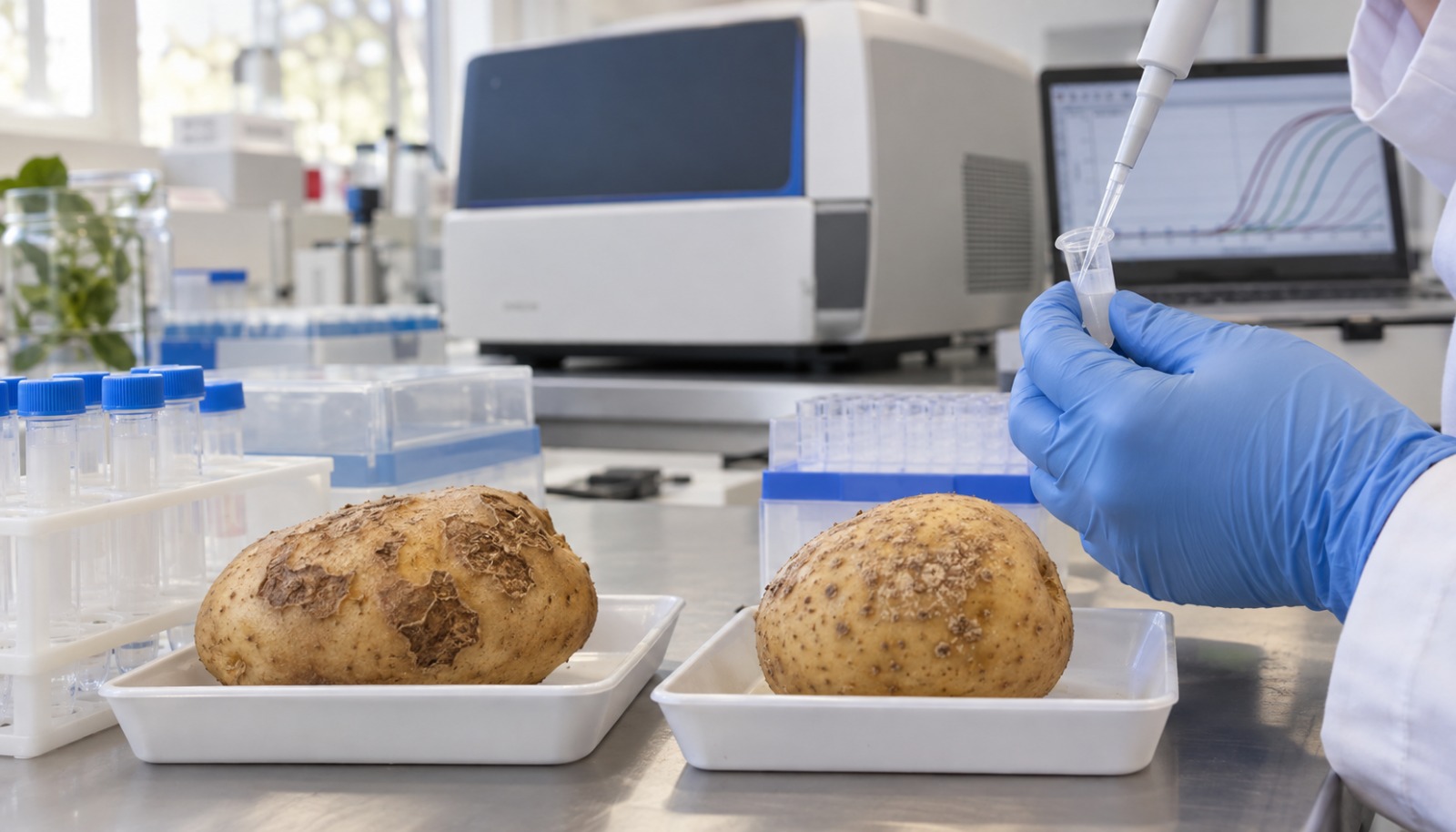
A team at the Pontifical Catholic University of Chile (UC) has secured FONDEF funding to turn SCAB-ID 2.0, a multiplex qPCR assay that detects and distinguishes the pathogens behind powdery scab and common scab, into a standardised tool for agricultural diagnostic laboratories.
Powdery scab and common scab are among the most frequently confused tuber blemish diseases. Both produce superficial lesions that downgrade skin quality, and symptoms alone are often not enough for a reliable diagnosis. Yet the causal organisms are unrelated. Powdery scab is caused by Spongospora subterranea, an obligate soil-borne plasmodiophorid. Common scab is caused by pathogenic Streptomyces bacteria, principally Streptomyces scabiei.
The distinction has practical consequences. The two diseases respond in opposite ways to soil moisture: keeping soil wet during tuber initiation is a standard measure against common scab, but the same conditions favour powdery scab. A misdiagnosis can therefore lead growers to manage one disease in a way that encourages the other.
Weekdays. Unsubscribe in one click.
From PhD protocol to laboratory tool
The project, based at UC’s Faculty of Agronomy and Natural Systems, was selected in the 2026 IDeA Technology Research competition run by FONDEF, the applied research programme of Chile’s National Research and Development Agency (ANID). It is led by Stephanie Riquelme, a graduate of UC’s doctoral programme in plant biotechnology. Marlene Rosales is the alternate director and Sara Acevedo joins as a researcher.
SCAB-ID 2.0 builds on a protocol Riquelme developed during her doctoral research. The assay runs a single multiplex qPCR reaction that identifies which of the two pathogens is present in a potato sample. The new phase aims to validate it under operational conditions, adding criteria for reproducibility, quality control and traceability, together with a transfer package to support its adoption by an agricultural diagnostic laboratory.
Riquelme said that a specific diagnosis made it possible to determine more precisely which agent was present in a sample and provided information useful both for phytosanitary assessment and for production and crop management decisions. The aim, she added, was a reproducible tool able to detect and differentiate both agents simultaneously in potato samples.
Scale of the funding
ANID’s call terms give an indication of the project’s scope. Grants under the 2026 IDeA Technology Research competition are capped at CLP 237 million per project over a maximum of 24 months, with beneficiary institutions required to co-finance at least 15% of the requested subsidy. Projects are expected to deliver an advanced prototype with a measurable gain in technology readiness. The amount awarded to SCAB-ID 2.0 and the identity of the laboratory expected to adopt the technology have not been disclosed.
Why it matters for seed potatoes
The team expects more accurate diagnosis to support phytosanitary decisions, lot assessment and segregation, and certification procedures.
The strongest case is in seed potato production. There is no effective chemical control for powdery scab, and the pathogen’s resting spores can survive in soil for many years. S. subterranea also transmits potato mop-top virus (PMTV), which causes internal necrosis in tubers. Because the main line of defence is to keep the pathogen off clean land, reliable laboratory identification at the seed lot stage has direct economic value.
One question remains open on the common scab side. The disease is caused by a group of pathogenic Streptomyces species, including S. acidiscabies and S. turgidiscabies as well as S. scabiei. The published project description names S. scabiei as the main agent but does not say whether the assay also detects the other species. That will be an important factor in how useful SCAB-ID 2.0 proves as a certification tool.
Source: Pontificia Universidad Católica de Chile / ANID project description