Belarus potato harvest passes one-third mark as Brest region doubles output in three days
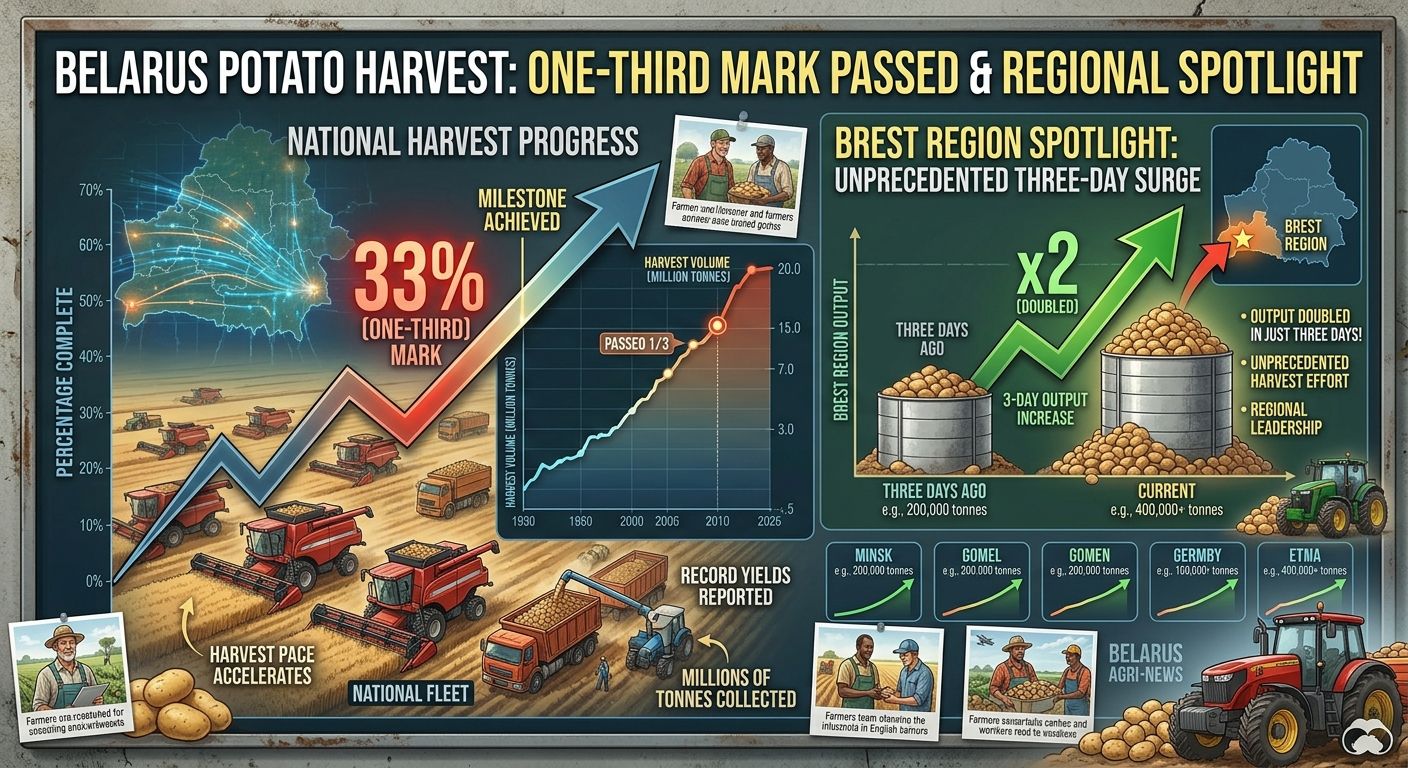
Minsk, 21 September 2026. Belarusian farms had lifted potatoes from 36% of their planned area by 21 September, according to operational data from the Ministry of Agriculture and Food reported by the state news agency BelTA. Output so far stands at 272,000 tonnes, with an average yield of 34.4 t/ha.
The pace has picked up. Only three days earlier, on 18 September, the ministry reported 28% of the area harvested, 212,000 tonnes lifted and an average yield of 34.0 t/ha. That means 60,000 tonnes were added in three days, or roughly 20,000 tonnes a day.
Brest drives the latest gains
Mogilev region remains the largest contributor, but Brest in the south-west accounted for almost half of the recent increase. Its harvested volume doubled from 28,000 to 56,000 tonnes between the two reports.
Weekdays. Unsubscribe in one click.
| Region | 18 Sept, ‘000 t | 21 Sept, ‘000 t | Change, ‘000 t |
|---|---|---|---|
| Mogilev | 69 | 78 | +9 |
| Minsk | 52 | 65 | +13 |
| Brest | 28 | 56 | +28 |
| Gomel | 26 | 29 | +3 |
| Grodno | 19 | 24 | +5 |
| Vitebsk | 18 | 20 | +2 |
| Total | 212 | 272 | +60 |
Source: Ministry of Agriculture and Food of Belarus, via BelTA.
Mogilev’s share of the national total has fallen from 33% to 29% as other regions catch up. Gomel and Vitebsk recorded the smallest gains.
Reading the figures with care
The data cover only part of Belarusian potato production, so international readers should read them with that in mind.
Farm scope. Dividing output by yield gives a harvested area of about 7,900 ha. That implies a total planned area of roughly 22,000 ha (editorial calculation). This matches the organised agricultural sector, meaning large collective and state-linked farms. In Belarus, as in much of the former Soviet Union, most potatoes are traditionally grown on household plots. These are small private gardens and smallholdings that feed their owners’ families and local markets, and they fall outside these operational reports. The 272,000 tonnes are therefore not an estimate of the national crop.
Yield. The average yield is calculated only on fields already harvested. It shifts as the campaign moves across regions and soil types, so the rise from 34.0 to 34.4 t/ha mainly reflects which fields were lifted in those three days. It does not forecast the final result.
The Russian market
Russia is the main outlet for Belarusian agricultural exports, and its market has tightened this season. Prices have since eased as the Russian harvest has gathered pace. The Russian Ministry of Agriculture reported a 12.3% fall in the average price over the month to 2 September.
The market is not in shortage, however. In 2025 Russia’s organised sector produced 8.5 million tonnes of potatoes, and the country’s potato self-sufficiency reached 97.9%, above the government’s 95% target. Russian media, citing the agriculture ministry and the Potato Union, report forecasts of around 8 million tonnes for 2026. Some analysts expect as little as 7.5 million tonnes.
Firmer prices in Russia could support demand for Belarusian potatoes, but no official data on this season’s trade flows have yet been published. Any price advantage is also likely to narrow as more Russian supply reaches the market.