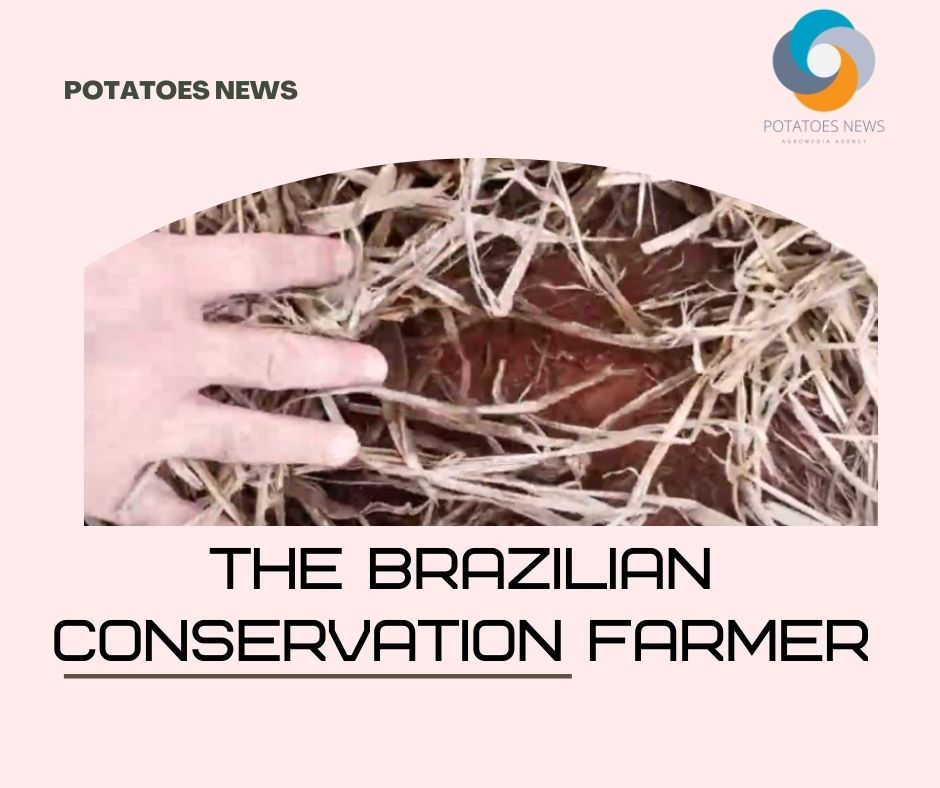
“As a conservation farmer, the practices we use on our farm are allowing us to ‘kidnap carbon’ from the atmosphere and store it in our soil. This makes me a better farmer. The practice of carbon farming supports my efforts to grow more food and help the environment at the same time,” writes Andre-Figueiredo Dobashi in this article published by Global Farmer Network. The article is titled “I’m a conservation farmer who kidnaps carbon for good“.
We republish Dobashi’s full article below, courtesy of Global Farmer Network.
The word “kidnapping” of course captures the attention of listeners. It puts them on guard. That’s why I use it. Most people have no idea that farmers routinely grab carbon dioxide out of the atmosphere—and that as we do, we’re fighting the harmful effects of climate change.
Weekdays. Unsubscribe in one click.
As farmers, we need them to understand what’s going on.
Part of our challenge is that the public, including many public officials, don’t know enough about the science of carbon farming and how it is allowing farmers to be part of the solution to climate change. When scientists try to explain why it is important to capture carbon, they tend to complicate the issue by using words such as “sequestration” that many people do not understand.
Have you ever heard anybody in a normal conversation say “sequestration”?
This is the kind of word that you discover in a study guide for a university entrance test, rather than one that you use in everyday talk with family and friends.
That’s why, as farmers, we need to find new ways to describe the process of carbon sequestration. With the idea of “carbon kidnapping,” I’ve chosen a metaphor. The power of metaphors is to let a vivid comparison understood by many help people see the original concept more clearly. The specific metaphor of carbon kidnapping can improve knowledge of actual science.
So, I’m a carbon kidnapper. Using carbon-smart practices on our farm, we are growing more food, increasing organic matter so the soil is healthier and using fewer inputs to do all of this good work.
Technically, I’m the leader of this mission. My crops do most of the work. They’re the real kidnappers.
Through an ordinary biological process, crops pull carbon dioxide out of the atmosphere. Then they push it down through their roots and deposit the carbon into the soil. That’s where it is held hostage and does the most good.
There are actually several good outcomes. First, carbon farming contributes to plant growth, which means that my corn and soybeans flourish. As my yields increase, and my input costs decrease, my economic fortunes rise allowing us to make continual improvements to our carbon farming practices.
Second, carbon farming improves my farm’s long-term soil health. It enriches the organic content in my fields, helps the soil retain moisture, and helps prevent soil erosion by holding the soil in place.
Third, it reduces the harmful effects of climate change. The greenhouse gases that emit from smokestacks and exhaust pipes fuel much of the problem. Carbon kidnapping on farms works in the opposite direction, sucking carbon out of the air and storing it below our feet.
The simple act of growing crops makes me a carbon farmer—but on our farm, we take extra steps to do an even better job. We’ve adopted no-till, which means we keep the soil intact rather than turn it over. By refusing to disrupt it, we do a better job of locking carbon in the dirt. We also use a crop rotation system and plant cover crops – I call them kidnapper crops – that don’t become food but, because of photosynthesis, convert carbon from the air, sink it into the soil and turn it into energy for plant growth.
Successful carbon kidnappers pay close attention to the ‘ransom’ they expect. In other words, we measure what we do. It starts with a baseline. How much carbon is in the soil right now? Then we check and double check and triple check—three measurements per season—to see how our fields perform.
To do this, we can access some state-of-the-art tools available through science-based soil labs to specifically measure how much more carbon is present in the soil. These types of tools will become even more common as we improve rural internet connectivity, allowing farmers in remote areas to measure the carbon, share the results online and carry on the sophisticated work of 21st-century agriculture.
As we study the results, we learn what works and what doesn’t. We can adjust our practices and improve what we do.
For many years, climate activists have criticized agriculture and farmers as part of the climate change problem, ultimately determining policies and laws that inhibit our work. Yet we are in fact a part of the solution to the dilemma of climate change.
By sharing our “carbon kidnapping” story, we are changing the narrative and helping society understand that carbon farming is the best deal in the world for all of us.