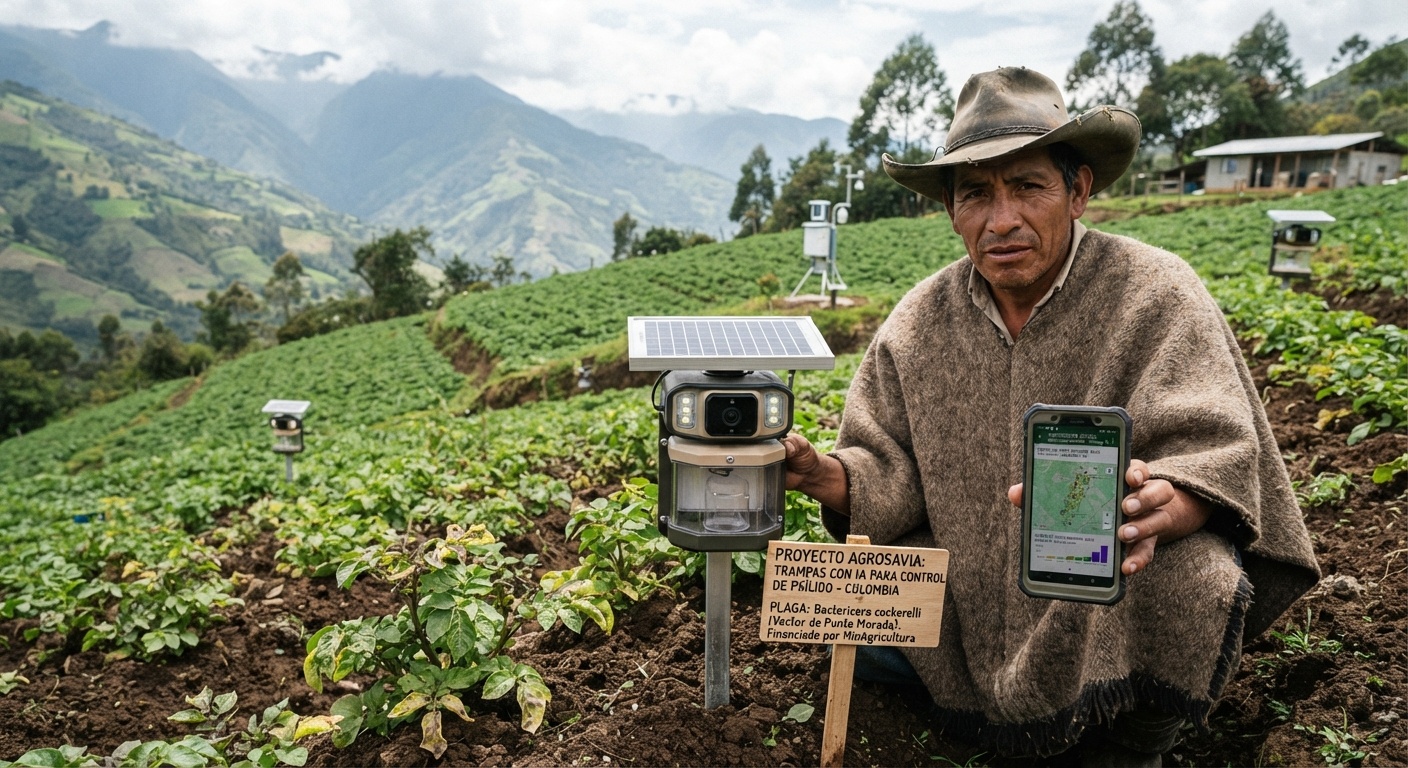
Colombia’s plant health authority is looking at automated insect traps as a possible upgrade to its monitoring of Bactericera cockerelli, the potato psyllid that spreads the pathogens behind purple top (punta morada) and zebra chip. No trial has been approved yet: the Colombian Agricultural Institute (ICA) said it would first evaluate the technology in the field before deciding whether to adopt it.
How the idea arose
The proposal emerged at EIMA International, the agricultural machinery show held in Bologna, Italy, on 10–14 November. According to ICA, its general manager, Carlos Eduardo Campo Cuello, and the president of the national potato growers’ federation Fedepapa, Richard Sánchez, met three agritech companies there. The companies were not named.
The traps shown to the delegation are solar-powered. They lure insects, photograph them and use artificial intelligence to count the catch. Alerts feed into an online platform that maps where insects are being caught. The announcement gives no timeline, location or design for a pilot.
Weekdays. Unsubscribe in one click.
Why monitoring matters
B. cockerelli is regarded as the main vector of the phytoplasmas that cause purple top and of the bacterium Candidatus Liberibacter solanacearum, which causes zebra chip. ICA states that crop losses from the disease complex can reach 100%.
In Colombia, the disease and its vector were first confirmed in 2021 in the department of Nariño, in the south-west, and ICA’s published information still places them there. The institute continues surveillance elsewhere; in April 2026, for example, it ran a phytosanitary field brigade in Tona, in Santander department.
Current practice relies on yellow sticky traps, which attract the psyllid. ICA advises placing them around the field edge at mid-canopy height. They must be inspected by hand and the insects identified by someone with the training to do so, which is the labour that automated counting would aim to reduce.
Mechanisation for small hillside plots
The delegation also reviewed tractor automation systems, anti-frost towers and machinery for potato cultivation. ICA says most Colombian potato growers farm between one and three hectares on slopes where tractors struggle to operate, and that walk-behind motorised cultivators are one option for planting, crop care and harvesting on such plots.
The Ministry of Agriculture and Rural Development is developing credit lines to help smallholders buy machinery. ICA plans to support the process with advice on good agricultural practice under a government rural-development programme it calls Campo Milagro.
What is still unknown
The announcement gives no price per trap, no accuracy figures for the AI count and no detail on how the species would be confirmed. Telling B. cockerelli apart from other small insects on an image is the central technical question, and laboratory verification would presumably still be needed for confirmation. Nor is it clear how the economics of a connected trap network would work for farms of one to three hectares. Only a field trial, if one goes ahead, can answer these points.
Sources: ICA and Agronegocios, via Argenpapa (16 November 2026); ICA Resolution 103325 of 2021 and ICA purple top information; EIMA International official website.