Russian Potato Viruses Prove More Cunning Than Expected – Scientists Decode Mutant Y-Virus Strains Nationwide
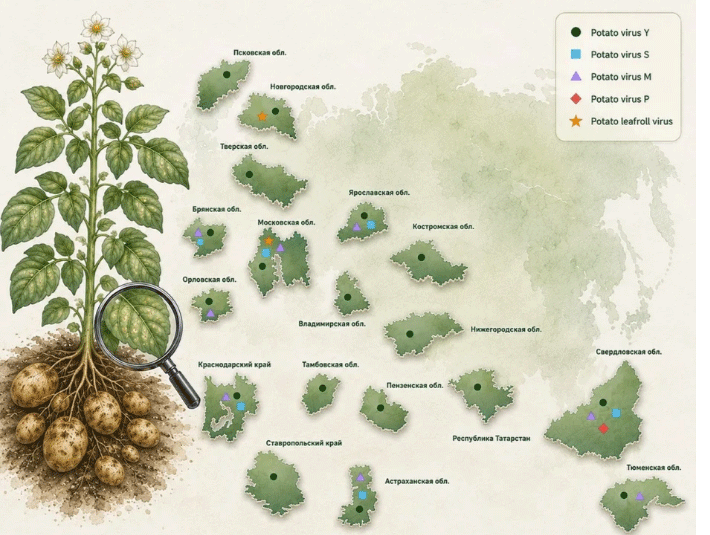
A sweeping genetic survey of potato viruses across 18 Russian regions has revealed an alarming reality: the most destructive pathogen – potato virus Y (PVY) – is not only ubiquitous but has also evolved into recombinant forms that were previously underestimated. Researchers from the Shemyakin-Ovchinnikov Institute of Bioorganic Chemistry (IBCh RAS) and their collaborators used next-generation sequencing to analyze RNA from leaves and tubers collected between 2021 and 2024. Their findings show that PVY dominates every sampled area exclusively through recombinant variants, while M-virus (PVM) and S-virus (PVS) frequently co-occur. In two regions, they also detected the leafroll virus (PLRV). More strikingly, mixed infections were found in half of all samples, with PVY and PVM together accounting for about one-third of cases – a complex epidemiological landscape that had not been fully appreciated before.
Given that viral diseases can slash potato yields by 50% or more – and Russia produces roughly 30 million tons annually, making potato the fourth most important food crop worldwide – these results carry significant practical weight. The decoded full-genome sequences are already being applied to develop biological protection strategies based on RNA-interference technology, which suppresses viral RNA in plants. By mapping the geographic distribution and genetic diversity of these pathogens, scientists now have a powerful tool to design targeted monitoring and control measures. The study underscores that Russian potato viruses are not only widespread but also genetically dynamic, demanding smarter, adaptive responses rather than one-size-fits-all solutions.