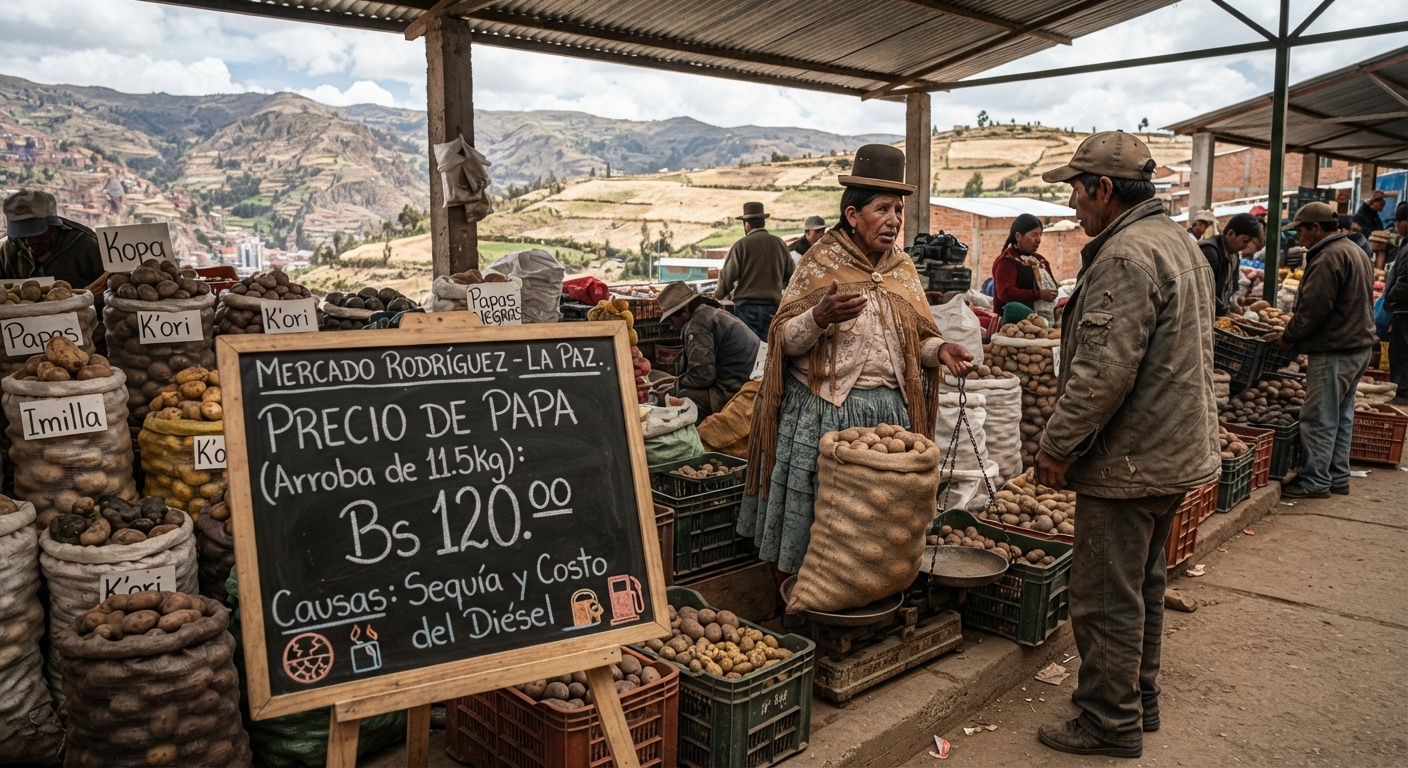
Potatoes are selling for up to 120 bolivianos (Bs) per arroba at the Rodríguez market in La Paz, Bolivia, according to a vendor survey published by Urgente.bo on 19 November. An arroba, the traditional Bolivian unit of weight, equals 11.5 kg, so the top price works out at roughly Bs 10.4 per kilogram. Traders link the rise to drought, high temperatures and the increased cost of diesel and farm inputs.
What vendors are charging
Soledad Blanco, who sells on Vicente Ochoa street, quoted Bs 100 per arroba for the imilla variety, a native Andean type, and Bs 110 for Holland-type potatoes. Another trader gave a range of Bs 55 to 120 depending on tuber size. A third vendor, Elisa, said prices began rising around Todos Santos, the All Saints holiday on 1 November, and confirmed similar quotes for both varieties.
Weather and transport costs
The traders pointed to drought and heat on the production side, together with higher diesel and input costs for growers. Blanco said the cost of moving loads that exceed the permitted weight has doubled, from Bs 30 to Bs 60. She also voiced concern about potato availability and the price of seed for farmers preparing the next crop.
Weekdays. Unsubscribe in one click.
Background: a year of fuel stress
Bolivia imports most of the diesel it consumes, and shortages have disrupted agriculture and transport throughout 2026. Road blockades lasted around 53 days in June and July. In August the government removed the diesel subsidy for large consumers, and in September the price for other buyers rose from Bs 9.80 to Bs 17.95 per litre, according to Chilean outlet Emol. Frost and drought on the Altiplano, the high plateau where much of the country’s potato crop is grown, added pressure on supply, and media reports in July described sharp price rises in some cities.
The current level is not a record for the year. In June, local broadcaster Red Uno reported La Paz prices of Bs 120 to 140 per arroba. Earlier, in February, Argenpapa had reported the opposite problem: overproduction that left farmers struggling to cover costs. The swing illustrates how exposed Bolivia’s potato market is to weather and input costs.
In international terms
Bolivia moved to a floating exchange rate on 29 June 2026. At the central bank’s official rate of Bs 11.84 per US dollar on 23 October, the latest quotation available, Bs 120 per arroba equates to about USD 10, or roughly USD 0.90 per kilogram. This is an approximate conversion.
A note on the data
The figures come from a handful of market vendors rather than official statistics, and the survey does not say whether the prices are retail or wholesale.
Sources: Argenpapa (citing Urgente.bo), 19 November 2026; Red Uno via eju.tv, June 2026; Associated Press, 17 August 2026; Emol, 21 September 2026; Correo del Sur, 23 October 2026; Página Siete via eju.tv.