Germany: Potato Trade Sees No Supply Crunch Despite 10.4 Million Tonne Harvest
Germany’s potato trade urged a measured view of supply at the 73rd Autumn Potato Get-together in Hamburg, as the 2026 crop is forecast at 10.4 million tonnes.
By Viktor Kovalev, POTATOES NEWS
Germany’s potato trade does not expect supply shortages this season, even though the 2026 crop is forecast at 10.4 million tonnes, about a quarter below last year. That was the main message from the 73rd International Autumn Potato Get-together (Kartoffel-Herbstbörse), held by the German Potato Trade Association (DKHV) in Hamburg on September 29, the association said in a press release on September 30.
Around 150 representatives of growers, traders, politics and industry associations attended the meeting.
Weekdays. Unsubscribe in one click.
The harvest figure comes from the preliminary Special Harvest and Quality Assessment (BEE), published by the Federal Ministry of Agriculture, Food and Homeland (BMLEH) on September 28. In 2025, Germany lifted 13.9 million tonnes, its largest crop since 1990. According to the ministry, this year’s volume is also 13% below the 2020–2025 average.
Two factors are behind the drop. The potato area shrank by about 11%: the preliminary land-use survey puts it at roughly 268,000 hectares, down from 301,800 hectares, top agrar reports. Yields suffered as well. The ministry points to a late start after rain in February and to heat and drought in summer, when tubers were bulking. The figures are projections rather than completed harvest statistics.
A smaller crop does not automatically mean a short market.
“What matters is what is available on the market and how supply and demand develop. We should therefore take a measured approach to the current situation and not jump to conclusions about potential supply shortages,” said Thomas Herkenrath, President of the DKHV.
Christoph Hambloch, market expert at Agrarmarkt Informationsgesellschaft (AMI), gave the keynote under the title “Why potatoes are not in such short supply – Current situation and outlook”. “In the coming months, the key factors will be how demand develops and how market participants manage the available volumes,” he said.
The ministry takes a similar line: despite the lower harvest, it expects supply and prices to remain stable. The DKHV release itself gives no figures on stocks or demand to support the assessment.
Politics was also on the agenda. Dr Melanie Leonhard, Hamburg’s Senator for Economic Affairs, Labour and Innovation, announced closer cooperation between the plant protection services of Hamburg and Bremen. The aim is to make phytosanitary inspections and potato sampling faster and more efficient. For traders, every day a consignment waits for a sampling result is a cost. “If we want goods to be available on the shelves, we need reliable and practical framework conditions for the food industry,” Leonhard said.
According to the DKHV, the sector is also dealing with the effects of climate change and growing requirements for sustainability and documentation, alongside plant protection and plant health rules.
The DKHV represents around 160 companies, including potato traders, packers, peeling companies, breeders, growers and machinery makers. POTATOES NEWS reported the preliminary German harvest estimate on September 26: Germany: Potato Harvest Forecast Falls 24.8% to 10.4 Million Tonnes.
Source: DKHV press release, September 30, 2026; BMLEH preliminary BEE results, September 28, 2026; top agrar.
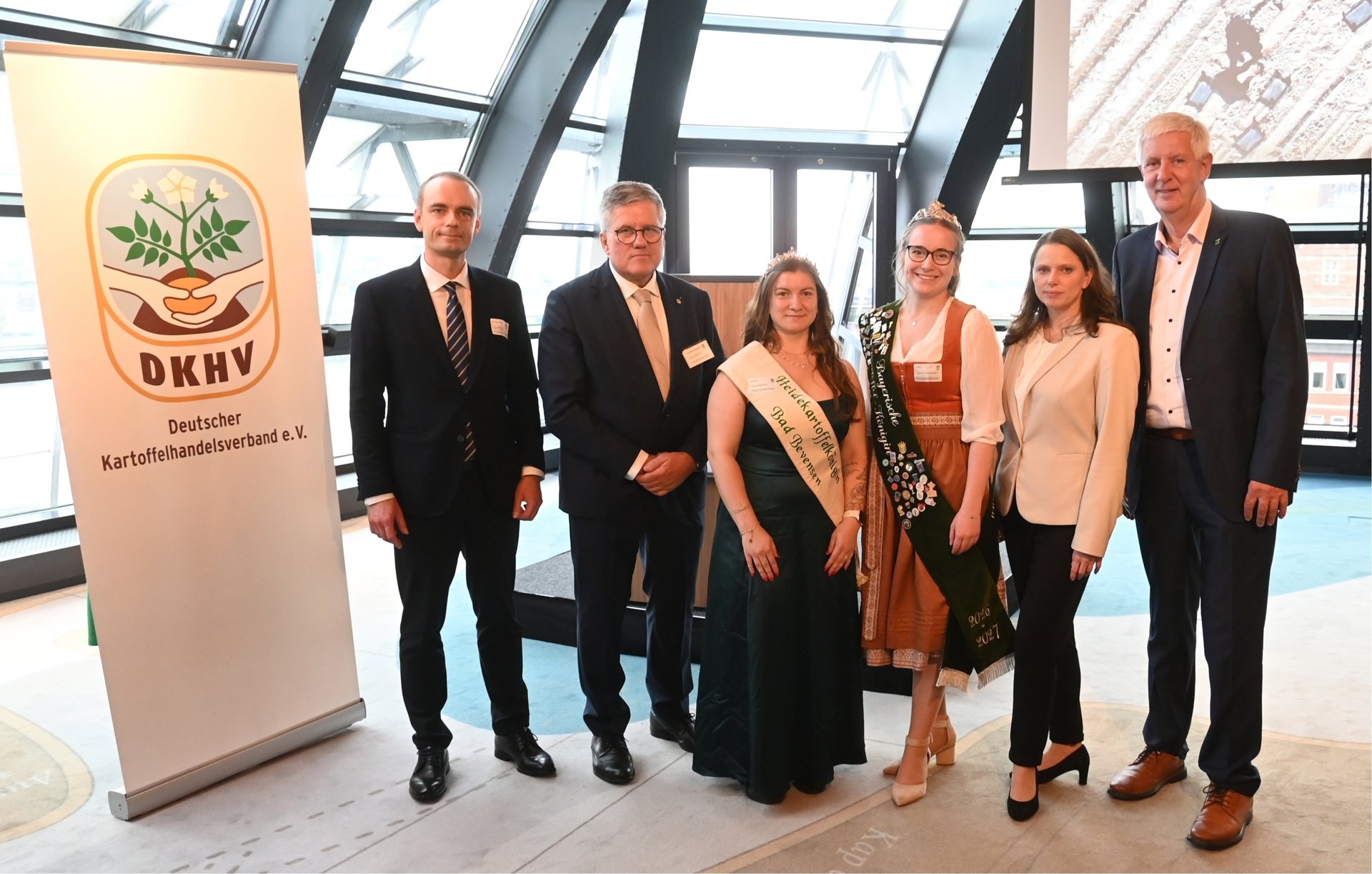
Photo: From left: Dr Illya Kolba, DKHV Managing Director; Thomas Herkenrath, DKHV President; Junona I, Heide Potato Queen; Julia I, Bavarian Potato Queen; Dr Melanie Leonhard, Hamburg Senator for Economic Affairs, Labour and Innovation; Olaf Feuerborn, UNIKA Chairman, at the 73rd International Autumn Potato Get-together in Hamburg. © DKHV