Europe: Potato Harvest Could Fall Below 40 Million Tonnes for the First Time — Less Than Six Months After a Price Collapse
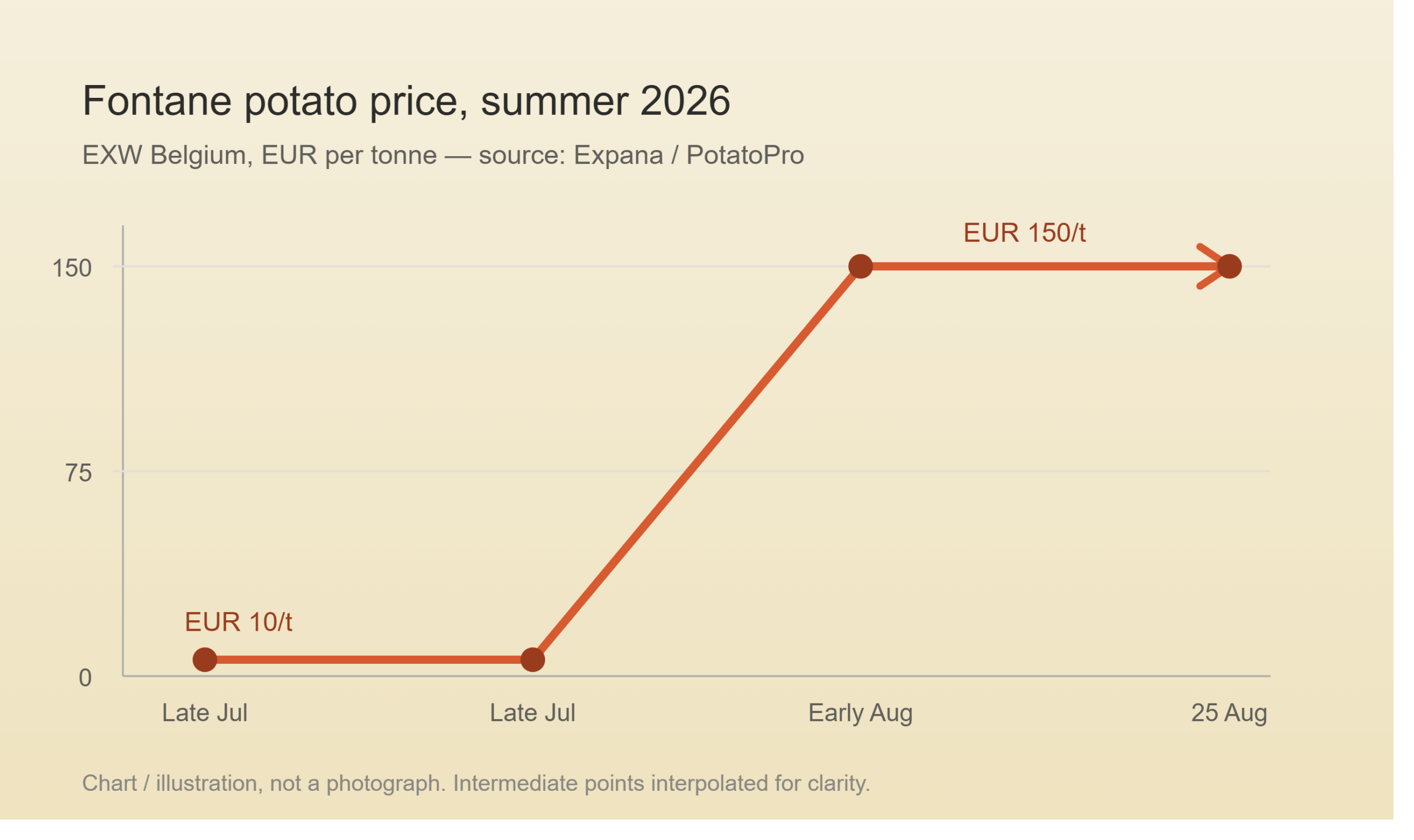
The EU's 2026 potato harvest forecast could fall below 40 million tonnes for the first time — roughly 15 million tonnes less than the previous year [to verify: exact scope of the figure — total EU harvest or only the industrial/processing segment]. The cause is a deliberate reduction in planted area following the 2025/26 oversupply, combined with five heatwaves and drought over the summer of 2026. The wholesale price of the processing variety Fontane rose from €10 to €150 per tonne in just two weeks.
As recently as early 2026, the European potato market was still living in a logic of oversupply: the free market for Fontane in Belgium was trading near zero euros per tonne, French growers were receiving guidance from the industry body UNPT on how to dispose of unwanted potatoes as fertilizer or compost, and the European Energy Exchange (EEX) announced it would close its processing-potato futures contract. Less than six months later, the picture has reversed.
According to analytics firm World Potato Markets, the EU’s 2026 harvest could fall below 40 million tonnes for the first time — around 15 million tonnes less than last year [to verify: whether this estimate covers the entire EU harvest or only the industrial/processing segment — the source headline refers to “industrial potato harvest,” but the scale of the figures doesn’t fully confirm that]. Germany, France, the Netherlands, Belgium and Poland all recorded year-on-year declines in planted area. The decision to cut plantings was made back in winter 2025/26 as a response to the previous season’s oversupply; an adverse weather factor was then layered on top — five heatwaves followed by drought, which could further reduce yields.
The market reacted sharply. According to Expana, the benchmark price for processing-grade Fontane potatoes EXW Belgium rose from €10 (≈$12) per tonne at the end of July 2026 to €150 (≈$176) per tonne in early August. As of August 25, the price held at €150 per tonne — trading activity remained slow, with some growers delaying harvest while waiting for rain [to verify: only one source given for the price — Expana; no independent second source was found for cross-checking].
Weekdays. Unsubscribe in one click.
The raw-material shortage coincided with rising EU exports of processed potato products to several markets. According to Trade Data Monitor, EU processed potato exports to South America grew 45.1% year-on-year in June 2026, led by shipments to Brazil, Colombia and Chile. Exports to the Middle East rose 23%, and to Africa 26.8%. In Asia, however, the trend is the opposite: rolling 12-month export volumes fell 23% due to stronger competition from regional producers (China, India and Egypt are expanding their own frozen-fry processing capacity).
Industry sources also link part of the increased demand for European product to U.S. trade policy: tariffs and uncertainty in the American market, along with possible tariffs of up to 50% on Canadian frozen fries entering the U.S., reportedly prompted some buyers in the Middle East and elsewhere to shift toward European suppliers [to verify: the original wording is cautious — “market sources indicate” — no separate official confirmation was found].
Why it matters. If the raw-material shortage in Europe is confirmed, it could intensify competition for the remaining potato supply and accelerate price increases for fries and chips heading into winter — an effect that would reach retail shelves and foodservice outside the EU as well. For exporters in Asia and Latin America, Europe’s sharp swing from surplus to shortage represents a window of opportunity, but it comes against a broader trend of recent months: Europe’s share of global processed-potato exports has been gradually declining amid the growth of regional producers in Asia and North Africa. The speed of the reversal itself — from near-zero prices at the start of the year to €150 per tonne in August — points to high market volatility and the fragility of the contract model, an issue industry associations (UNPT, NEPG) had already flagged, warning of a “structural asymmetry of risk” for growers.
Sources:
- PotatoPro, “Europe: Industrial potato harvest could fall below 40 million tonnes” — https://www.potatopro.com/news/2026/europe-industrial-potato-harvest-could-fall-below-40-million-tonnes (primary data: World Potato Markets — harvest forecast; Expana — Fontane price, single source; Trade Data Monitor — export data)
- potatoes.news, “The Million-Tonne Trap…” (February 2026) — background: France’s record 2025 harvest and the decision to cut 2026 plantings
- potatoes.news (Malay edition), “Pasaran Kentang Global pada 2026” (April 2026) — background: zero-euro Fontane prices and the EEX futures contract closure