
Economode’s Answer to Frying Oil Waste: Filtration and Rapid Cooling

Economode’s Frying Oil Filtration and Rapid Cooling: How Fines Removal Extends Frying Oil Life and Snack Shelf Life
Economode Food Equipment builds fines removal and rapid oil cooling directly into its batch fryer range, on a simple premise: the oil is absorbed into every fried snack, so its condition is a product-quality decision, not a housekeeping one. Here is how that engineering extends both frying oil life and finished-snack shelf life, batch after batch.
Why oil quality is the hidden variable in snack quality
Economode Food Equipment (India) Pvt. Ltd. designs its batch fryers around a point many first-time producers underweight: oil condition, as much as potato variety or slice thickness, sets the quality of the finished snack. Frying oil is not a neutral bath the slices pass through; it is absorbed into the product, and by the time chips reach the pack it accounts for a meaningful share of their weight, roughly a third by common industry reckoning. Whatever state the oil is in, clean or spent, goes into what the customer eats. That is why Economode engineers filtration and cooling into the fryer itself, rather than leaving oil quality to chance downstream.
Because oil degrades gradually rather than failing outright, a busy line can easily miss the moment it turns from usable to actively harming the product, until a batch is returned for exactly that reason. For a processor chasing repeat buyers, oil management is a control point sitting upstream of every other decision on the line.
Weekdays. Unsubscribe in one click.
How frying oil breaks down
Frying oil breaks down along three overlapping paths. Oxidation, as hot oil meets air, splits triglycerides into compounds that darken the oil and add stale, rancid notes. Hydrolysis, driven by moisture from the food, raises free fatty acids and speeds further breakdown. Polymerisation links oil molecules into heavier compounds, thickening the oil over successive cycles. All three worsen with time at temperature and feed one another.
The factor most producers underrate is food fines. Small particles that shed during frying keep cooking in the oil long after their batch has left the tank, in effect burning continuously, darkening the oil faster than clean frying would and carrying bitter off-notes into the next run. Removing fines is one of the highest-leverage ways to slow degradation, because it eliminates a source of uncontrolled heating between batches and overnight.
India’s regulator draws a hard line on how far oil can go. The FSSAI caps Total Polar Compounds in used cooking oil at 25 percent, beyond which it must be discarded, with fresh oil expected to sit no higher than 15 percent. The limit has been in force since 1 July 2018, precisely because repeated frying without proper oil management pushes oil past safe reuse.
Filtration: removing fines to protect the oil
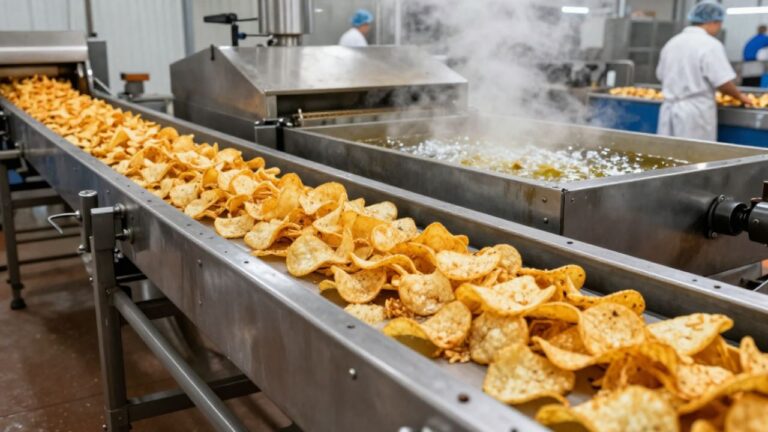
Since fines act fast, pulling them out promptly is the first line of defence, and it is where Economode concentrates much of its fryer engineering. Across the batch-fryer configurations a bucket filter sits in the oil path to catch the coarse fines thrown off during frying, before they can keep cooking in the tank. On the Rectangular Fryer, Economode offers a continuous filter option for higher-volume runs, described in the brochure as delivering better fines removal and maintained oil quality over a long run, built for extended shifts rather than single small batches.
Across the range the filtration system is framed around one outcome: fines removal that increases the shelf life of the oil. That carries a direct commercial edge, since oil is a recurring cost and every extra day a fill stays within spec lowers oil use per unit produced. Moving oil through the loop is handled by an SS air-cooled pump, engineered for no additional water cooling, so filtration adds performance without adding a utility connection. All oil-contact surfaces are SS 304 food-grade throughout.
- Bucket Filter – captures coarse fines in the oil-recirculation path
- Continuous Filter (Rectangular Fryer option) – fines removal for extended production runs
- Cooling Coil / Oil Tank with Cooling System – faster oil cooling between frying cycles
- SS Air Cooled Pump – circulates oil with no additional water-cooling utility
- Superior Insulation – reduces heat loss, comfortable working environment
- MOC SS 304 food-grade – across all oil-contact components
Rapid cooling & storage: the second half of oil life
Filtration deals with what is in the oil; the second lever is temperature. Oil kept hot longer than needed keeps oxidising even between batches, which is why Economode builds a cooling coil into the oil tank, the oil-tank-with-cooling-system shown across its circular and rectangular models, described in the brochure as delivering faster oil cooling and improved shelf life. On the Rectangular Fryer with Continuous Filter, the brochure frames it as rapid cooling of oil to prevent degradation and improve product shelf life, attacking the same outcome from the temperature side rather than the particulate side.
Superior insulation works alongside it: better insulation limits ambient heat loss while the cooling system still brings oil temperature down quickly between cycles. A lower oil-holding volume relative to throughput improves turnover, since less oil in the system means each charge is refreshed with fresh oil more often. Every oil-contact component is built in SS 304 food-grade steel.
Filtration and rapid cooling are two halves of one system. Fines removal stops particulate-driven degradation at source; rapid cooling limits the oxidation that continues even in clean oil held too hot. Together they separate an oil charge that degrades within a shift from one that holds its quality, and its contribution to the snack’s flavour, colour and shelf life, across a full production run. In a category where the oil is quietly one of the biggest running costs and one of the loudest quality signals, that is where the engineering earns its place.
Reach Economode directly for filtration and cooling-system specifications on any fryer configuration, or visit the brand site for the full equipment range.
WhatsApp +91 88792 70383 Email sales@economodefood.com Visit economodefood.comFull batch fryer brochure – circular and rectangular pan configurations, filtration and oil-cooling systems, fuel options, and line accessories for potato chips, banana chips, pellet and namkeen production.
Download brochure (PDF)Frequently asked questions
Why does frying oil need filtration?
Fines that shed during frying keep cooking in the oil if left in the tank, in effect burning continuously between batches. That speeds oxidation and darkening, pushes bitter off-flavours into the next run, and shortens how long a single oil charge stays usable. Filtration takes those fines out before they can keep degrading the oil.
What are fines, and why do they shorten oil life?
Fines are small pieces of fried product, crumbs, broken bits and batter debris, that separate during frying and stay suspended in the oil. Because they keep cooking long after their batch has left the fryer, they act as a continuous low-level heat source that accelerates oxidation, hydrolysis and polymerisation faster than clean frying alone.
How does cleaner oil extend a snack’s shelf life?
The oil is absorbed into the snack, so degraded oil, darker, higher in free fatty acids and carrying off-notes, is absorbed along with it. Oil kept cleaner through fines removal passes less of that degradation into the product, supporting better retained flavour and colour across shelf life.
Does rapid oil cooling really matter between batches?
Yes. Oil held at frying temperature keeps oxidising even when it is not actively cooking. Bringing it down quickly between cycles, rather than letting it idle hot, limits that ongoing thermal damage, which is why systems that pair filtration with a dedicated cooling coil report better oil life than filtration alone.
Is there a legal limit on used cooking oil quality in India?
Yes. The FSSAI caps Total Polar Compounds in used cooking oil at 25 percent, in force since 1 July 2018, beyond which the oil must be discarded. Fresh oil is expected to stay at or below 15 percent.
Which Economode features support oil management?
A bucket filter (standard) and a continuous filter option on the Rectangular Fryer for fines removal; a cooling coil in the oil tank for rapid cooling; an SS air-cooled pump that circulates oil without an extra water-cooling utility; superior insulation; and SS 304 food-grade construction on all oil-contact components.
This Industry Spotlight is published in partnership with Economode Food Equipment (India) Pvt. Ltd. Editorial framing and verification are the responsibility of the Potatoes.news Editorial Team.
Methodology: Economode product and specification details are drawn from Economode’s Batch Fryer brochure. Frying-oil chemistry is stated in general terms. The Total Polar Compounds limit cited is per FSSAI regulation.