Beyond the River Bank: How to Turn a Profit on Steppe Potatoes Using Deep Wells and Smart Irrigation

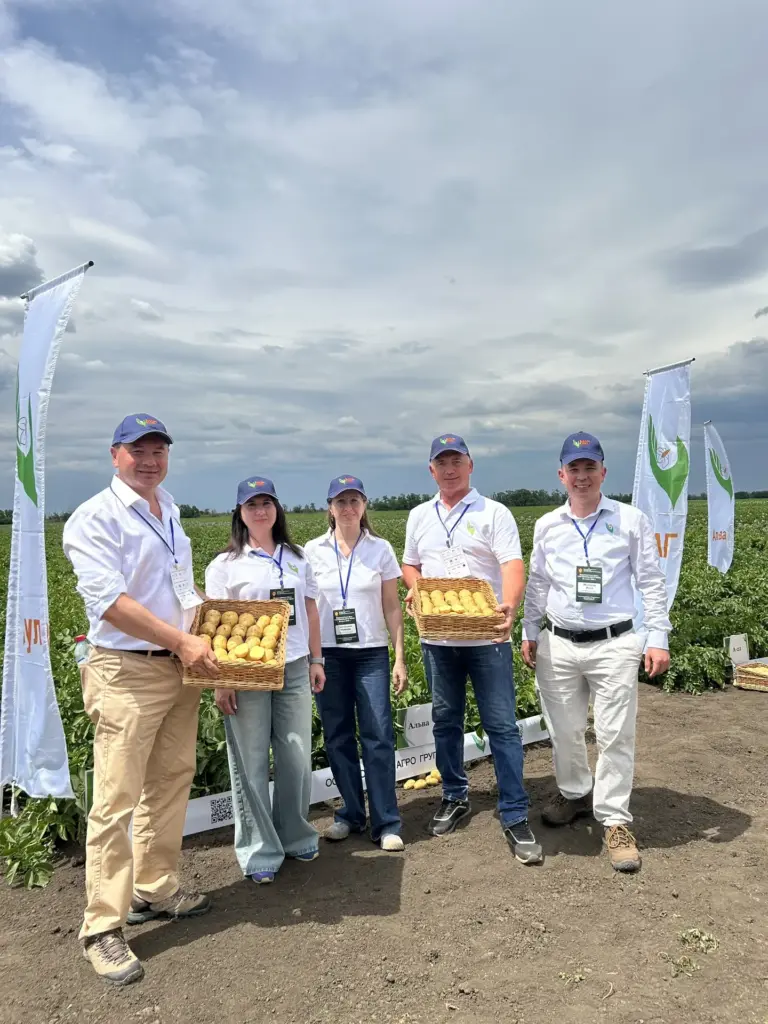
The Pavlodar Region has long earned its reputation as the primary vegetable basket of Kazakhstan. However, conventional wisdom dictates that successful potato farming here is only viable “by the water”—directly on the banks of the Irtysh River. As part of the International Potato Tour, we visited a unique enterprise that shatters this exact stereotype. Located a staggering $150\text{ kilometers}$ away from the nearest river, this farm extracts its irrigation water from wells nearly a kilometer deep—and the potato crop itself has become the primary economic savior of a massive agricultural holding.
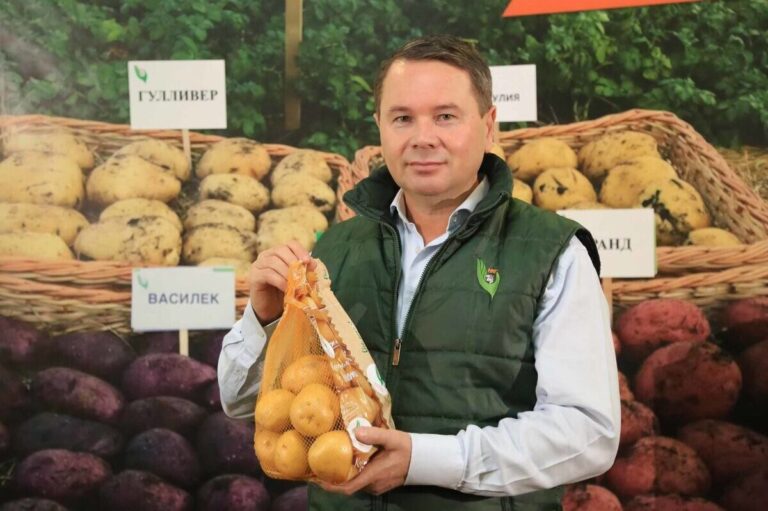
To understand the economics of steppe vegetable production, why livestock farmers need the “live” cash flow generated by root crops, and what irrigation technologies protect yields from extreme heat, we sat down with Erjan Nasharov, head of the Nur Al-Kh holding, and Maksim Bukayemskiy, director of the seed-growing division Baymyrza-Agro 2018.


The Financial Maneuver: Why Does a Dairy Giant Need Potatoes?
The vegetable segment on this farm is quite young—potatoes and carrots have been cultivated here for only their third season. Historically, Nur Al-Kh operates as a heavy-hitting dairy producer, boasting a herd of $5,000$ milking cows. Sustaining such a massive herd with succulent forage (silage and haylage) under the arid conditions of the Pavlodar steppe on rainfed land is an impossible task: at best, rainfed corn yields peak at just $15\text{ t/ha}$ ($150\text{ ц/га}$).
Weekdays. Unsubscribe in one click.
To guarantee its forage base, the company embarked on large-scale and highly expensive artificial irrigation projects. However, forage production represents “long money”. Too much time elapses from the initial sowing to the eventual profit realized from milk sales, yet credit lines and operational liabilities demand payment here and now.
Erjan Nasharov, Head of the Nur Al-Kh Holding: “The infrastructure costs for irrigation in our zone are immense because there are no natural bodies of water nearby. Livestock economics take a long time to break even. That is exactly why we introduced commercial vegetables—potatoes and carrots—into our crop rotation. These are high-margin crops that provide us with ‘live’ working capital in the exact same year the crop is harvested. The vegetables effectively finance our day-to-day operations and cover our financial obligations.”
Today, a strict, scientifically grounded crop rotation tied directly to forage production has been established on the irrigated lands: Corn $\rightarrow$ Vetch-Oat Mix $\rightarrow$ Commercial Vegetables (Potatoes / Carrots) $\rightarrow$ Alfalfa.
Water Worth Its Weight in Gold: Two-Stage Lifting
The irrigation engineering implemented at the farm is entirely unique for the region. Due to the colossal distance from major rivers, water must be literally “wrestled” from the depths of the earth, utilizing local sources and spring flood reservoirs.
- First-Stage Pumping Station: Submersible pumps draw water from deep wells and discharge it around the clock into gigantic artificial storage reservoirs lined with a specialized waterproofing film. The process of filling these reservoirs begins in the early spring.
- Second-Stage Pumping Station: Powerful pumping units draw water from the reservoir and distribute it across the fields under high pressure.
Admittedly, this dual-stage lift increases electricity costs compared to riverfront operations. However, the expenditures are entirely justified by the quality: the steppe’s artesian water is soft, clean, and perfectly suited for the plants.
A Solid Bet on ‘Gala’ and Fine-Drop ‘Mist’ Systems
This season, the land dedicated to potatoes reached $120\text{ hectares}$ (up from $100\text{ ha}$ last year), with an additional $50\text{ ha}$ allocated to carrots. The scale of production is strictly capped by the capacity of their own modern $6,000\text{-ton}$ vegetable storage facility, which features full climate control and utilizes bulk storage.
The agronomic team skipped any experimentation with varieties, selecting the reliable and time-tested “Gala”. They deliberately avoid the early-season segment due to highly volatile pricing structures. The potatoes are marketed as a large mix (including premium table-grade sizes) and are quickly snapped up by buyers in the southern regions of the country and neighboring foreign markets.
Field watering duties are handled by dependable Valley circular pivot machines. While they currently run on manual controls, a comprehensive automation project is actively underway to transition the machines to remote control equipped with soil moisture sensors and irrigation monitoring systems.
The primary technological pride of the irrigation brigade is the transition to innovative fine-dispersion “Tuman” (Mist) nozzles.
Maksim Bukayemskiy, Director of Baymyrza-Agro 2018: “We tested the ‘Tuman’ system last year on carrots and achieved ideal results. Conventional nozzles hit the crop with heavy droplets, which over time break down and wash out the soil ridges. The ‘Tuman’ system delivers a microscopic droplet. Instead of pooling into puddles, the water completely and evenly saturates the entire ridge, behaving very much like drip irrigation. Furthermore, during peak summer heat hours, this system instantly lowers the temperature on the field, protecting the plants from thermal stress.”
Alongside the wide-coverage pivot machines, agricultural drones have found their niche on the farm. They are utilized as a tactical agronomic aid to precisely treat small, awkward field fragments and tight corners where a tractor-towed sprayer physically cannot maneuver. Under favorable weather conditions, a single drone successfully covers up to $200\text{ hectares}$ in a single shift.
Professionals Dedicated to the Land
Even the most advanced technology is ineffective without the right people. The Chief Agronomist is currently navigating his 16th season on the land. A graduate of the local university with a degree in Agronomy, he began his career as a traditional grain farmer. He openly admits that grueling field practice quickly forced him to put his university textbooks aside.
“When I first joined the farm, the director told me immediately: ‘Now forget the theory and learn everything from scratch out in the field’. And we continue to learn every single year. But I love my work and do not regret a single day. The most gratifying moment of the year is the harvest. When you see the tangible results of your labor over the entire season and everything runs seamlessly, it brings immense joy to your soul.”
An equally meticulous philosophy is applied to the machinery operators. Operator Aphanasiy, who manages the vegetable machinery complex from planting all the way to the mechanical harvest, is a rare specialist. He will never abandon his equipment in the field or switch over to another machine until he has personally and meticulously prepped his sprayer for winter conservation down to the last bolt. It is on the shoulders of such dedicated professionals that this challenging steppe project stands.
Key Takeaway from the International Potato Tour:
The experience of the Nur Al-Kh holding and the Baymyrza-Agro 2018 enterprise conclusively proves that a lack of proximity to natural rivers is no reason to bypass high-margin vegetable farming. A precise financial calculation, the audacity to invest in deep-water irrigation infrastructure, and a sharp focus on emerging technologies (automation, fine-mist irrigation) allow farmers to secure excellent potato yields right in the heart of the arid Kazakh steppe.