
Chilean researchers move to bring a single-test ID for powdery and common scab into diagnostic labs
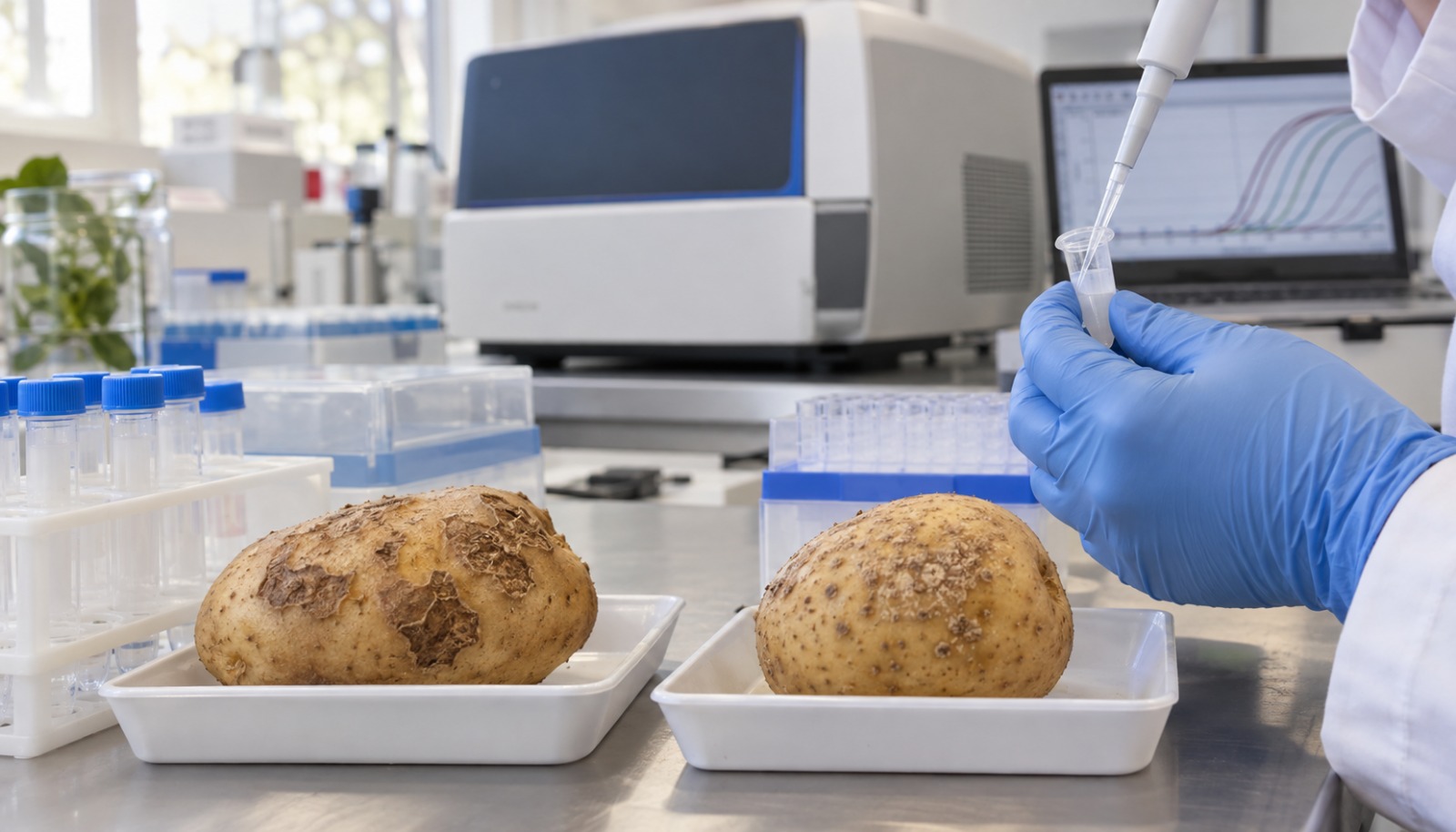
Powdery scab and common scab can leave near-identical lesions on potato tubers, yet they are caused by entirely different organisms and call for different management responses. A team at the Pontificia Universidad Católica de Chile (UC) has won backing from Chile’s national research agency to turn a laboratory protocol that tells the two apart in a single reaction into a validated diagnostic service.
The project
The project, SCAB-ID 2.0, was selected in the 2026 FONDEF Technological Research competition run by ANID, Chile’s National Research and Development Agency. FONDEF is ANID’s applied research programme, designed to take university research towards products and services with commercial or public use.
The project is led by Stephanie Riquelme, a graduate of UC’s doctoral programme in plant biotechnology. Marlene Rosales serves as alternate director and Sara Acevedo as researcher; both are academics at UC’s Faculty of Agronomy and Natural Systems.
Weekdays. Unsubscribe in one click.
The system builds on a protocol Riquelme developed during her doctoral research. A university social media post announcing her thesis defence indicates the thesis dealt with the molecular detection, quantification and population genetic characterisation of the powdery scab pathogen [VERIFY: thesis title known only from a truncated Instagram snippet].
Two diseases, one symptom picture
The two diseases have very different causes, even though growers often cannot tell them apart by eye.
Powdery scab is caused by Spongospora subterranea, an obligate soilborne parasite belonging to the plasmodiophorids, a group of protists. It is often loosely described as a fungus, but it is not one. Besides damaging tubers, it forms galls on roots. It also transmits Potato mop-top virus (PMTV), which causes internal necrosis in tubers.
Common scab is a bacterial disease caused by Streptomyces species. The project team names S. scabiei as the principal agent, and the qualifier matters: several other pathogenic Streptomyces species can cause the same disease.
Because the pathogens differ, so do the levers for control. Rotation, field selection, irrigation management and seed treatment all depend on which organism is present. A misdiagnosis can therefore lead directly to the wrong management decision.
How the test works
SCAB-ID 2.0 is based on multiplex real-time PCR (qPCR). Targets for both pathogens are amplified in the same reaction tube, and each is read through its own fluorescent signal.
qPCR assays for S. subterranea in soil, roots and tubers have been published since the early 2000s. The Chilean project claims novelty on two points:
- combining both scab pathogens in a single assay;
- standardising that assay for routine use.
In the new phase, the team plans to validate the system under operational conditions. The validation will build in criteria for reproducibility, quality control and traceability. It will also produce a transfer package, a set of documentation that would allow the method to be adopted by an agricultural diagnostic laboratory.
Riquelme said the aim was to have a reproducible tool that would allow both agents to be detected and differentiated simultaneously in potato samples.
According to ANID’s description of the funding line, projects in this category are expected to validate their technology at advanced-prototype level within two years. The budget and timeline for SCAB-ID 2.0 itself have not been disclosed.
Why it matters to the supply chain
The developers argue that more precise diagnosis would support growers and companies in three areas:
- phytosanitary decisions;
- the assessment and segregation of lots;
- certification processes.
The certification point is most relevant for seed potato production. Both pathogens can be carried on seed tubers, and S. subterranea resting spores can survive in soil for many years. An objective laboratory result, in place of visual grading, reduces the risk of two opposite errors: passing an infected lot, or rejecting a healthy one.
Open questions
The announcement leaves several key parameters unanswered:
- Streptomyces targets. It is not stated whether the assay targets S. scabiei specifically or the pathogenicity genes shared across pathogenic Streptomyces species. This determines whether common scab caused by other species would be picked up.
- Performance data. No sensitivity, specificity or limits of detection have been published.
- Sample types. It is not stated whether the system works on tubers only or also on soil.
- Partners. The host laboratory for technology transfer has not been named, and there is no information on whether industry partners are involved.
- Earlier version. It is unclear what distinguishes version 2.0 from an earlier version. No public information on a SCAB-ID 1.0 could be found.
Editorial notes
- Single source. The only available source is the press release published by Portal Agro Chile on 22 September 2026 and credited to the Portal Innova press team. No original release could be found on the UC Faculty of Agronomy website.
- Taxonomy. Spongospora subterranea is deliberately not called a fungus in this article.
- Funding details. The two-year horizon comes from ANID’s description of the IDeA IT funding line, as relayed by the University of Concepción. The 2025 funding ceiling for this line (around CLP 237 million) has been left out, because the actual grant amount for this project is unknown.
- Russian-version flags retained. The single-source status and the [VERIFY] marker on the thesis title carry over from the Russian version.
Sources
- Portal Agro Chile, 22 Sept 2026: https://www.portalagrochile.cl/2026/09/22/innovacion-para-el-diagnostico-agricola-proyecto-fondef-desarrollara-sistema-para-detectar-y-diferenciar-enfermedades-de-la-papa/
- University of Concepción (VRID), IDeA IT 2026 call notice: https://vrid.udec.cl/wp-content/uploads/2025/12/VRID-INFORMA-FONDEF.pdf
- UC Ciencia 2030, overview of ANID funding instruments: https://ciencia2030.uc.cl/archivos/aplica-ciencia/taller-2-fondos-concursables.pdf
- Plant Disease, qPCR for S. subterranea in soil; PMTV vector role: https://pubmed.ncbi.nlm.nih.gov/31613190/
- European Journal of Plant Pathology, real-time PCR for S. subterranea in soil, water and plant tissue (2003): https://link.springer.com/article/10.1023/A:1024764432164
- Thesis defence announcement, S. Riquelme (Instagram, snippet): https://www.instagram.com/p/Db_umAaiRc8/