Nigeria: Potato Yields Stay Near 3.8 t/ha as Output Reaches 1.23 Mt
Key takeaways
- 1.23 Mt of potatoes grown in Nigeria in 2024, per FAOSTAT
- 3.76 t/ha average Nigerian yield in 2024, per FAOSTAT data
- 20% growth in Nigerian potato output between 2010 and 2024
- 4 open-access varieties released in Nigeria in June 2023
Why it matters
- For farmers
- Replace farm-saved seed with certified or positively selected seed where possible, and ask NRCRI or seed programmes about the four 2023 varieties: Unica, Juriya, Babban, Kyau.
- For processors
- Secure supply through contracts linked to clean seed and extension support, since open-market potatoes vary widely in quality and availability.
- For suppliers
- Treat Nigeria as a seed-system market: small-pack certified seed, virus testing and advisory services matter more than volume sales of imported seed.
- For investors
- Screen Plateau State for storage and seed multiplication projects; with yields near 3.8 t/ha, even modest gains change farm margins and supply to processors.
60-second summary
Nigeria grows more potatoes than a decade ago, yet each hectare still yields very little. FAOSTAT puts 2024 production at about 1.23 million tonnes, up roughly a fifth on 2010, while the average yield is only 3.76 tonnes per hectare. The implied harvested area is close to 327,000 hectares. The International Potato Center reports a similar 3 to 4 tonnes per hectare, which confirms the gap. North African producers such as Egypt and Algeria reach 30 to 34 tonnes per hectare in the same database. Most Nigerian potatoes come from the cool highlands of Plateau State. Farmers replant their own tubers, so viruses and bacterial wilt accumulate. Four heat-tolerant CIP varieties were released in 2023, but clean seed multiplication is still small. Seed suppliers, storage builders and snack processors are the groups with most to gain. The caveat is data quality: FAOSTAT figures for Nigeria rely partly on estimates, so the trend is more reliable than any single year.
Nigeria produced 1.23 million tonnes of potatoes in 2024, according to FAOSTAT. In 2010 the figure was 1.03 million tonnes. Output therefore grew by about 20% in 14 years.
The growth came from area, not from productivity. The average yield in 2024 was 3.76 tonnes per hectare, according to FAOSTAT. Dividing production by yield gives a harvested area of roughly 327,000 hectares.
The International Potato Center (CIP) gives a similar picture. In June 2023, CIP said Nigerian farmers harvest 3 to 4 tonnes per hectare. Two independent sources therefore agree on the scale of the yield gap.
Weekdays. Unsubscribe in one click.
A small crop in a large country
For comparison, FAOSTAT puts the 2024 yield at 30.1 t/ha in Egypt and 33.9 t/ha in Algeria. The average for Kenya was 9.7 t/ha. Nigerian yields are about one-eighth of North African levels.
Production is concentrated in the highlands. According to CIP, the main growing areas are the higher-elevation local government areas of Plateau State. Potatoes need cool nights to set tubers. Most of the lowland savanna is too hot for the crop.
Seed is the main bottleneck
Quality seed is the constraint named most often. The Collaborative Seed Programme, a Nigerian seed sector platform, reported limited access to quality seed at a national webinar in February 2024. Farmers often replant their own tubers for many seasons. Viruses and bacterial wilt build up in such seed.
In June 2023, Nigeria released four open-access varieties from CIP breeding lines. They are called Unica, Juriya, Babban and Kyau. The National Root Crops Research Institute (NRCRI) led the release with CIP. GIZ Nigeria funded the work. CIP described the varieties as high-yielding, disease-resistant and heat-tolerant.
New varieties only help if clean seed reaches farmers. Nigeria still lacks a large certified seed multiplication chain. Storage is also weak, so farmers often sell at harvest when prices are lowest.
Why it matters
Nigeria is Africa’s most populous country. The gap between 3.8 t/ha and North African yields shows the size of the opportunity. Seed companies, storage investors and processors could all benefit if yields double. But the gains depend on a working seed system, not only on imported varieties.
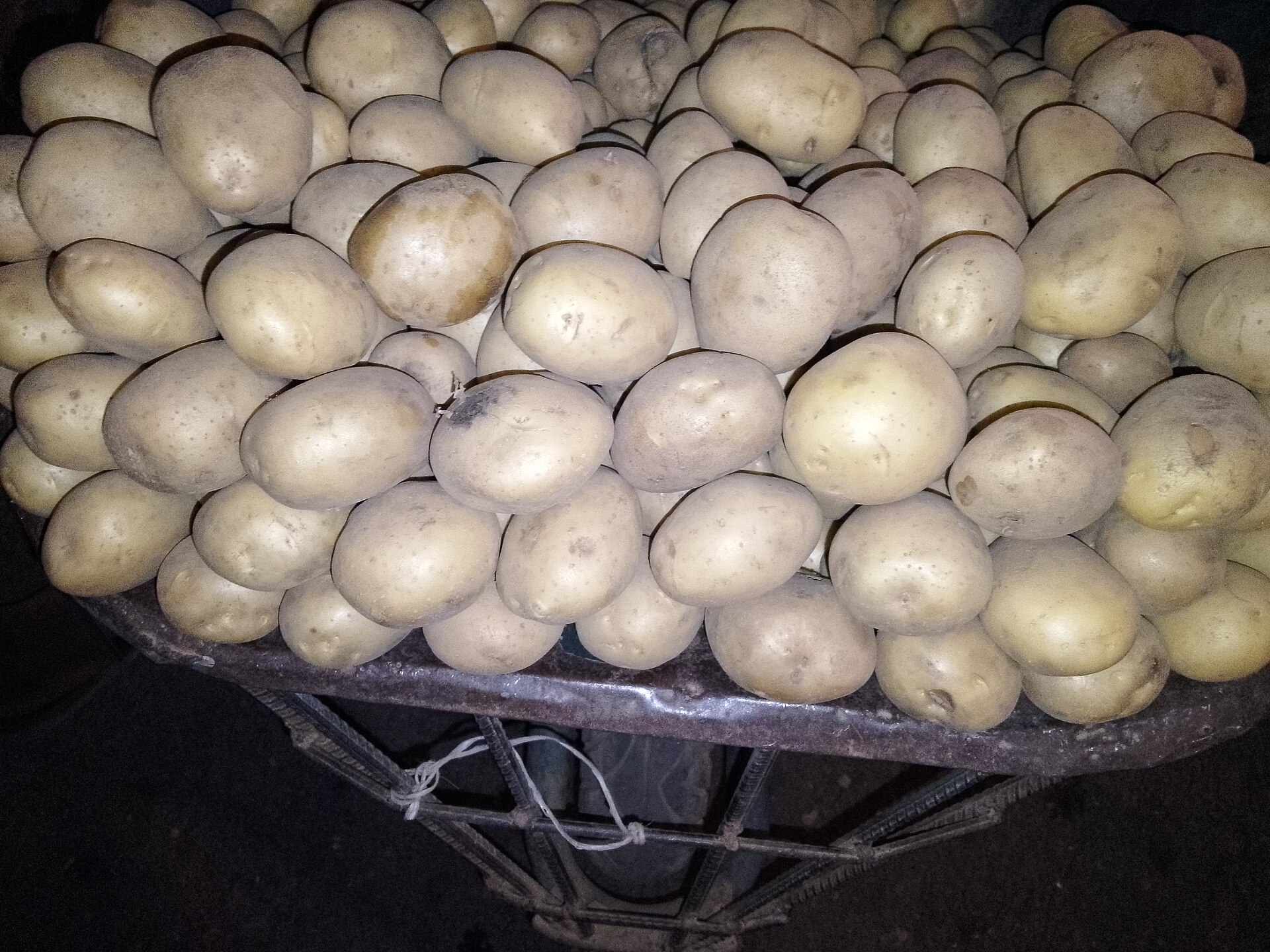
Photo: Irish potatoes, the common name for potatoes in Nigeria (illustrative). Bembety / Wikimedia Commons, CC0
Global Potato Brief
Top five stories, prices, disease alerts and events. Weekday mornings, no advertising.
What next
The next test is whether seed of the 2023 varieties is multiplied at scale in Plateau State. FAOSTAT will publish 2025 data in the coming months, showing whether yields move above the 3–4 t/ha range.
Sources
- FAOSTAT, Crops and livestock products (QCL) — https://www.fao.org/faostat/en/#data/QCL
- Our World in Data, potato production (FAOSTAT data) — https://ourworldindata.org/grapher/potato-production
- Our World in Data, potato yields (FAOSTAT data) — https://ourworldindata.org/grapher/potato-yields
- International Potato Center — https://cipotato.org/pressreleases/four-new-climate-smart-potato-varieties-released-nigeria/
- Collaborative Seed Programme Nigeria — https://csp-nigeria.org/2024/02/27/boosting-nigerias-potato-industry-key-takeaways-from-the-seed-sector-platform-webinar/
Linked in this material
- Country
- Nigeria
- Technologies
- certified seed; heat-tolerant varieties