Argentina: Potato Price Rally Cuts Urea Cost to 0.76 Tonnes of Potatoes per Tonne
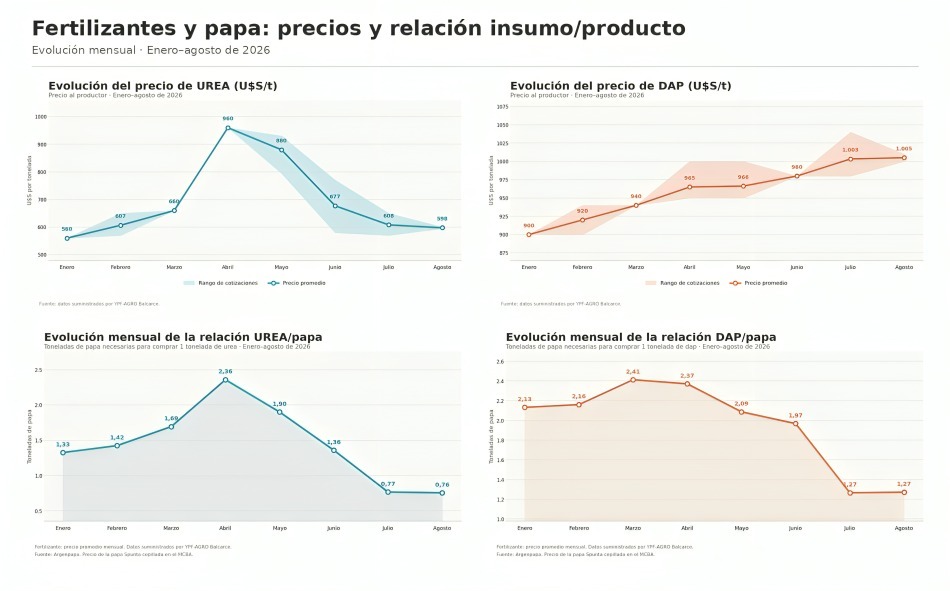
Argentine potato growers in southeastern Buenos Aires province entered the 2026/27 planting window with the most favourable fertiliser purchasing terms of the year. The improvement did not come from cheaper fertiliser. It came from a mid-year jump in wholesale potato prices — and by late August that jump was already unwinding.
The indicator
The input/output ratio divides the price of one tonne of fertiliser by the price of one tonne of potatoes. The result states how many tonnes of potatoes a grower must sell to buy a tonne of urea or diammonium phosphate (DAP). A falling number means a better position for the grower.
Tonnes of potatoes required per tonne of fertiliser, 2026
Weekdays. Unsubscribe in one click.
| Jan | Feb | Mar | Apr | May | Jun | Jul | Aug | |
|---|---|---|---|---|---|---|---|---|
| Urea | 1.33 | 1.42 | 1.69 | 2.36 | 1.90 | 1.36 | 0.77 | 0.76 |
| DAP | 2.13 | 2.16 | 2.41 | 2.37 | 2.09 | 1.97 | 1.27 | ≈1.27 |
Source: Argenpapa. Fertiliser prices to the grower: YPF-AGRO Balcarce. Potato price: Spunta cepillada, Mercado Central de Buenos Aires (MCBA).
Between April and August the volume of potatoes needed to buy a tonne of urea fell by roughly 68%.
Two fertilisers, two trajectories
Urea was the volatile one. Grower-level prices reported by YPF-AGRO Balcarce started the year at US$560/t, climbed to US$960/t in April — 71% above January — then corrected through US$880 in May, US$677 in June, US$608 in July and roughly US$598 in August. That leaves August about 7% above January but nearly 38% below the April peak.
Independent market reporting confirms the shape of the curve. The turning point came in mid-April, when Middle East tensions and an Indian tender pushed the Argentine market to a peak of US$850–870/t CFR. By mid-August, the domestic wholesale reference had eased from US$600 to US$580/t FCA, with import values down to US$450–460 CFR, according to Ingeniería en Fertilizantes. The absolute levels differ across these series because they price different points in the chain — import, wholesale, and delivered-to-grower. Bichos de CampoAgrolatam
DAP behaved differently. It moved from US$900/t in January to US$980 in June, passed US$1,000 in July and averaged about US$1,005/t in August — a cumulative rise near 12% with no meaningful second-half correction. No independent grower-level DAP series could be located, so these figures rest on a single supplier of information.
The potato side did the work
Spunta cepillada at MCBA rose from US$498.08/t in June to US$792.59 in July and US$790 in August. With fertiliser roughly flat over the same two months, that move alone explains the improvement in both ratios.
Two qualifications matter. First, the quotation covers first-quality, brushed, graded potatoes sold under an accredited brand — the upper tier of the wholesale stall, not what reaches the grower. Argenpapa states plainly that the ratio is an orientation indicator rather than a profitability estimate, and excludes marketing, freight, conditioning and commissions.
Second, the August monthly average conceals a reversal. MCBA’s statistics and prices department recorded Spunta down 16.6% in the week to 24 August and a further 19.6% in the week to 28 August — two consecutive weeks of decline. The ratio facing growers in September is almost certainly worse than 0.76. Gastro BalanzGastro Balanz
What it means in the field
Scale of the nitrogen saving. Work by Giletto, Rattín and Echeverría (FCA-UNMdP / EEA INTA Balcarce) with Caldiz (McCain Argentina) established nitrogen requirements for maximum yield in southeastern Buenos Aires at 280 kg N/ha for Innovator and 245 kg N/ha for Gem Russet. Academia.edu
An editorial calculation, assuming 280 kg N/ha supplied entirely as urea at 46% N and a 45 t/ha crop, puts consumption near 0.61 t urea/ha. At April prices that is US$585/ha; at August prices, US$364/ha — a difference of roughly US$220/ha. Expressed in produce, the burden falls from 1.44 to 0.46 t of potatoes per hectare, or from 3.2% to 1.0% of gross output. This is an upper bound: part of the nitrogen arrives via DAP (18% N) and via soil mineralisation. The doses were established on processing varieties and are cited here as an order of magnitude, not as a recommendation for Spunta.
Against the cost base. Argenpapa’s own calculation, built on figures supplied by southeastern Buenos Aires growers, puts August 2026 production at US$15,484 per hectare, or US$344.09/t at a reference yield of 45 t/ha — 31.5% above 2025. A US$220/ha saving on urea covers under 1.5% of that. Fertiliser is not broken out as a separate line in the published structure; seed accounts for about US$2,390/ha and irrigation US$2,389/ha, while marketing and transport absorb roughly US$4,885/ha, or 31.55% of the final cost. Argentina: Producir papa Spunta cuesta más de US$ 15.000 por hectárea y el costo aumentó 31,5% en un año | ARGENPAPA +2
A timing gap. Fertiliser for the 2026/27 crop is bought during the spring planting window, September to November. The August ratio therefore describes the purchasing decision now in front of growers — but its denominator is the price of the crop already harvested, not the one about to go in the ground. It is a buying signal, not a margin.
Risks
The ratio is blind to yield: identical per-hectare spending produces very different costs per tonne at 35 versus 45 t/ha. Cheaper nitrogen is also not an argument for higher rates. The same INTA Balcarce trials found that high nitrogen doses delay the onset of tuberisation, promote haulm growth and reduce tuber dry matter content — a direct quality risk where the crop is destined for processing. Academia.edu
Nor is the price level secure. Planted area in General Belgrano was down 30–40%, with a similar trend in early potato area in southeastern Buenos Aires, keeping fresh-market supply tight. The mid-2026 improvement may reflect contracting supply rather than expanding demand. Mercado Central