
15 Sep 2026 Global Potato Industry General partnerAVGUST
The Global Potato Industry
Peru·News·Soil

Why Potatoes Could Be Humanity’s First Crop on Mars – Insights from NASA-Backed Research
2 min read Updated
Why Potatoes Could Be Humanity’s First Crop on Mars – Insights from NASA-Backed Research

Key takeaways

  • CIP ran the experiment in 2016 with NASA support
  • Peruvian desert soil used as a Mars analogue
  • Martian pressure and air composition recreated
  • Some varieties sprouted and began to grow
  • High calorie yield per unit area is the argument

Why it matters

For farmers
The experiment is a stress test of the crop’s limits — soil conditioning and pressure control, not genetics, were the variables.

60-second summary

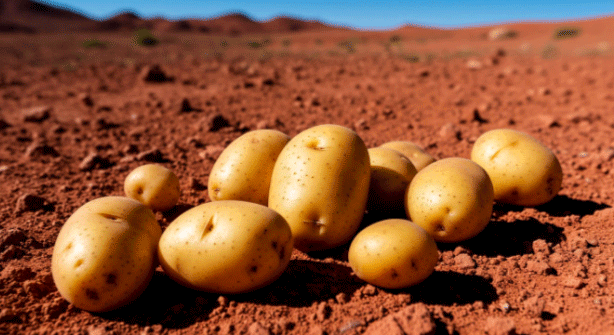
In 2016 the International Potato Center, with NASA support, tested whether potatoes could grow under Martian-like conditions. Rather than going to Mars, researchers used the Peruvian desert, whose soil closely resembles the Martian surface, and recreated Martian atmospheric pressure, air composition and environmental conditions in controlled growth chambers before planting several varieties. Some sprouted and began to grow, showing that with soil conditioning and regulation of water, temperature and air pressure, cultivation on Mars is a realistic possibility. The reason the crop is chosen over others is practical: where every square metre and drop of water counts, what matters is caloric output per unit area, and potatoes are strong on that measure. They are rich in carbohydrates, carry vitamin C and potassium, and store for relatively long periods after harvest — qualities that have made them a lifeline in wars and famines.

2016year of the CIP experiment
General partner
General partnerCrop protection for the potato industry

If humanity ever establishes a settlement on Mars, what crop would be planted first? Fans of The Martian might recall astronaut Mark Watney surviving on potatoes, but this scenario is not merely science fiction—real scientists have been testing its feasibility. In 2016, the International Potato Center (CIP), with support from NASA, conducted a groundbreaking experiment to determine whether potatoes could grow under Martian-like conditions. Rather than traveling to the Red Planet, researchers chose the Peruvian desert—a region with soil remarkably similar to that of Mars, often dubbed “Earth’s Mars.” There, they recreated Martian atmospheric pressure, air composition, and environmental conditions in controlled growth chambers and planted several potato varieties. The results were astonishing: certain varieties actually sprouted and began to grow, demonstrating that with proper soil conditioning, water, temperature, and air pressure regulation, potatoes could indeed be cultivated on Mars. The researchers concluded that, given the right conditions, growing potatoes on the Red Planet is a realistic possibility.

But why potatoes over countless other crops? The answer is surprisingly practical. In space, where every square meter and drop of water is precious, a crop that maximizes caloric output per unit area is essential—and potatoes excel in this regard. Nutritionally, they are rich in carbohydrates for efficient energy supply, contain vitamin C, potassium, and other beneficial nutrients, and can be stored for relatively long periods after harvest. Historically, potatoes have served as a lifeline during wars and famines, proving their resilience and ability to sustain populations when other food sources failed. Should humanity ever build a city on Mars, it is highly likely that potatoes will be among the first plants to be cultivated—making our extraterrestrial future perhaps more familiar than we imagine.
7 / 100 SEO Score

Global Potato Brief

Top five stories, prices, disease alerts and events. Weekday mornings, no advertising.

Sources

  1. International Potato Center (CIP) experiment with NASA support — described in the article

Linked in this material

Country
Peru
Sections
NewsSoil
Advertisement
A5 · 970 × 90Available — book this placement