Over the years, researchers have amassed an abundance of data comparing the pros and cons of whole and cut seed. Recently, my team examined data from 10 consecutive years of field trials comparing the response of cut seed potatoes and small, whole seed potatoes (also known as single-drop seed) to fungicide seed piece treatments that target Fusarium dry rot.
This article appears in the March 2022 issue of Potato Grower.
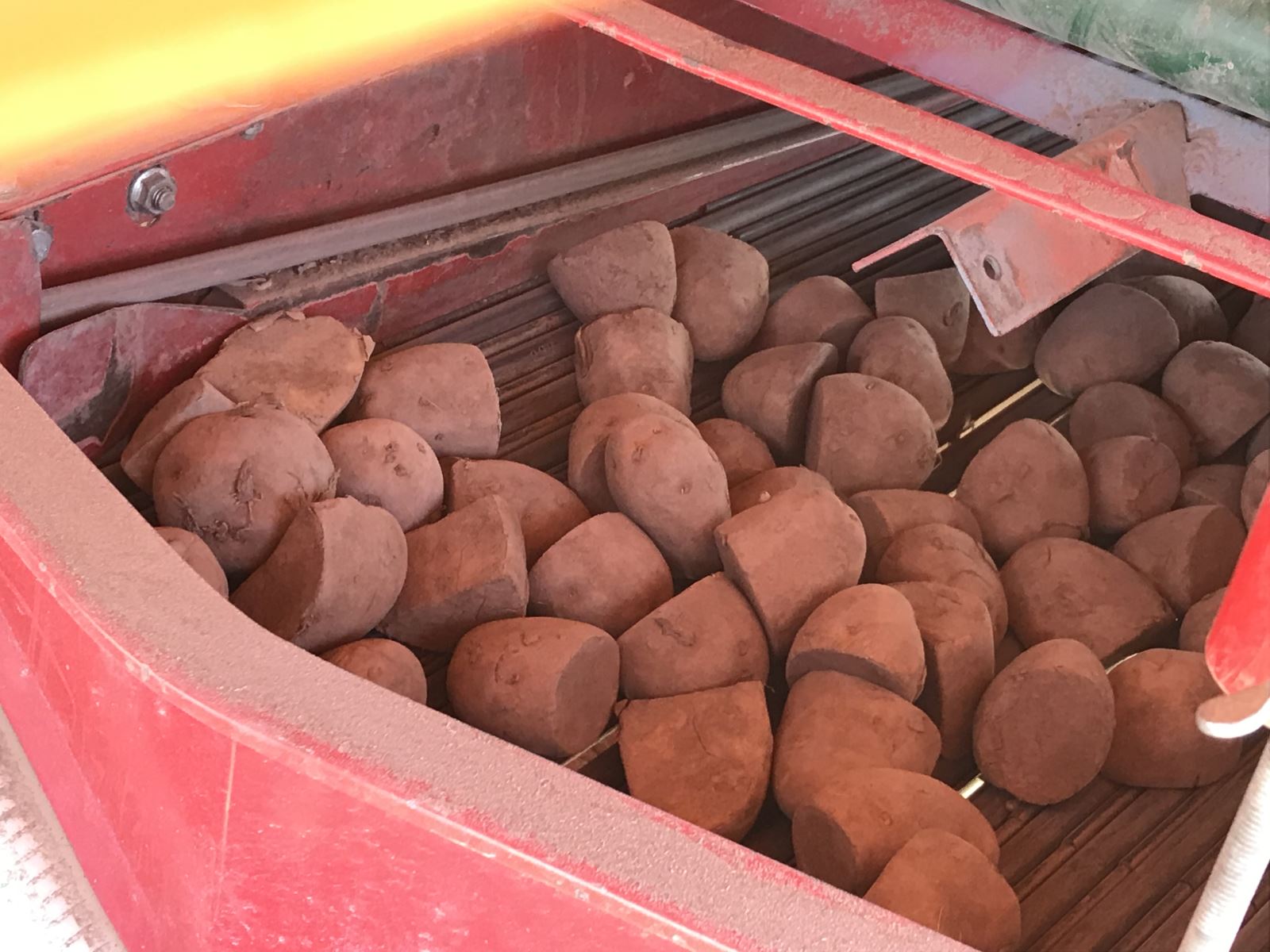
Previously published research showed that use of cut seed that was treated with a protectant fungicide seed treatment resulted in less Fusarium dry rot and greater yields (of large tubers and overall yield) compared to single-drop seed that didn’t receive the fungicide. However, in this earlier research, no comparisons were made with single-drop seed that was treated with a fungicide. Since then, similar trials at the University of Idaho were designed to include such a treatment, where fungicide was applied to single drop seed.
Specifically, we wanted to know if a fungicide seed piece treatment was as effective on whole seed as it is on cut seed in reducing Fusarium dry rot, a disease that can develop during storage, after seed handling and preparation, and after planting. The disease can arise from tuber-borne inoculum or from pathogens that are found in the soil. We also wanted to know if fungicide-protected cut seed would still outperform single-drop seed when it was also protected with a fungicide.
Weekdays. Unsubscribe in one click.

What We Did
All trials for our 10-year study were conducted at the University of Idaho Aberdeen Research & Extension Center. Russet Burbank seed potatoes from the same certified seed lot were used within each of the 10 years. The six treatments were the same across all the years:
- Cut seed, not inoculated and not treated with fungicide
- Single-drop seed, not inoculated and not treated with fungicide
- Inoculated cut seed, no fungicide
- Inoculated single-drop seed, no fungicide
- Inoculated cut seed, treated with fungicide
- Inoculated single-drop seed, treated with fungicide
The fungicide seed treatment we used was a commercially available combination of fludioxonil and mancozeb, and we applied it at the full labeled rate.
All inoculated treatments (treatments 3 through 6) were sprayed with a cocktail of spores from laboratory-grown Fusarium dry rot pathogens immediately after cutting and before applying any fungicide seed treatment, to simulate tuber-borne dry rot pathogens. The experiment was established using what is known as a randomized complete block design. This is a standard type of experimental design in agricultural research because it accounts for the natural variation that occurs in a field.
Once plants started to appear, we started collecting data. Within a few weeks of planting, we started to assess emergence. Mid-season, we dug up 10 plants per plot to evaluate stem numbers, Fusarium dry rot on the mother seed piece or whole tuber, and components of yield and grade. Since the trials were planted in fields with a history of Rhizoctonia canker, we also assessed for that disease. Plants were vine-killed using a diquat product, and about three weeks later, the remaining plants in the plots were harvested.
What We Found
When we looked at the data, we found that single-drop seed emerged better than cut seed (whether treated with fungicide or not), and fungicide-treated seed (whether single-drop or cut) had better emergence than non-fungicide treated seed. We also looked at stem number, which would be useful when managing a potato crop, because tuber size can be related to the number of stems. Some markets desire large, uniform tubers (a goal typically resulting from fewer stems), while other markets demand smaller, more numerous tubers (a goal generally best achieved from plants that produce more stems).
Alas, our data didn’t contribute meaningfully to efforts related to predicting stem number, which likely can’t be done based on seed type alone. This outcome is not surprising, because research conducted and reported by other groups has shown that predicting stem number is complicated and more influenced by other factors outside the scope of our study, such as heat units in storage or use of plant hormones.
When it comes to Fusarium dry rot, we were able to clearly demonstrate that a fungicide seed piece treatment led to the lowest levels of Fusarium dry rot in all but two years, regardless of seed type. We also showed that single-drop seed nearly always had lower levels of Fusarium dry rot compared to cut seed, regardless of whether a fungicide seed piece treatment was used.
Now for the bottom-line question: How does seed type influence yield and quality? When data from all years were combined and analyzed, it turns out that there was no difference in large tuber yield of single-drop seed compared to that of cut seed. Looking at total yield (including U.S. No. 1, U.S. No. 2 and culls), we found that although single-drop seed led to total yield that was greater than that of cut seed, seed type didn’t have a noticeable effect on yield of U.S. No. 1 tubers. A greater impact on total yield, and more importantly on total U.S. No. 1 yield, was achieved simply by using a fungicide seed potato treatment, regardless of seed type.
In the end, what seed type is best depends on many factors, such as those dictated by the confines of a particular farming operation, availability, costs of single-drop compared to cut seed, and even the potato variety (the work here was limited to Russet Burbank). We know Fusarium dry rot on seed potatoes is currently best managed by use of high-quality certified seed, implementing handling practices of seed tubers that minimize wounds and promote healing, and planting under conditions that prevent condensation on the seed and promote plant growth.
In addition to these strategies, one of the best tools for managing Fusarium dry rot in seed potatoes, regardless of seed type used, is to use an appropriate protectant fungicide directly applied to the seed.