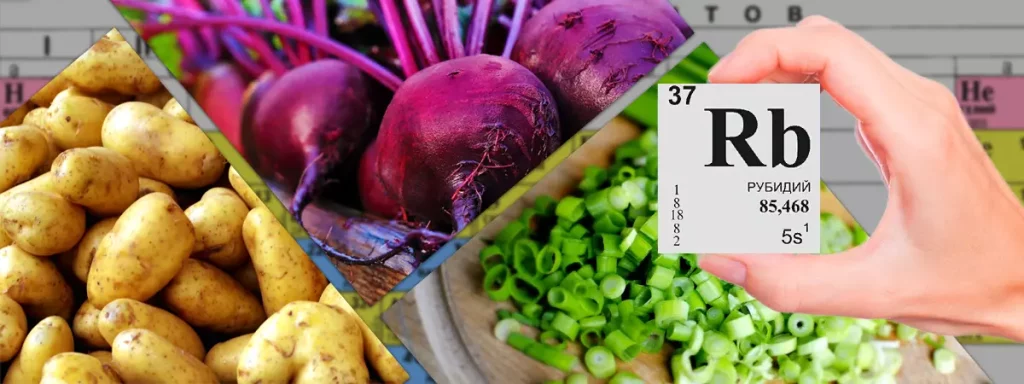
Rubidium has a documented place in potato physiology research, including experiments on ion uptake by tuber tissues. Its usefulness as an experimental tracer helps explain its appearance in scientific papers. That role should be kept distinct from a claim that rubidium is a proven fertiliser for commercial potato production.
Updated November 2026. This source-linked edition replaces the earlier article while retaining its archive address and original publication date.
The earlier research asked an uptake question
Higinbotham and Hanson’s 1955 Plant Physiology paper examined the relationship between external rubidium concentration and the amounts and rates taken up by excised potato tuber tissue. The title identifies a focused physiological problem: how tissue responds to the surrounding solution.
Weekdays. Unsubscribe in one click.
The experimental unit is important. A piece of tuber tissue gives researchers access to transport behaviour under controlled conditions. It does not represent the complete sequence from root uptake in soil to canopy development, tuber growth, grading and sale. A transport experiment can be valuable without being a fertiliser-yield trial.
Later work examined the regulation of transport
In 1999 Biologia plantarum research, Reddahi and colleagues studied potassium uptake in potato tuber tissue in relation to abscisic acid, proton extrusion and calcium fluxes. The publication identifies rubidium-86 uptake among its experimental subjects. The authors examined responses to changes in external pH and to compounds used to investigate calcium-related processes.
Their results supported a proposed relationship between hormone responses and ion transport. This is evidence about the behaviour of the experimental tissue and the interpretation of its transport system. It should not be converted into an instruction to apply a hormone, an inhibitor or a rubidium compound in a potato field.
Tissue condition is part of the experiment
A companion 1999 paper on ageing and abscisic acid compared freshly cut potato tuber tissue with tissue aged for 24 hours. Uptake behaviour differed with external potassium concentration and tissue condition, while abscisic acid increased uptake rates. The experiment makes tissue preparation part of the interpretation.
For a reader comparing experiments, questions about tissue preparation, time after cutting, solution composition and the measured interval are therefore substantive. A larger tracer signal may help answer a transport question, but does not by itself establish that a harvested crop would produce more marketable potatoes. The endpoint being claimed must be the endpoint actually measured.
Connecting physiology with farm nutrition
A practical potato nutrient guide, such as the University of Alaska’s recommendations, discusses potassium in a crop-production context and uses soil information to guide interpretation. That is a separate kind of evidence from a tracer experiment on excised tissue.
For growers, the useful connection is to understand the biological questions behind nutrient research while evaluating field recommendations on field evidence. A proposed fertiliser benefit needs a defined formulation, an appropriate comparison, a complete crop assessment and quality measurements relevant to the intended buyer. A tracer’s presence in the methods section does not supply those results.
The rubidium literature is consequently worth restoring as a research story. It shows how investigators study ion movement and its regulation in potato tissue. Its contribution is knowledge of physiology; the cited work does not demonstrate the previous promises of better flavour, shelf life, drought tolerance or commercial yield from rubidium feeding.
What this means for growers and the supply chain
- Read rubidium use in the methods as part of the experimental design.
- Keep tracer uptake distinct from a crop-yield or product-quality endpoint.
- Evaluate potassium nutrition through locally relevant agronomic evidence.