• Latest
  • Trending
  • All
  • News
  • Business
  • Politics
  • Science
  • World
  • Lifestyle
  • Tech
chlorine in fertilizers

Too much chlorine in fertilizers can harm crops

10.04.2021
Potato Season in Kyrgyzstan – “The Second Bread” of the Nomads and the Traditional Kuurdak Dish

Potato Season in Kyrgyzstan – “The Second Bread” of the Nomads and the Traditional Kuurdak Dish

20.06.2026
Palbongsan Potato Festival in Seosan – A Must-Visit Summer Rural Experience in Chungnam

Palbongsan Potato Festival in Seosan – A Must-Visit Summer Rural Experience in Chungnam

20.06.2026
Jeongseon-gun Pioneers Advanced Mechanization Model for Potato Farming to Tackle Rural Labor Shortages

Jeongseon-gun Pioneers Advanced Mechanization Model for Potato Farming to Tackle Rural Labor Shortages

20.06.2026
Jeongseon-gun Drives Agricultural Mechanization – 70% of Potato Farming Equipment Shared to Tackle Labor Shortages

Jeongseon-gun Drives Agricultural Mechanization – 70% of Potato Farming Equipment Shared to Tackle Labor Shortages

19.06.2026
Qingdao’s Purple Potato Sensation – Crunchy, Sweet, and Eaten Raw, Sold Out Before Harvest

Qingdao’s Purple Potato Sensation – Crunchy, Sweet, and Eaten Raw, Sold Out Before Harvest

19.06.2026
From Pig Feed to Profitable Harvest – How a Mountain Village’s Potato Plan Transforms Elderly Lives

From Pig Feed to Profitable Harvest – How a Mountain Village’s Potato Plan Transforms Elderly Lives

19.06.2026
Precision and Productivity: Insights into Advanced Potato Cultivation on Heavy Soils

Precision and Productivity: Insights into Advanced Potato Cultivation on Heavy Soils

19.06.2026
Boosting Agricultural Efficiency: Ecuador’s MAGP Launches Potato Yield Operation in Azuay

Boosting Agricultural Efficiency: Ecuador’s MAGP Launches Potato Yield Operation in Azuay

19.06.2026
Peru Advances Potato Industrialization with New Strategic Regulation

Peru Advances Potato Industrialization with New Strategic Regulation

19.06.2026
Boosting Potato Productivity: New Investment in Huancavelica, Peru

Boosting Potato Productivity: New Investment in Huancavelica, Peru

19.06.2026
Henan’s Contract Potato Harvest Booms – Specialty Farming Paves the Way for Rural Prosperity

Fujian Launches “Zhenghe High-Mountain Potato” Brand – Elevating Specialty Agriculture to New Heights

18.06.2026
Henan’s Contract Potato Harvest Booms – Specialty Farming Paves the Way for Rural Prosperity

Henan’s Contract Potato Harvest Booms – Specialty Farming Paves the Way for Rural Prosperity

18.06.2026
  • Home
  • IPT
    • POTATO 2.0
  • News
  • AGROTECHNOLOGY
  • IRRIGATION
  • About Us
    • Contact us
Sunday, June 21, 2026
  • Login
POTATOES NEWS
  • Home
  • IPT
    • POTATO 2.0
  • News
  • AGROTECHNOLOGY
  • IRRIGATION
  • About Us
    • Contact us
No Result
View All Result
POTATOES NEWS
No Result
View All Result
Home AGROTECHNOLOGY Agronomy

Too much chlorine in fertilizers can harm crops

by Alexey Demin
10.04.2021
in Agronomy, Fertilizers and pesticides
0
chlorine in fertilizers
845
SHARES
2.4k
VIEWS
Share on LinkedInShare on ВКонтакте
Chlorine is ubiquitous in nature and is taken by plants from various sources: from fertilizers, from soil, from precipitation, from water used for irrigation or from polluted air.

Lower and poorer quality yield – what could be the reason for this? According to ICL Polska experts, these may be factors that are usually not paid too much attention, such as too high a concentration of chlorine in the soil.

Chlorine plays an important role in many physiological processes of plants and is a micronutrient from the point of view of their nutrition. The average chlorine content in plants is 2-20 mg g -1  dry weight. The chlorine requirements of most species are 10 to 100 times lower. Nevertheless, chlorine affects water management, photosynthesis and transpiration. It is ubiquitous in nature and is taken by plants from various sources: from fertilizers, from soil, from precipitation, from water used for irrigation or from polluted air. Therefore, in cultivation, we more often encounter too much (in many cases, toxic) amount of this element than with its deficit. We talk to Paweł Głowicki from ICL Polska about how to avoid the problem of excess chlorine.
calculation rules needed

Why is chlorine harmful to plants?

First of all, because there is often too much of it in the soil, and few plants thrive in his company. Germinating and young plants are particularly sensitive to the effects of chlorine, as this element, through its influence on enzymatic systems, disrupts plant development, and in particular reduces the germination capacity of seeds. Symptoms of chlorine poisoning include drying of the tops and edges of the leaves, followed by browning and falling off. 

Chlorophilic is only a small group of plants, which include: sugar beet, fodder beet, celery, chard. Grains, corn, rapeseed, grasses, clovers, soybeans, red beets, and most cabbage are neutral to this substance. Plants partially tolerating chlorides are: potato, sunflower, grapevine, black currant, tomato, radish, Brussels sprouts, peas,

Which crops are particularly sensitive to the high concentration of this nutrient?

Plants very sensitive to chlorides are fruit trees and shrubs – gooseberries, raspberries, red currants, strawberries, blackberries, blueberries, stone fruit (especially cherries) and vegetables such as: beans, broad beans, cucumber, pepper, onion, lettuce, vegetables early, all crops under cover and starch potatoes, tobacco, hops.

 Ornamental plants are also sensitive. Therefore, only fertilizers that are low in chloride or that do not contain chloride are recommended for fertilizing these crops. Increased concentration of this component in the substrate causes poor growth and negatively affects both the size and quality of the crop (loss of taste, decrease in sugar, starch and protein levels, decrease in storage capacity, both in raw and processed form).
irrigated field
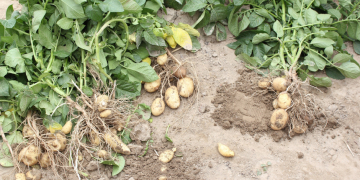
An excess of chlorine in the soil may deteriorate the quality as well as reduce the starch content in potato tubers.

What distinguishes your product – Polysulphate – on the market of this type of fertilizer?

The fact that it is characterized by a very low chlorine content (very low salinity index compared to other fertilizers of this type). You can practically say that it is a chloride-free fertilizer – ideal especially for crops sensitive to this ingredient. In addition, it is perfectly soluble in water, easily digestible and inexpensive product for fertilizing crops, providing plants with four essential nutrients: sulfur, potassium, magnesium and calcium.

 Polyhalite, the main component of Polysulphate, is a mineral that is a natural multi-component fertilizer, mainly composed of sulfur (48% SO 3 ), potassium (14% K 2O), magnesium (6% MgO) and calcium (17% CaO) in the form of sulphate. Polysulphate – as the research shows – guarantees an optimal, prolonged release of sulphates from the fertilizer, adapted to the plant vegetation process, and the risk of their loss through rinsing is significantly reduced. 

Looks like the Polysulphate family of fertilizers has grown recently?

Yes. Polysulphate is also a component of many fertilizers, the so-called PK PluS. One of the many available on the Polish market is PK PluS 10-20 + 2MgO offered by ICL Polska. The numerous available formulations of ICL PK PluS fertilizers allow farmers to use phosphorus and potassium together with sulfur, magnesium and calcium in one application – one granule contains as many as 5 nutrients. 

The distinguishing feature of the ICL PK PluS fertilizer is a mixture of two forms of potassium: chloride and sulphate. As a result, we reduce the amount of chlorides supplied to the soil and increase the flexibility of fertilizer application. With intensive nitrogen fertilization, sulfur, which is a component of these fertilizers (and remember that arable soils in our country are less and less rich in sulfur available to plants) significantly support its transformation in the plant.

Can the product be used in organic farming?

Yes. Polyshulphate has been approved for use in organic farming all over the world, including Poland, because it is a crushed, naturally occurring mineral – polyhalite, obtained from rocks and not chemically processed. This mineral is a natural, multi-component fertilizer. Therefore, this fertilizer has obtained a certificate of product qualification for use in organic farming.

Too much chlorine in fertilizers can harm crops

/agronomic-archive/

Tags: ADSirrigationmineral fertilizerssoil management
Share59Share42
Alexey Demin

Alexey Demin

  • Trending
  • Comments
  • Latest
Potatoes.news 2025: The Nervous System of the Global Potato Industry

Potatoes.news 2025: The Nervous System of the Global Potato Industry

01.01.2026
Subway launches Spudway: a new era of hot baked potatoes

Subway launches Spudway: a new era of hot baked potatoes

26.02.2025
Processing and Packaging Equipment supplier tna expands manufacturing in the Netherlands

Processing and Packaging Equipment supplier tna expands manufacturing in the Netherlands

22.04.2021
Aviko Belgium orders peace of mind

Aviko Belgium orders peace of mind

0
Potato crops at risk of disease during slower desiccation

Potato crops at risk of disease during slower desiccation

0
GRIMME Technica will not take place

GRIMME Technica will not take place

0
Potato Season in Kyrgyzstan – “The Second Bread” of the Nomads and the Traditional Kuurdak Dish

Potato Season in Kyrgyzstan – “The Second Bread” of the Nomads and the Traditional Kuurdak Dish

20.06.2026
Palbongsan Potato Festival in Seosan – A Must-Visit Summer Rural Experience in Chungnam

Palbongsan Potato Festival in Seosan – A Must-Visit Summer Rural Experience in Chungnam

20.06.2026
Jeongseon-gun Pioneers Advanced Mechanization Model for Potato Farming to Tackle Rural Labor Shortages

Jeongseon-gun Pioneers Advanced Mechanization Model for Potato Farming to Tackle Rural Labor Shortages

20.06.2026
BE PROFY IN POTATOES NEWS

Copyright © 2010-2026 POTATOES NEWS.

Navigate Site

  • Home
  • IPT
  • News
  • AGROTECHNOLOGY
  • IRRIGATION
  • About Us

Follow Us

Welcome Back!

Login to your account below

Forgotten Password?

Retrieve your password

Please enter your username or email address to reset your password.

Log In
No Result
View All Result
  • Home
  • IPT
    • POTATO 2.0
  • News
  • AGROTECHNOLOGY
  • IRRIGATION
  • About Us
    • Contact us

Copyright © 2010-2026 POTATOES NEWS.