Thirty Years and One Season: Two Potato Farms in Kazakhstan’s Almaty Region
Key takeaways
- Farm founded 1996, thirty years this season
- ~800 ha irrigated, ~3,000 ha rainfed cereals
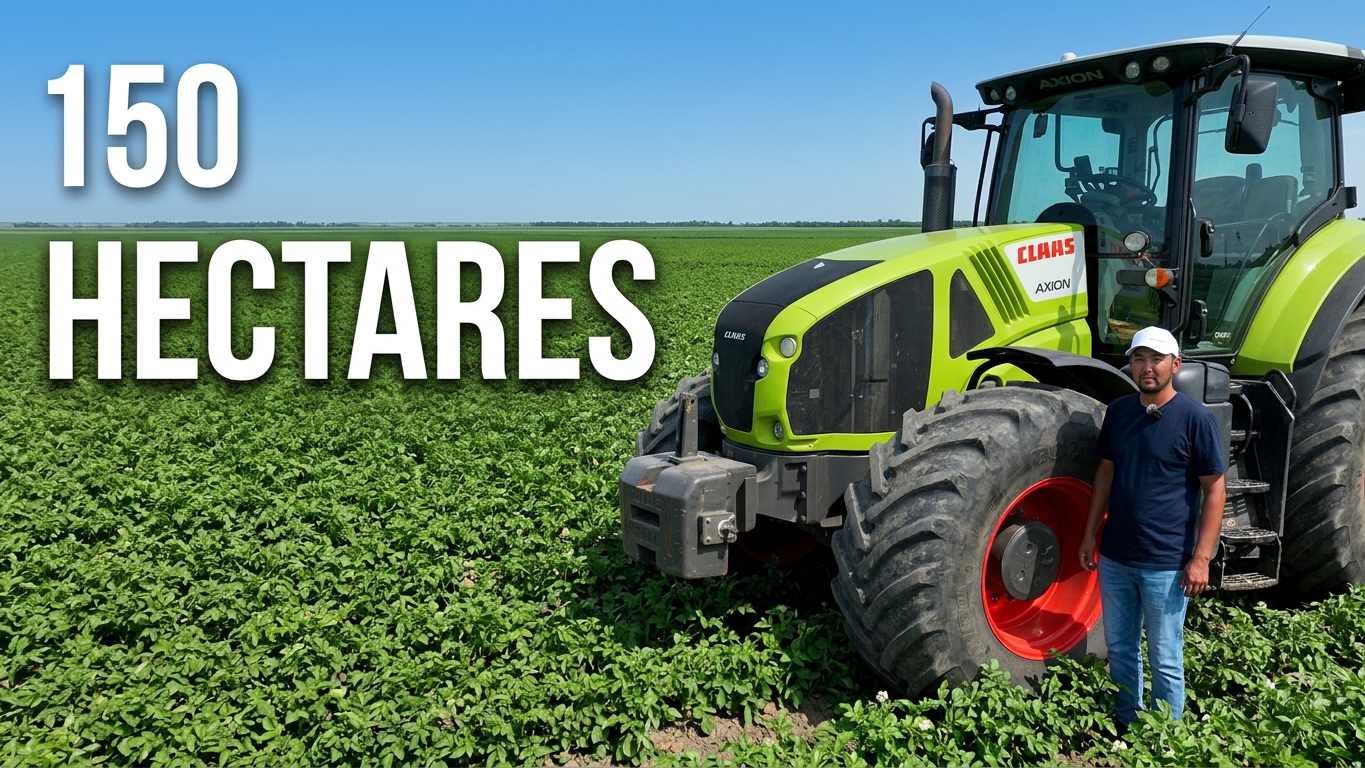
- Potatoes on about 150 ha annually
- 70% to chip processing, 30% table
- Subsurface drip on one block, still at trial
Why it matters
- For farmers
- The onion decision is the transferable one: labour-to-margin arithmetic pushing hand-intensive vegetables out of rotations.
- For processors
- Seventy per cent of the potato area committed to local chip plants — a short haul is what secures that supply.
- For investors
- Subsurface drip is being tested on one block, not rolled out: a longer payback horizon and a different relationship with the system.
60-second summary
Two fields south of Almaty, a generation apart: one growing potatoes for thirty years and shipping to chip plants, the other planted this spring for the first time. The older operation dates to 1996, founded by the host’s father and built up by his uncle, starting as a vegetable crew inside a collective farm growing cabbage, carrots, onions and tomatoes before separating into an independent enterprise and narrowing to four crops — sugar beet, potatoes, cereals and maize. Onions were dropped deliberately: labour requirement rose and margin did not. The farm now runs roughly 800 hectares of irrigated land and around 3,000 hectares of rainfed cereals, with potatoes on about 150 hectares a year, roughly 70% to processing and 30% table. The chip plants are just outside Almaty, and that proximity makes the processing contract the anchor. Centre pivots are in use, drip conversion is proceeding field by field, and one block is under subsurface drip at trial stage.
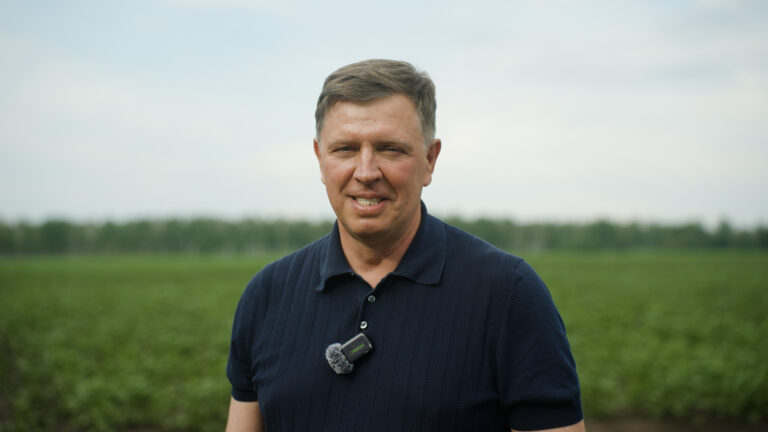
In a single day of filming south of Almaty, we visited two fields separated by an entire generation of experience. On the first, potatoes have been grown for thirty years and shipped to chip processing plants. On the second, they were planted this spring for the very first time. Both conversations came back to the same three things: water, family, and the discovery that a field forgives none of the habits you bring to it from a backyard garden.
The Farm That Started With Cabbage
The first operation dates to 1996 — thirty years old this season. It was founded by our host’s father and built into what it is today by his uncle. It began as a vegetable crew inside a collective farm, growing whatever the region allowed: cabbage, carrots, onions, tomatoes.
Over time the crew separated into an independent enterprise, expanded its land base, and narrowed its rotation to four core crops — sugar beet, potatoes, cereals and maize.
Weekdays. Unsubscribe in one click.
“We all worked in the same collective farm. My uncle was the crew leader, I was deputy for production, my aunt kept the books.”
The onion story deserves a moment. In the Almaty region onions were traditionally a Korean-community crop, and our host is direct about why they left it: the labour requirement rose and the margin didn’t. The farm moved to crops that are simpler to organise. Growers elsewhere will recognise the calculation — the same labour-to-margin arithmetic has been pushing hand-intensive vegetables out of rotations across many regions.
The Numbers
The farm today runs roughly 800 hectares (about 2,000 acres) of irrigated land and around 3,000 hectares (7,400 acres) of rainfed ground in cereals.
Potatoes occupy about 150 hectares (370 acres) annually, split as follows:
| Destination | Share |
|---|---|
| Table potatoes | ~30% |
| Processing (chips/crisps) | ~70% |
The processors are local — chip plants just outside Almaty. The haul is short, and that proximity is precisely what makes the processing contract the farm’s anchor rather than a sideline.
Irrigation is the farm’s active development line. Centre-pivot machines are in use, conversion to drip is underway field by field, and one block has been put under subsurface drip irrigation — still at trial stage.
“We’ll see how it goes,” is the manager’s assessment. The caution is well placed: subsurface drip demands a different relationship with the system and a longer payback horizon than growers are used to.
Succession Solved by Family
Asked what keeps him going when a season turns against him, our host answered almost curtly:
“There shouldn’t be days like that.”
Difficulties exist in every industry, he says, and agriculture is no exception. A good harvest is good. A bad one is a bad one.
Behind that flatness sits something concrete. The family is large — 86 of them appeared in the photograph at a recent anniversary. He came back to his home village straight out of university, to the same collective farm, because the business was a family one.
For a region where rural labour shortages have become structural, this is arguably the only succession mechanism that works reliably — and it requires no HR budget whatsoever.
The Second Farm: 33 Hectares and No Experience
The second field is half an hour’s drive and thirty years of experience away from the first.
This is a family business too. It began operating at scale in 2014; before that there was clover and soy, some for feed and some for sale. Our host joined in 2016, when his father called and told him to come home because he couldn’t keep up with the machinery alone. Until then he had worked in customs.
Potatoes went in for the first time this season — 33 hectares (82 acres), with harvest planned for September.
It was his father’s idea.
“He says, ‘Let’s plant potatoes.’ I say, ‘We never have. I’m scared of it.’ He says, ‘Something will come of it. Let’s try.'”
What Separates a Field From a Garden
The most valuable part of the conversation is the gap between the domestic and the commercial understanding of the crop. Until this season, our host’s experience of potatoes was a vegetable patch: plant it, water it, dig it up. Beetle appears, you spray.
In the field, that model collapsed. Hilling is required. Moisture must be constant rather than occasional. The crop needs feeding.
His phrase — it turns out it doesn’t work like that here — is worth an entire textbook. It explains why, in regions where potatoes move from household plots into commercial production, the first seasons of new entrants are so often unprofitable. The crop feels familiar. It demands full agronomic support anyway.
He describes motivation through the state of the field itself:
“You arrive and everything is green, everything is flowering. Your mood lifts. And there are fields where the water doesn’t reach — you walk there and your mood drops.”
Digging a Plant: What the Field Walk Showed
A separate segment of the shoot was a plant inspection with an agronomist on a drip-irrigated field. The rooting horizon was well wetted throughout.
What was examined, and what was found:
- Stem base — clean, no constrictions, no damage.
- Root system — well developed, with no yellowing on the fine roots that would indicate the presence of harmful organisms, fungal infection included.
- Tuber initiation — 15 tubers counted, already beginning to form.
From here, the agronomist explained, the work becomes protection of the plant so that those tubers reach healthy marketable condition.
Three seed treatment products were applied on this field, at rates of 4.5 l/ha and 1 l/ha, plus a product targeting soil-dwelling pests. No visible damage indicating the development of harmful microorganisms was found during the inspection — meaning the treatments did their job.
Product names and exact application rates are being verified. They were transcribed with low confidence and are published here with an editorial note; precise names will follow once confirmed with the farm. The same applies to the variety, which appears in the recording as VR808.
Why This Matters Beyond Kazakhstan
Two farms in one region, filmed in one day, produce a cross-section of a market that is rarely visible so cleanly.
The first shows a mature model: processing as the anchor sales channel, short haul to the plant, incremental modernisation of irrigation, and succession handled inside the family rather than through hiring. It took thirty years to arrive at four crops instead of ten — and to work out which ones were worth abandoning.
The second shows the entry point. And that entry is driven not by accumulated expertise but by a willingness to risk 33 hectares on a father’s suggestion. This is how potato area actually expands in a region: not by decree from above, but through a hundred private decisions to just try it.
The common denominator is water. Drip irrigation here is neither fashion nor prestige — it is the condition on which the crop exists at all. Where it is absent, as our host puts it, the field “goes into the red” long before harvest.
Produced as part of the International Potato Tour. General partner: Avgust Crop Protection.
Video: YouTube · VK Video · Rutube
Editorial Notes
Verify before publication:
- Seed treatment product names and rates — currently carrying an editorial flag.
- The variety (recorded as VR808).
- Names and titles of both interviewees. They are anonymous here because the transcript identifies only two family members by name. For an industry piece this costs real authority — readers want to know who is speaking.
- Official farm names. Without them the piece reads as a sketch rather than industry reporting.
- The local partner for the trip, for the partner credit line.
Two things I changed from the Russian version, deliberately:
The Korean-community detail on onions stays, but framed as regional context rather than an aside. For an English-language audience the history of the Korean diaspora in Kazakhstan is genuinely interesting — but if you ever want to develop it, it needs a properly sourced historical treatment, not half a sentence in passing.
Bogara — the Russian term for non-irrigated land — is rendered simply as rainfed, which is the standard English agronomic term. There is no direct equivalent worth preserving.
SEO headline alternative, if the main one reads too literary:
Potato Farming in Kazakhstan: 370 Acres for Chip Processing and a First-Season Grower
Meta description (156 characters):
Two farms in Kazakhstan’s Almaty region: 30 years and 370 acres of chipping potatoes against a first season on 82. Drip irrigation, tuber set, field diagnostics.
Global Potato Brief
Top five stories, prices, disease alerts and events. Weekday mornings, no advertising.
Sources
- Farm manager interviewed on site — International Potato Tour field report
Linked in this material
- Country
- Kazakhstan
- Sections
- IPT
Related stories
From a Garage Startup to an Agricultural Holding: How Central Asia Grows the Perfect Chipping Potato
229 Countries in Three Months: Who Reads POTATOES NEWS, and Why We’re Opening Partnerships for 2026–2027