The Pavlodar Phenomenon: How Potatoes are Changing Agriculture in Kazakhstan
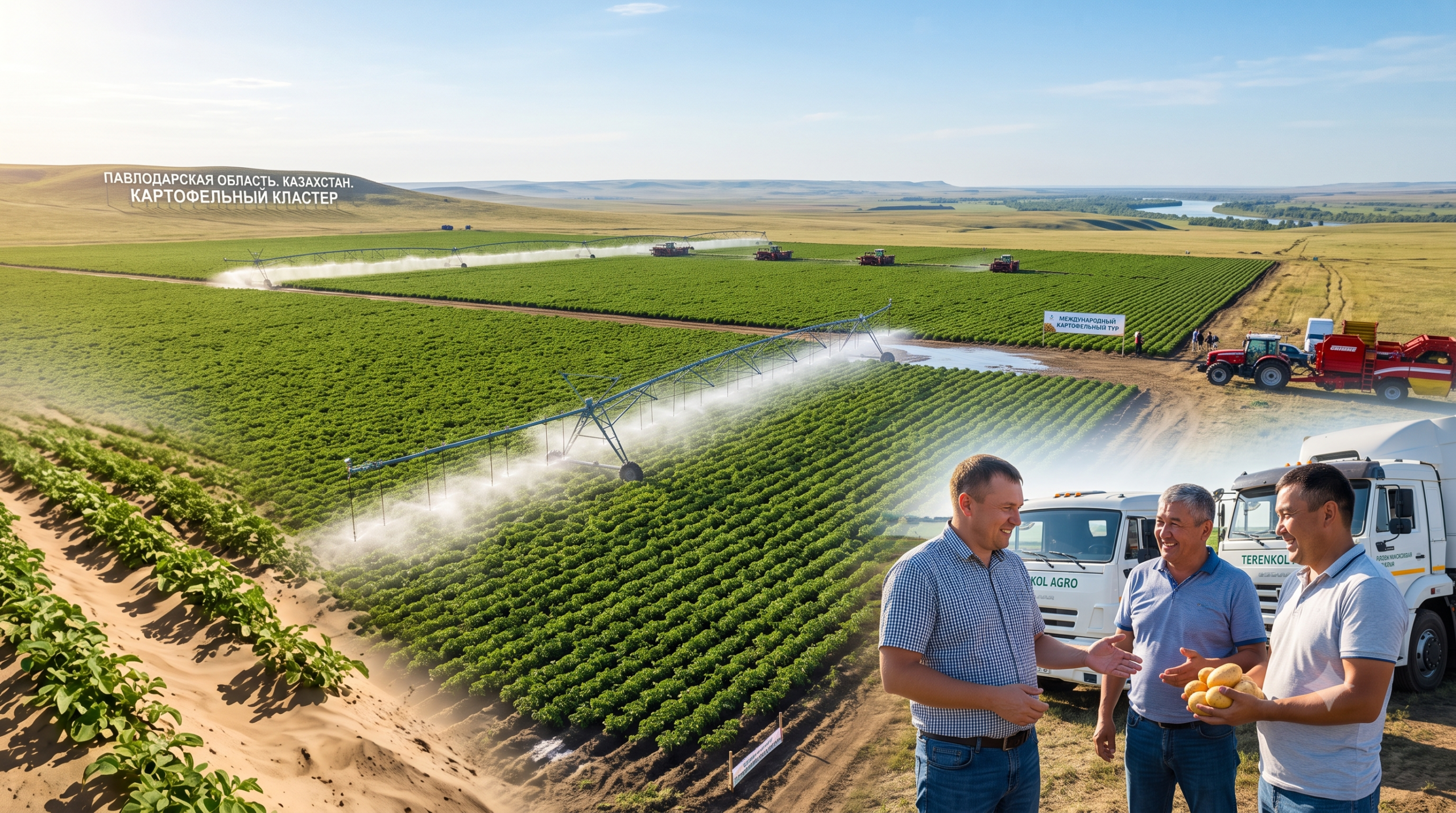
Special Report from the International Potato Tour: Pavlodar Region, Kazakhstan
Today, the Pavlodar region is one of the key potato-growing clusters in Kazakhstan. As part of our International Potato Tour, we visited the Zhelezinsky and Terenkolsky districts to see firsthand how local farmers harvest record yields on sandy soils amid abnormal heat and resource shortages. They provide the “second bread” not only for their own region but also for the capital, while exporting their products to southern countries.
Sand and Sun: Perfect Washing and Harsh Dunes


The specifics of potato farming in this region are dictated by nature itself. The local soils are predominantly sandy. On one hand, this is an undeniable advantage during the harvest.
“If there is no rain during the harvest, our potatoes come out perfectly clean, as if right out of the washer,” shares Dmitry Kozinets, head of the “Terenkol Agro” peasant farm, who transitioned into agriculture from the transportation business in 2017.
Weekdays. Unsubscribe in one click.
However, sand has its dark side—severe wind erosion. Timur Kabdulov, head of the “KAP” peasant farm, who cultivates 550 hectares of potatoes, talks about battling the elements:
“We have terrible wind erosion here. If you make a classic fallow land with soil cultivation, dunes 50 centimeters high grow right at the end of the fields. Therefore, I try not to touch the soil; I use chemicals and sow oats to secure the topsoil.”
The second challenge is the climate. Abnormal heat (over 30°C for a month) requires continuous irrigation. Farmers pour 15-20 mm of water, and the irrigation machines never stop for a minute.
From Grain to Vegetables: Economics and Profit Margins
It is interesting to observe how the profile of the farms is changing. Many managers and agronomists were staunch “grain growers” in the past. What makes them switch to vegetables? The answer is simple: economics.
For large livestock complexes, potatoes become a financial cushion. Nikolay, an agronomist at a young farm with 5,000 heads of cattle, explains this strategy:
“Growing forage in our non-irrigated (bagara) zone is very difficult. We introduced irrigated plots, built reservoirs, and drilled wells 850 meters deep. These are huge borrowed funds. It takes a lot of time for the forage to grow and for the cow to give milk. But potatoes and carrots mean ready cash. We grow them, sell them, and in the same year, we have working capital to pay off our debts.”
The entry barrier to this business is high today. According to Dmitry Kozinets, with the capital he started with 9 years ago (buying an old Soviet DDA sprinkler system), he could only manage about 10 hectares today. Now, farmers use modern frontal and pivot machines, powerful equipment (such as Grimme), and build state-of-the-art vegetable storages with government support (subsidies for storage facilities are about 800,000 tenge per ton, and up to 30% for elite seeds).
The Undisputed Leader: Gala Variety
There is a monopoly of one variety in the fields of the Pavlodar region. The vast majority of farms rely on the Gala variety. The reasons are pragmatic: excellent keeping quality, stable yield, and high market demand. Experiments with red varieties show that local clients and buyers from Uzbekistan (the main export destination) prefer yellow potatoes.
Farmers try to purchase seeds of the highest reproduction (elite seeds are even imported from Germany) and propagate them on their farms, providing themselves with excellent quality planting material for several years ahead without losing yield.
Agronomy: The Battle for Tuber Health
The potato crop demands immense attention. Eldar Usmanov, an agronomist at “Astyk PV” LLP (2,500 hectares under irrigation), compares his work to medicine:
“A potato is like a living creature. It needs a lot of attention; you have to constantly monitor it. The plant is alive, and we are its doctors. We must ensure that it stays healthy.”
And there is plenty to treat. Under intensive irrigation, farmers face a complex of diseases:
- Rhizoctoniosis (black scurf): One of the main problems on light soils, leading to cracks in the tubers. The fight is conducted by applying modern fungicides (azoxystrobin, fludioxonil) directly during planting.
- Alternariosis (early blight): Appears during heat stress, starting in late June.
- Late Blight (Phytophthora): Although not an annual disaster, it keeps farmers on high alert. The number of preventive treatments in some farms has grown from 2 to 8-9 per season.
- Pests: Nematodes and wireworms also require adjustments to crop rotation and the use of insecticides (e.g., fipronil).
The nutrition scheme is also intensive. Impressive doses are applied to the soil before planting and hilling: 500 kg of diammonium phosphate (DAP), potassium chloride and sulfate, and saltpeter.
Infrastructural Barriers: Water and Electricity
The main obstacle to the development of irrigated agriculture in the region today is not a lack of land or equipment, but an electricity shortage.
According to Eldar Usmanov, when the active irrigation season begins and neighboring large farms simultaneously turn on dozens of pumping stations, there is a catastrophic lack of voltage in the grid.
The second problem is access to water. Farms located far from the Irtysh River (up to 150 km) have to drill ultra-deep wells (up to 850 m) with low yields (only 20 l/s) and build huge storage ponds, which requires massive investments.
The Human Factor
Despite the heat, sandstorms, plant diseases, and power outages, the people working here are truly passionate about what they do. Most farms are family-owned, where experience is passed down from fathers to children, and responsibilities are clearly distributed among brothers and sisters (as, for example, in the “Kundyz” peasant farm, which has grown from 40 hectares in 1993 to 15,000 hectares today).
When asked what gives them strength when they feel like giving up, the farmers unanimously answer: the support of their families, love for their work, and, of course, the magic of the result.
“The most enjoyable part for me is the harvest process,” summarizes agronomist Nikolay. “When you see what you have grown over the season, and you are harvesting it, there is joy in your heart when everything worked out and is going smoothly.”