Tanzania: Farmers Harvest 752,520 Tonnes of Irish Potatoes and Sell 87.8% Unprocessed
Mainland Tanzania produced 752,520 tonnes of Irish potatoes in the 2023/24 agricultural year at 10 t/ha, the national statistics bureau says. Small farms grow almost all of the crop.
Mainland Tanzania produced 752,520 tonnes of Irish potatoes in the 2023/24 agricultural year. This is the result of the Annual Agricultural Sample Survey 2023/24 by the National Bureau of Statistics (NBS) and the Office of the Chief Government Statistician in Zanzibar. The key findings report was released in September 2025. The survey found no Irish potato production in Zanzibar.
The average yield was 10.0 tonnes per hectare. With this yield, the crop area was roughly 75,000 hectares.
The survey shows a sector run by small farms:
Weekdays. Unsubscribe in one click.
- Agricultural households produced 752,332 tonnes, at 10.0 tonnes per hectare.
- Large-scale farms produced only 188 tonnes, at 3.5 tonnes per hectare.
- Tanzania has 8,971,794 agricultural households in total.
Irish potato is a cash crop for these households. According to the NBS, households sold 87.8% of their potato harvest unprocessed and used only 8.1% for their own food. Large-scale farms sold 97.7% of their crop unprocessed. The report calls Irish potatoes an exception among roots and tubers, because a much larger share is sold.
In the same NBS table, Irish potatoes were the largest root and tuber crop in Mainland Tanzania. The table lists 467,733 tonnes of cassava and 301,428 tonnes of sweet potatoes. The key findings report does not give a regional breakdown, the planted area, or a comparison with 2022/23 for potatoes.
Why it matters
The data describe a market crop grown almost entirely by small farmers. Nearly nine of every ten tonnes go to buyers, but almost none is processed on the farm. This means that value is added, if at all, by traders and processors further down the chain.
A yield of 10 tonnes per hectare is modest. Large farms reached only 3.5 tonnes per hectare, which suggests they are not yet a driver of better practice. For seed suppliers, processors and development projects, the main opportunity is with smallholders: better seed, storage and links to processing could raise both yields and the share of value that stays in Tanzania. Better regional data would help target this work.
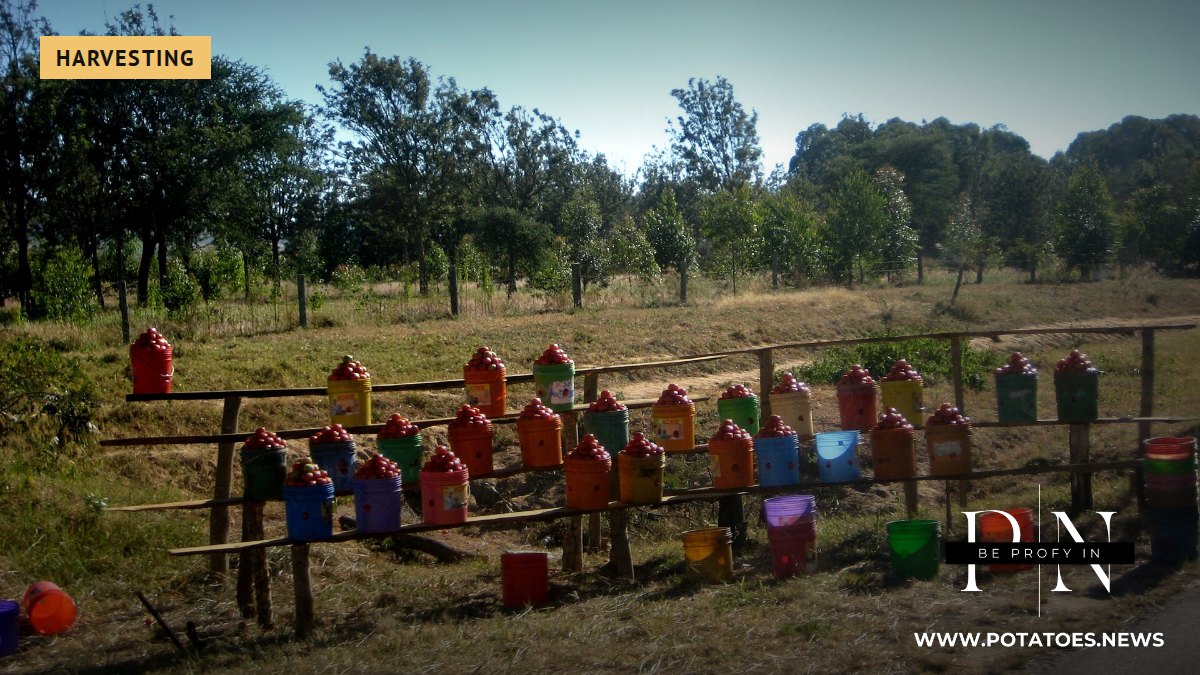
Photo: Farm produce stand in Njombe region, Tanzania (illustrative). Duniasikuzote / Wikimedia Commons, CC BY-SA 4.0