Sri Lanka: Potato Imports Reach 186,145 Tonnes in 2025, Far Above Local Harvest
Sri Lanka imported 186,145 tonnes of potatoes in 2025, while its two local seasons gave less than 30,000 tonnes, Central Bank data show. Domestic output has fallen for years.
Sri Lanka imported 186,145 tonnes of potatoes in 2025, according to the Agriculture Sector Data Bulletin of the Central Bank of Sri Lanka (CBSL), May 2026 edition. This was more than the 180,121 tonnes of 2024 and the 168,184 tonnes of 2023. In January–April 2026 imports were 66,488 tonnes, against 81,312 tonnes in the same months of 2025, a fall of about 18% by our calculation.
Small local seasons
Local production is much smaller. Sri Lanka grows potatoes in two seasons, Maha and Yala. CBSL data show:
- 2023 Yala: 21,026 tonnes
- 2023/24 Maha: 21,291 tonnes
- 2024 Yala: 20,916 tonnes
- 2024/25 Maha: 15,010 tonnes
- 2025 Yala: 14,360 tonnes
- 2025/26 Maha: 23,047 tonnes (Department of Agriculture forecast)
The 2024/25 Maha and 2025 Yala seasons together gave 29,370 tonnes, by our calculation. Imports in 2025 were more than six times larger. Forecasts can also miss. In May 2025, the bulletin showed a forecast of 25,510 tonnes for the 2024/25 Maha season. The final figure was 15,010 tonnes.
Weekdays. Unsubscribe in one click.
A long decline
The Department of Census and Statistics shows that local production was higher in the past. In 2007 the country harvested 75,263 tonnes on 5,238 hectares. In 2012 it was 75,352 tonnes on 4,847 hectares, and in 2017 it was 52,998 tonnes on 3,300 hectares. Potatoes grow mainly in the hill districts of Nuwara Eliya and Badulla.
Seed is the bottleneck
Seed is also imported. According to the EU delegation in Sri Lanka (August 2024), the country needs about 2,000–2,500 tonnes of seed potatoes, which are imported. The EU-funded Agriculture Sector Modernization Project (ASMP) supports a local seed cluster. About 400 farmers grow seed on 300 acres in the Wakkadahinna area, with a target of 1,500 tonnes. More than 150 million rupees went into the Government Seed Farm at Seetha Eliya, and a cold store for seed was built at Boralanda.
Why it matters
Sri Lanka is one of the clearest import-dependent potato markets in South Asia. Local farmers supply only a small part of demand, and their output has fallen by more than half since 2012. Imports fill the gap, so global and regional prices pass directly to Sri Lankan consumers.
For exporters, Sri Lanka is a market of about 180,000–190,000 tonnes a year. For local policy, the seed programme is the key test. If local seed reaches 1,500 tonnes, it could cover a large part of the seed need and help growers in the hills compete with imported potatoes.
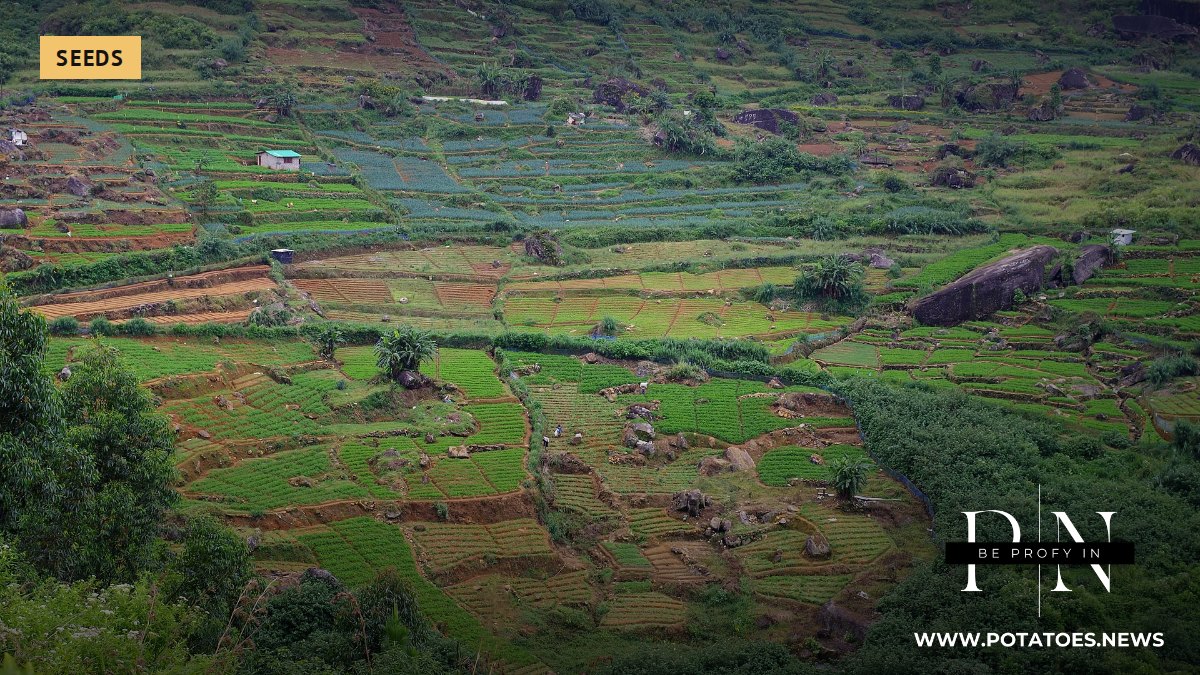
Photo: Vegetable farms in the Nuwara Eliya region, Sri Lanka (illustrative). Dinkum / Wikimedia Commons, CC BY-SA 3.0