Every winter, vast parts of northern India brace for a familiar yet harmful phenomenon — stubble burning. Particularly prevalent in Punjab, Haryana, and Uttar Pradesh, the practice of burning paddy residue releases massive quantities of carbon monoxide, CO₂, and particulate matter, significantly degrading air quality in nearby regions, including Delhi-NCR. Despite being a quick and inexpensive way to clear fields, stubble burning is ecologically disastrous and economically short-sighted.
But a game-changing solution is emerging from Himachal Pradesh, where scientists at the Krishi Vigyan Kendra (KVK) in Dhaula Kuan have developed an eco-friendly technique for cultivating potatoes using paddy stubble as mulch — turning a major pollution source into a sustainable farming resource.
No Plowing, No Chemicals — Just Innovation
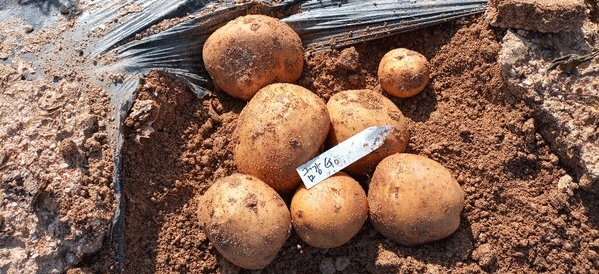
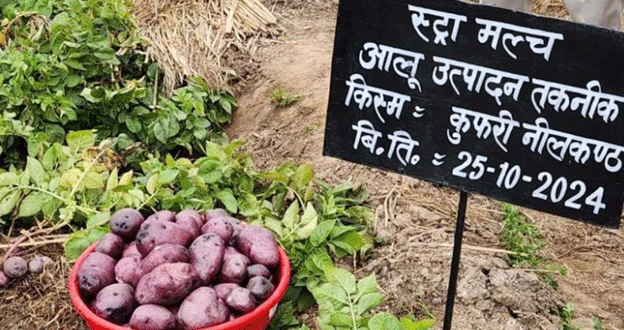
The method involves planting Kufri Neelkanth potato seeds directly on moist, post-harvest paddy fields, covering them with around 9 inches of paddy stubble. There is no plowing, no application of synthetic fertilizers, and minimal irrigation. Instead, the team used Ghanjeevamrit, a traditional organic bio-fertilizer made from cow dung, cow urine, legume flour, and water.
The stubble mulch acts as:
- A natural insulator, conserving soil moisture
- A weed suppressant
- A slow-release fertilizer, decomposing over time to enrich the soil
As a result, the crop needed only three light irrigations, and in seasons with adequate rainfall, irrigation could be avoided altogether. Within just three months, the potatoes were ready for harvest.
Impressive Results on the Ground
In the initial trials over 0.5 hectares, the results were promising. Scientists found that stubble from two hectares of paddy could be effectively used to grow potatoes on one hectare of land, converting agricultural waste into a valuable resource. The approach also:
- Eliminated fuel costs for plowing
- Reduced fertilizer expenditure
- Lowered water use, aligning with climate-resilient agriculture goals
On average, the organic yield reached 300–325 quintals per hectare, compared to 375–400 quintals under chemical-intensive methods — a modest reduction with significant environmental trade-offs.
A Healthier Potato with Better Storage
The Kufri Neelkanth variety grown under this method offers added health benefits. Rich in antioxidants, it supports immune health, may reduce the risk of cardiovascular diseases and cancer, and has a low glycemic index, making it suitable for diabetic diets. Its light purple skin and strong storage life make it ideal for both fresh markets and processing.
Looking Ahead: Scaling Up and Spreading Awareness
Encouraged by the results, institutions like the Walnut Agricultural Research Sub-Center in Una and Palampur Agricultural University are expanding the trials. Government-backed programs are also being developed to train farmers, demonstrate techniques, and provide financial and technical support to adopt this sustainable approach.
According to Dr. Naveen Kumar, Vice-Chancellor of Palampur Agricultural University, this method could be a national model to reduce stubble burning, improve farm profitability, and boost environmental sustainability.
A Solution Rooted in Science and Tradition
India produces over 56 million metric tons of potatoes annually, ranking second globally after China. However, much of this production still relies heavily on chemical inputs, expensive irrigation, and energy-intensive practices. The Himachal initiative shows how blending scientific research with traditional organic knowledge can lead to solutions that are both effective and replicable.
The potato-stubble method pioneered in Himachal Pradesh is more than just a novel farming practice — it’s a powerful example of how agricultural innovation can solve deep-rooted environmental challenges. With the right support, this technique could revolutionize farming across stubble-burning regions of India, offering a blueprint for low-cost, eco-friendly, and climate-smart agriculture.