Russia: Duma Bill Would Delay Genetic Passports and Isolation Rules for Seed Producers to 2028
Bill No. 1341065-8 would move two requirements of the seed production law — genetic passports for varieties and mandatory spatial isolation — from 1 September 2027 to 1 September 2028.
A group of deputies in Russia’s State Duma has introduced a bill that would postpone two key requirements of the federal law “On Seed Production” by one year, from 1 September 2027 to 1 September 2028, the parliamentary newspaper Parlamentskaya Gazeta reported on 16 September. The Potato Union republished the news on 17 September.
Bill No. 1341065-8 concerns, first, the requirement for every variety or hybrid to have a genetic passport, and second, mandatory spatial isolation of seed crops. Both rules apply to all crops, including seed potatoes.
The bill was introduced by deputies V. Kashin, A. Gordeev, N. Vasilyev, V. Egorov, A. Anikeev, S. Yakhnyuk and A. Lavrinenko. In the explanatory note, the authors say that the procedural rules for issuing genetic passports have not yet been written and that the implementing rules on spatial isolation face “methodological difficulties”. They also argue that businesses need more time to create protective measures such as shelterbelts around seed fields.
Weekdays. Unsubscribe in one click.
The seed production law, adopted in 2021, is designed to tighten control over the origin and quality of seed in Russia. Genetic passports are meant to confirm the identity of a variety, while isolation distances reduce the risk of cross-contamination and disease spread between seed crops and other plantings.
The Potato Union’s republication gives “454-FZ” in a way that could be read as the bill number; that is the number of the 2021 law itself. The bill number is 1341065-8, as given by Parlamentskaya Gazeta.
The bill has only been introduced and must pass three readings in the Duma, approval by the Federation Council and the president’s signature before it takes effect. If it is not adopted, the requirements will apply from 1 September 2027 as currently scheduled.
potatoes.news has followed the Russian seed-potato sector’s efforts to build domestic variety testing and certification, including recent inspections of domestic varieties near Moscow (read more).
Why it matters
For Russian seed-potato producers, genetic passports and isolation rules mean new costs for testing, documentation and field layout. A one-year delay would give them more time to comply, but also prolong uncertainty about how the rules will work in practice, since the procedures they depend on have not yet been written.
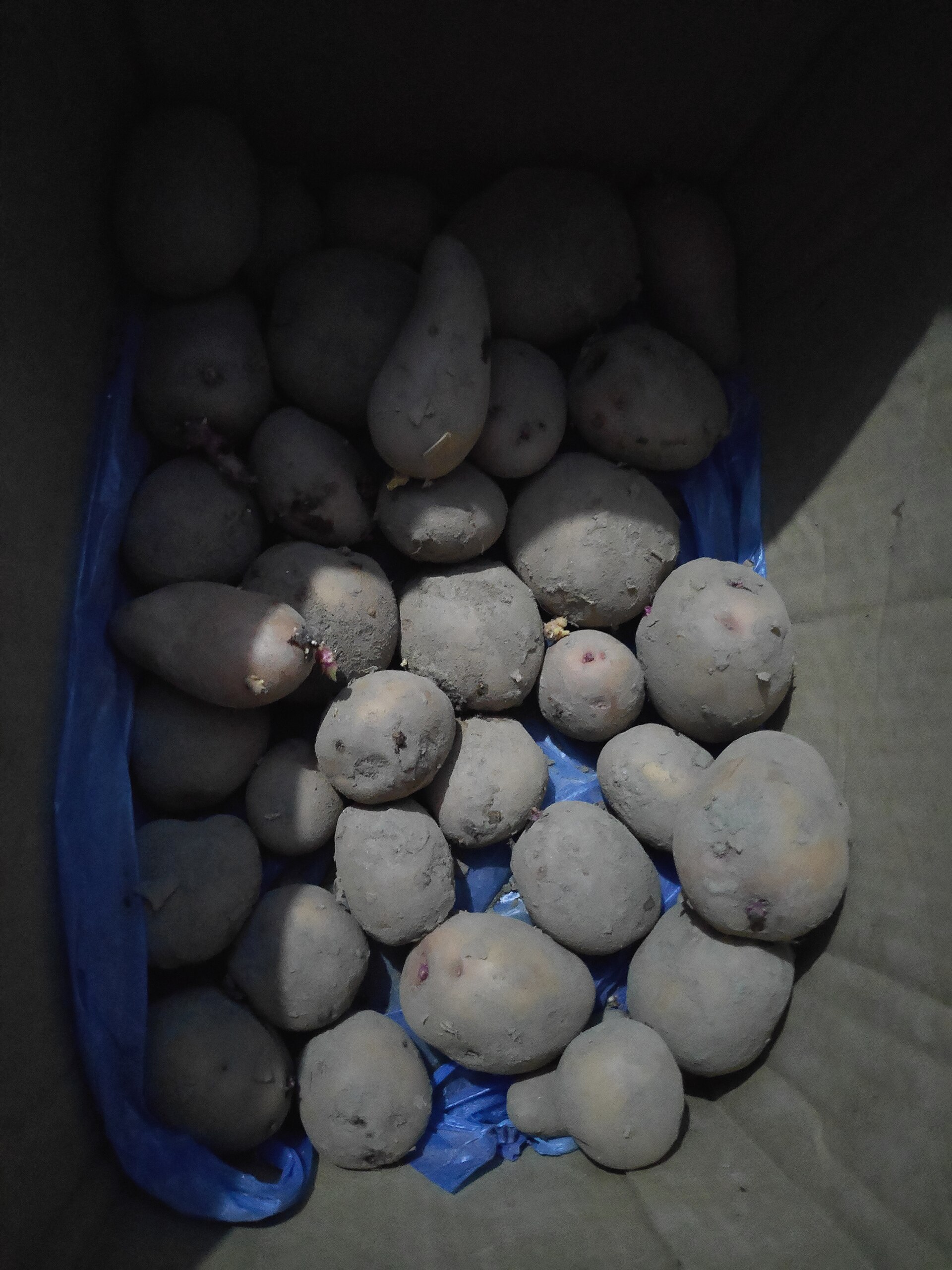
Photo: Seed potatoes (illustrative). Gaurav Dhwaj Khadka / Wikimedia Commons, CC BY-SA 4.0