Source date: 14 November 2026. Based on reporting by SciDev.Net via Argenpapa, with additional regulatory and research sources.
Potato growers in Huancabamba, in northern Peru, were spraying insecticides every four days during the 2022/23 season, according to a survey by the International Potato Center (CIP). Even so, 85% of those surveyed said they were dissatisfied with the results. The survey also recorded harvest losses of up to 75%, a figure reported by Argenpapa without details of how it was calculated. The cause is a still poorly understood disease cluster known in Spanish as punta morada and in English as the potato purple top complex, which is now a growing plant-health concern in the crop’s Andean homeland.
What is known about the complex
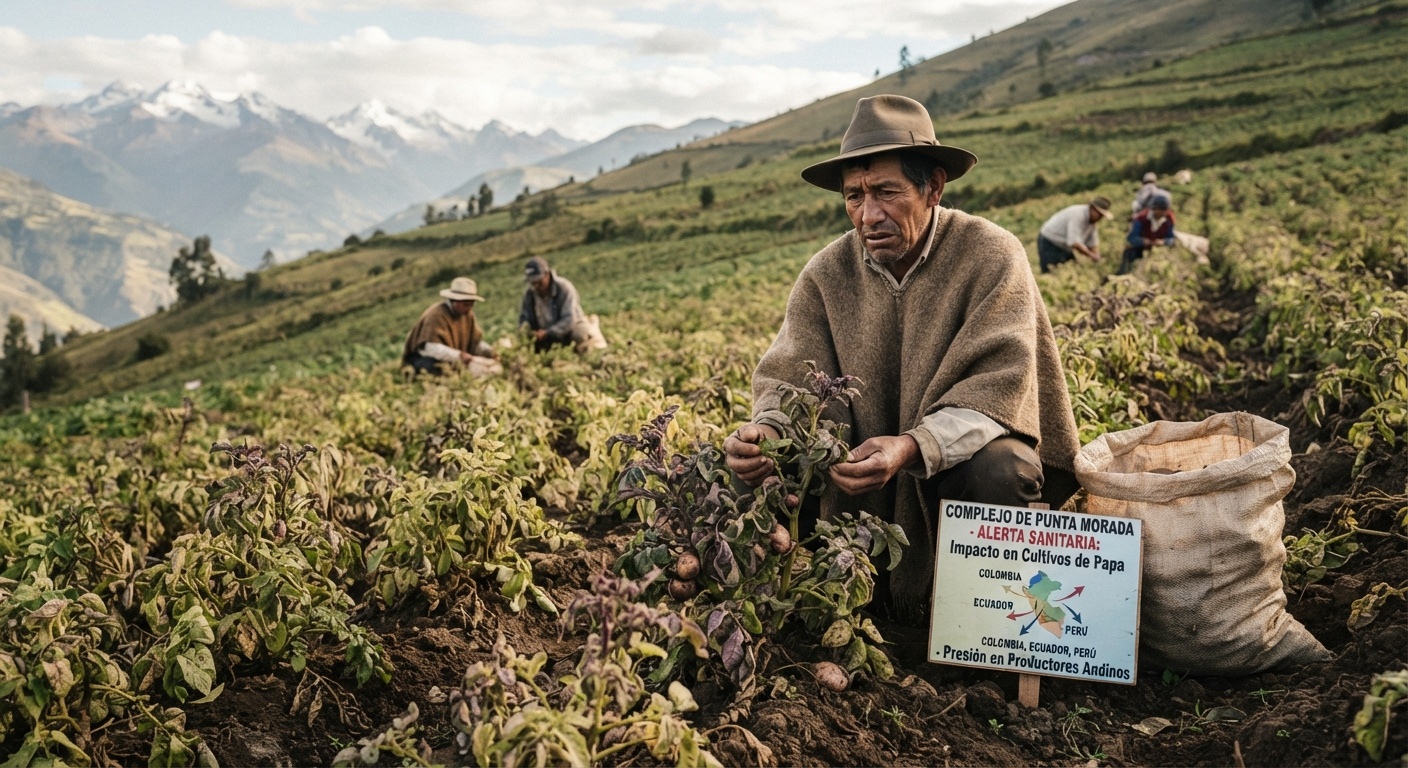
CIP says plants in parts of Peru, Ecuador and Colombia are showing purple foliage, stunted growth and reduced tuber quality. Scientists link the symptoms to phytoplasmas, to zebra chip disease and to the potato psyllid (Bactericera cockerelli), an insect that moves pathogens between plants.
Weekdays. Unsubscribe in one click.
The psyllid transmits Candidatus Liberibacter solanacearum, the bacterium associated with zebra chip. Phytoplasmas, which have long been tied to purple top symptoms, are being studied as part of the same complex.
Much remains unresolved. CIP plant pathologist Wilmer Pérez said the contribution of each microorganism to the symptoms has yet to be determined, and that it is still debated which insects transmit the phytoplasmas. Researchers at Ecuador’s national agricultural research institute, INIAP, have said mixed infections make identifying the pathogens in a given field particularly difficult.
Impact on growers
Xavier Cuesta, an INIAP researcher, said the diversity of native potato varieties planted has fallen in some Ecuadorian provinces. He added that, above 3,000 metres, some farmers have stopped growing potatoes or tree tomatoes because of the risk and the cost of managing the problem.
Separate reporting by FreshPlaza from the PataFEST project cites Cuesta as saying Ecuador’s cultivated potato area is 75% smaller than before the disease was identified, with insecticide applications up by between 50% and more than 100% in some areas. That figure measures planted area in Ecuador and should not be confused with the 75% harvest loss reported from Huancabamba.
Regulation and research
Colombia has been the most active on the regulatory side. Its agricultural institute, ICA, confirmed the psyllid in 17 municipalities of Nariño department, on the Ecuadorian border, in 2021 and introduced phytosanitary measures there. Nariño is Colombia’s third-largest potato producer, with about 30,500 hectares and roughly 511,000 tonnes a year. A 2026 draft resolution would extend psyllid surveillance and control to solanaceous crops nationwide.
At regional level, the FONTAGRO programme is funding a four-year project across Ecuador, Peru, Colombia and Chile, with a total budget of about US$698,000. Its stated targets are a 25% average cut in yield losses among adopting growers, a 15–20% reduction in pesticide spending, and a 50% reduction in the use of high-impact insecticides. It focuses on diagnostics, seed quality and field-level management.
CIP has also launched an online resource to help growers recognise symptoms and find information on the pathogens and the psyllid, according to the SciDev.Net report.
Risk of wider spread
SciDev.Net reported preliminary findings in Bolivia and quoted specialists warning that conditions are favourable for the problem to move into Chile and Argentina. These are expert warnings rather than confirmed forecasts. They matter for the wider trade because the vector is mobile. Carmen Castillo of INIAP has noted that the pest can cross quarantine barriers, which is why surveillance, clean seed systems and integrated pest management are central to the response in the region.
For growers, the pattern so far is one of rising protection costs, narrower varietal choice and, at altitude, the abandonment of some potato land. Whether the complex remains an Andean problem will depend largely on how quickly diagnostics and seed controls catch up.
Sources: Argenpapa (14 Nov 2026); CIP, Strengthening plant health to secure food systems: understanding the Purple Top Complex; FreshPlaza, Ecuador tests potato disease controls as purple top threatens Europe; FONTAGRO, Potato purple top complex in the Andean Region; ICA Colombia, Resolution 103325 of 2021 and 2026 draft resolution.