16 Sep 2026 Global Potato Industry General partnerAVGUST
The Global Potato Industry
World·Storages·News

Preparing for Potato Storage 2026/2027: Curing, Ozonation, and Sprout Suppression Strategies
2 min read Updated
Preparing for Potato Storage 2026/2027: Curing, Ozonation, and Sprout Suppression Strategies

Key takeaways

  • Wet September lifting raises anthracnose risk
  • Soft bacterial rot (Pectobacterium) also elevated
  • Curing: 14 days at 15-18 C, 95% humidity
  • Ventilation at 70 m³/h per tonne
  • Ozonation cuts surface microbial load

Why it matters

For farmers
Curing is not a formality this season: wounds from a wet lift are the entry point for Pectobacterium, and suberisation is what closes them before the pile is cooled.
For processors
Ozonation lowers microbial load in the store without residues, which matters where the crop goes into processing with clean-label requirements.

60-second summary

Storage managers face raised risk of anthracnose and soft bacterial rot going into 2026/27, because wet conditions during September lifting combine soil moisture with harvest damage — the two things those pathogens need. The recommended answer is a curing period of 14 days at 15-18 °C and 95% relative humidity, with forced ventilation at 70 cubic metres an hour per tonne. That phase lets superficial wounds heal and suberise, forming a barrier against rot, while surface moisture is drawn off gradually. Ozonation during the same window disinfects the store atmosphere and lowers surface microbial load without leaving chemical residues.

14 dayscuring period
15-18 Ccuring temperature
95%relative humidity during curing
70 m³/h per tonneforced ventilation rate
General partnerCrop protection for the potato industry

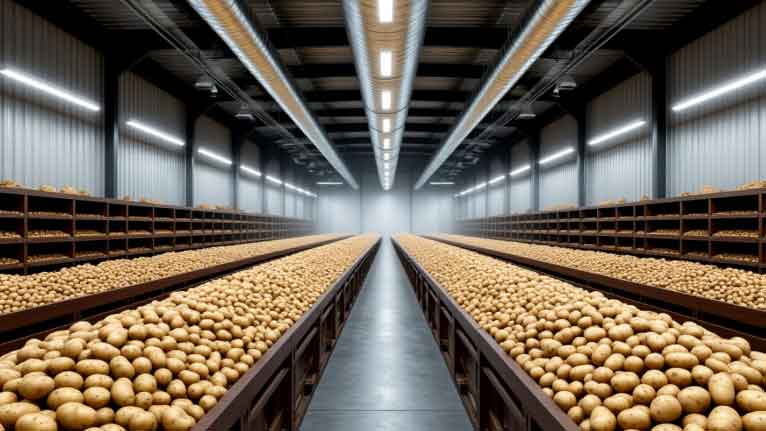
As the 2026 harvest season approaches, potato storage managers are bracing for elevated risks of anthracnose and soft bacterial rot (Pectobacterium) due to the wet conditions expected during September’s lifting operations. The combination of soil moisture and tuber damage during harvest creates a favorable environment for these pathogens, making post-harvest management more critical than ever. To mitigate these threats, industry best practices emphasize a mandatory curing period of 14 days at 15-18°C with 95% relative humidity, coupled with forced ventilation at a rate of 70 m³/h per ton of product. This therapeutic phase allows superficial wounds to heal and suberize, forming a natural barrier against rot pathogens while excess surface moisture is gradually removed. Ozonation during this period further enhances disease suppression, as ozone gas effectively disinfects storage atmospheres and reduces surface microbial loads without leaving chemical residues, offering a clean-label solution for protecting tuber quality during the critical early storage phase.

Alongside disease management, sprout control represents a major regulatory and technological shift for the 2026/2027 storage season. The traditional active ingredient chlorpropham (CIPC), once the industry standard, is being phased out across many markets due to regulatory restrictions and consumer demand for residue-free produce. In its place, storage facilities are increasingly adopting natural alternatives such as peppermint oil formulations (e.g., Biox-M) and 1,4-dimethylnaphthalene (1,4-DMN), applied via advanced fogging systems to ensure uniform distribution throughout storage facilities. These next-generation sprout suppressants offer effective dormancy extension while complying with evolving safety standards and organic certification requirements. The transition demands careful recalibration of application protocols, including timing, dosage, and ventilation management, to maximize efficacy while minimizing phytotoxicity. By integrating these combined approaches—rigorous curing, ozone sanitation, and novel sprout inhibitors—storage operators can significantly reduce post-harvest losses, maintain processing quality, and ensure market readiness for the season ahead.

Global Potato Brief

Top five stories, prices, disease alerts and events. Weekday mornings, no advertising.

Linked in this material

Country
World
Sections
StoragesNews
Audience 41,368 LinkedIn 21,000 YouTube 3,756 Newsletter 3,746 views · last 15 videos Media kit →